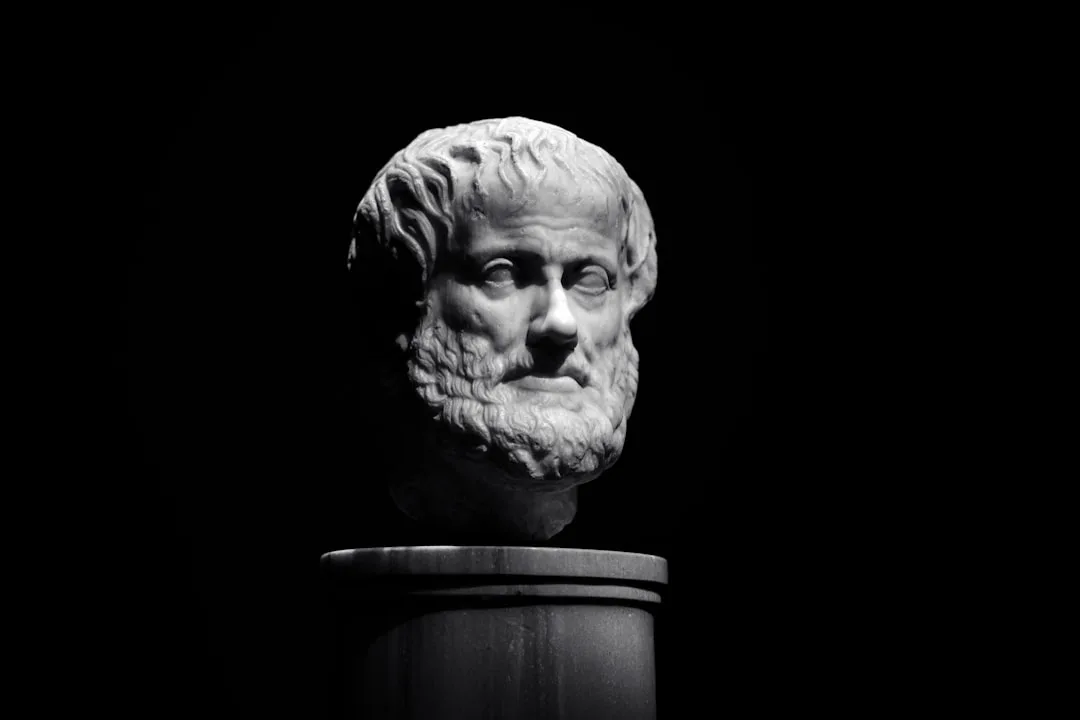
Stoicism — In 161 AD, Marcus Aurelius became Roman Emperor - the most powerful person in the Western world. He commanded an army of 300,000 soldiers. He controlled an empire stretching from Britain to Mesopotamia. He had access to whatever pleasures wealth and power could provide.
He also kept a private journal. Not a record of his conquests or his decisions of state, but a set of notes he wrote to himself, often in the form of reminders and admonitions. "You have power over your mind, not outside events. Realize this, and you will find strength." "The impediment to action advances action.
What stands in the way becomes the way." "Do not indulge in such thoughts as, What then will be his fate? or When will that happen? but rather thus, What is in me to do, and how may it be done?" The journal was never intended for publication. We know it as the Meditations, and it has been read continuously for nearly two thousand years.
Marcus Aurelius was a practitioner of Stoicism - a philosophy founded in Athens around 300 BC that became the dominant intellectual tradition of the Roman world. In the twenty-first century, it has experienced a remarkable revival, read by Silicon Valley executives and elite athletes, by people in therapy and people in prison, by anyone seeking a practical framework for living well in a world beyond their control.
The Origins of Stoicism
Stoicism was founded by Zeno of Citium, a Phoenician merchant who arrived in Athens around 300 BC after surviving a shipwreck that destroyed his cargo. According to tradition, he visited a bookseller and was introduced to Socratic philosophy. He began studying under Crates the Cynic and later established his own school.
Zeno taught at the Stoa Poikile - the "Painted Porch," a public colonnade in Athens - which gave the philosophy its name. He attracted a following that included some of the most brilliant minds of the ancient world. The school's teachings were developed by successors including Cleanthes and Chrysippus, whose systematic development of Stoic logic, physics, and ethics turned it into the most technically sophisticated philosophical system of the ancient world.
Of the original Greek Stoics, almost nothing survives. What we have are the writings of the three great Roman Stoics: Seneca (4 BC - 65 AD), Epictetus (50 - 135 AD), and Marcus Aurelius (121 - 180 AD). They wrote in different circumstances - Seneca as a wealthy statesman and playwright, Epictetus as a former slave turned teacher, Marcus Aurelius as emperor - and their differences in tone and emphasis reflect those differences in life.
But they drew from the same philosophical tradition and shared its core commitments.
The Dichotomy of Control
The single most important concept in Stoic practice is the distinction the Greeks called eph' hemin and the Romans called in nostra potestate: what is up to us and what is not up to us.
Epictetus opens the Enchiridion (his short handbook of Stoic practice) with this:
"Some things are in our control and others not. Things in our control are opinion, pursuit, desire, aversion, and, in a word, whatever are our own actions. Things not in our control are body, reputation, command, and, in one word, whatever are not our own actions."
This is not merely a philosophical observation but a practical prescription. The Stoic framework says: invest your effort, your desires, and your emotional energy only in what is genuinely up to you. Everything else should be met with acceptance.
What is up to us:
- Our judgments and beliefs
- Our values and what we consider important
- Our intentions and goals
- How we interpret and respond to events
- Our actions
What is not up to us:
- The outcome of our actions
- Other people's behavior and opinions
- Our health, wealth, and physical circumstances
- What happens to us
This distinction sounds simple and proves difficult in practice. The challenge is that most people organize their emotional lives around the second category: anxiety about reputation, desire for wealth, fear of illness, resentment of others' actions. The Stoic practice is to gradually redirect that investment toward the first category.
The modern psychologist's vocabulary for this is internal vs. external locus of control: the degree to which people believe their outcomes are determined by their own actions (internal) or by forces outside themselves (external). Research by Julian Rotter and subsequent researchers has found that internal locus of control is consistently associated with better health, academic achievement, and life satisfaction - a finding that mirrors the Stoic framework developed two millennia earlier.
The Four Stoic Virtues
The Stoics held that virtue - specifically, the four cardinal virtues - is the only genuine good. Everything else (wealth, health, pleasure, social status) is what they called preferred indifferents: things that have value in ordinary terms but are not essential to the good life and should not be pursued at the cost of virtue.
1. Wisdom (Sophia / Phronesis)
Wisdom is the master virtue: the capacity to know what is genuinely good and to navigate life accordingly. It is not merely knowledge of facts but practical judgment - the ability to perceive what a situation actually calls for and to respond appropriately.
For the Stoics, wisdom encompasses knowing the dichotomy of control, understanding the true nature of goods and evils, and seeing through the distorted judgments that cause suffering. Much of what Stoic philosophy teaches is an exercise in developing this clarity.
2. Courage (Andreia)
Courage is not recklessness but the willingness to act rightly even in the face of difficulty, danger, or social pressure. Epictetus spent much of his teaching on this virtue: how to speak the truth when it is unwelcome, how to maintain your values under pressure, how to face death without flinching.
For Marcus Aurelius, courage manifested in the capacity to continue doing his duty as emperor despite chronic illness, military crises, and the deaths of children. For Epictetus, who was enslaved and had his leg broken by his master, it manifested in refusing to allow external violence to corrupt his internal freedom.
3. Justice (Dikaiosyne)
Justice is the virtue that governs our relationship with others: treating people fairly, fulfilling our obligations to family and community, and recognizing that humans are social beings with responsibilities to each other.
This is often underemphasized in popular accounts of Stoicism, which focus on individual resilience and equanimity. But Marcus Aurelius writes repeatedly about his duties as emperor: to govern justly, to serve the common good, to see himself as a servant of the people rather than their master. Justice is the outward-facing virtue that prevents Stoicism from becoming mere self-absorption.
4. Temperance (Sophrosyne)
Temperance is self-discipline and moderation: not being controlled by appetites, not overconsumption, not allowing pleasure or desire to override reason and values. The Stoics were not ascetics who rejected pleasure; they were people who refused to be ruled by it.
Seneca, despite being enormously wealthy, wrote extensively about the dangers of luxury and the way excessive comfort softens moral character. His Letters to Lucilius describe his practice of occasional voluntary hardship - simple food, cold baths, simple clothing - as a way of demonstrating to himself that he could live without his comforts and therefore was not enslaved to them.
The Key Stoic Practices
Stoicism is not primarily a set of beliefs to hold but a set of practices to perform. The philosophy was understood as a way of life (bios), not a theory to be contemplated.
Negative Visualization (Premeditatio Malorum)
The practice of contemplating potential negative outcomes - illness, loss, death - not to produce anxiety but to reduce it. By imagining the loss of something we value, we appreciate it more fully in the present and prepare ourselves to face its loss without being destroyed.
Seneca practiced this regularly: "Let us prepare our minds as if we had come to the very end of life. Let us postpone nothing. Let us balance life's books each day." The practice reflects an awareness that the things we love will not last and that accepting this truth allows deeper engagement with life rather than desperate clinging.
This practice has a direct modern parallel in negative mental contrasting - the research-backed technique developed by Gabriele Oettingen that involves identifying obstacles to goals as part of the planning process. It also appears in memento mori traditions across cultures: the medieval European practice of keeping skulls in paintings as reminders of death, or the Japanese concept of mono no aware (the pathos of things passing).
The View from Above
Marcus Aurelius repeatedly practices what modern philosophers call the "view from above": imagining one's personal circumstances from a vastly elevated perspective, seeing the whole of human history and geography, and recognizing how small one's personal dramas are in that context.
"Confine yourself to the present." "All things are far removed and vanish quickly." The practice is not nihilistic but scaling: most of what causes us distress looms large because we are too close to it. Pulling back in imagination reduces the emotional charge without eliminating genuine concern.
The Daily Review
Seneca describes his habit of reviewing each day's actions each evening: "When the light has been removed and my wife has fallen silent, aware of the habit that's now mine, I examine my entire day and go back over what I've done and said." Not as self-flagellation but as honest accounting - where did I act well? Where did I fall short of my values? What can I do better tomorrow?
This practice maps onto modern psychological work on deliberate practice and reflective learning: improvement requires honest assessment of actual performance, not just intention.
Journaling
Marcus Aurelius's Meditations is itself a practice rather than a finished philosophical treatise. He was not writing for an audience; he was using writing to clarify his thinking, remind himself of principles he found easy to forget, and maintain the habit of self-examination.
The practice of regular reflective writing as a philosophical tool has been independently developed in many traditions. The cognitive science behind it is sound: externalizing thoughts on paper slows them down, creates distance from them, and allows evaluation that is not available in the flow of internal thought.
Common Misunderstandings
Stoicism is not emotional suppression
The most pervasive misunderstanding is that Stoics are emotionally numb or suppress their feelings. The Stoics distinguished between passions (pathe) - irrational emotional reactions based on false judgments about what is good or bad - and good emotions (eupatheiai) - rational affective responses that arise from accurate assessments.
The Stoic ideal is not the absence of feeling but freedom from being controlled by irrational disturbances. Grief at the death of a loved one is entirely compatible with Stoicism; prolonged destructive despair that paralyzes function is not. Joy at genuine goods is Stoic; desperate excitement about things outside your control is not.
Epictetus and Marcus Aurelius both write with evident passion about human welfare, justice, and their own failings. Seneca wrote movingly about his grief at losses. The Stoics were fully feeling human beings who cultivated equanimity, not robots.
Stoicism is not fatalism
Another common misreading is that Stoicism means passive acceptance of whatever happens - that if you cannot control outcomes, you should not try to change them. This is the opposite of the Stoic position.
The dichotomy of control does not mean abandoning effort. It means being attached to the effort rather than the outcome. A doctor does everything possible for a patient's recovery while accepting that death is sometimes inevitable. A Stoic entrepreneur does excellent work while accepting that the market may not reward it. The effort is fully controlled; the outcome is not. The Stoic acts with full engagement while releasing the outcome.
Marcus Aurelius fought wars, reformed administration, and served as emperor for nearly two decades. He was not passive.
Stoicism is not about indifference to others
Stoicism has sometimes been caricatured as purely self-focused. But the virtue of justice and the Stoic concept of cosmopolitanism - the idea that all humans share a common rational nature and that our duties extend beyond family and city to all of humanity - are central to the philosophy.
Marcus Aurelius writes: "What injures the hive injures the bee." Epictetus teaches that our social roles - parent, child, citizen - create genuine obligations. Seneca's letters show deep care for his correspondent Lucilius. The Stoics were not individualists in the modern sense; they understood humans as fundamentally social creatures with duties to their communities.
Stoicism in Modern Life
The philosophical framework of Stoicism has found practical applications in several contemporary domains.
Cognitive Behavioral Therapy
Albert Ellis, who developed Rational Emotive Behavior Therapy (REBT) in the 1950s, and Aaron Beck, who developed Cognitive Behavioral Therapy (CBT), both explicitly acknowledged debt to Stoic philosophy. The core CBT insight - that it is not events that disturb us but our interpretations of events - is directly from Epictetus: "It's not things that disturb us, but our judgments about things."
CBT techniques - identifying automatic thoughts, testing them against evidence, replacing distorted interpretations with accurate ones - are secular, empirical versions of the Stoic practice of examining judgments and correcting false ones.
Sports Psychology
The focus on process over outcome in elite sports psychology - performing the next action well rather than tracking the scoreboard - is directly Stoic in structure. Controlling what you can control (preparation, effort, attention) while releasing attachment to what you cannot (the score, the opponent's performance, officiating decisions) is exactly the dichotomy of control applied to athletic performance.
Leadership
Many executives and business leaders have adopted Stoic practices. Ryan Holiday's popular Stoicism books, particularly "The Obstacle Is the Way" (2014), have brought Stoic principles to a business audience. The themes - resilience, equanimity under pressure, focus on what you can control, service orientation - translate directly to leadership contexts.
What Stoicism Cannot Do
Stoicism is not a complete philosophy of the good life for all purposes, and its limits deserve acknowledgment.
It is primarily a philosophy of individual cultivation under adverse conditions. It is less developed as a philosophy of political transformation. While the Stoics valued justice, their framework focuses on individual virtue rather than on changing unjust structures - a limitation that has been noted by critics who argue that acceptance of external circumstances can rationalize acceptance of injustice.
Epictetus was enslaved. His philosophy helped him maintain inner freedom under that condition, and this is remarkable. But the philosophy does not ask the political question: how do we end slavery? Individual Stoicism and collective justice require each other but are not identical.
The modern reader who takes from Stoicism only the personal equanimity while ignoring the Stoic commitment to justice as a cardinal virtue is practicing an incomplete version.
The Three Stoics Compared
| Stoic | Dates | Background | Key Work | Primary Emphasis |
|---|---|---|---|---|
| Seneca | 4 BC - 65 AD | Wealthy statesman, playwright | Letters to Lucilius | Voluntary hardship, time management, friendship |
| Epictetus | 50 - 135 AD | Born into slavery, later teacher | Discourses, Enchiridion | Dichotomy of control, freedom within constraint |
| Marcus Aurelius | 121 - 180 AD | Roman Emperor | Meditations | Daily practice, duty, equanimity under power |
The Enduring Relevance
What accounts for Stoicism's extraordinary longevity and current revival?
The philosophy addresses a permanent feature of the human condition: the gap between what we can control and what happens to us. This gap has not closed with technology or prosperity. We still age and die. We still lose people we love. We still face circumstances we did not choose. We still find our best efforts producing outcomes we did not intend.
Stoicism does not promise to eliminate this gap. It offers a way of living in it without being destroyed by it - and the evidence that this approach produces human flourishing comes not from controlled experiments but from two thousand years of readers finding in it something that helps them live well.
Marcus Aurelius, writing to himself in the middle of the night in a military camp on the Danube frontier, not expecting to be read, produced something that has outlasted his empire by nearly two thousand years. Whatever he found in this philosophy, it worked.
Frequently Asked Questions
What is Stoicism in simple terms?
Stoicism is a school of ancient Greek and Roman philosophy that holds that the path to a good life is through virtue and reason, not through the acquisition of external goods or the avoidance of external hardships. Its central insight is the dichotomy of control: some things are up to us (our judgments, values, and responses) and some things are not (our bodies, reputation, wealth, and what others do). Wisdom consists in clearly distinguishing these two categories and directing effort only toward what we can actually control. This produces equanimity - a stable, rational engagement with whatever circumstances arise.
Who were the main Stoic philosophers?
The most influential Stoics for modern readers are the three Roman Stoics: Marcus Aurelius (121-180 AD), the Roman Emperor who wrote the Meditations as a private journal of self-examination; Epictetus (50-135 AD), a former slave whose lectures were recorded by his student Arrian in the Discourses and the shorter Enchiridion; and Seneca (4 BC-65 AD), a statesman and playwright whose essays and letters remain some of the most accessible Stoic texts. The philosophy was founded by Zeno of Citium around 300 BC in Athens, where he taught at the Stoa Poikile (Painted Porch) - the origin of the name Stoicism.
What is the dichotomy of control in Stoicism?
The dichotomy of control is the foundational Stoic distinction between what is ‘up to us’ (eph’ hemin in Greek) and what is ‘not up to us.’ According to Epictetus, only our own judgments, desires, and responses are truly up to us - everything else, including our bodies, health, wealth, reputation, and what other people do, is outside our direct control. The Stoic prescription is to invest effort and emotion only in what we can control, and to maintain an attitude of acceptance toward what we cannot. This is not passivity but a precise targeting of effort where it can actually make a difference.
Does Stoicism mean suppressing emotions?
A common misunderstanding is that Stoicism requires emotional suppression or cold detachment. The Stoics did not advocate eliminating emotions but distinguishing between passions driven by false judgments and well-founded feelings that arise from accurate assessments. The goal is not the absence of feeling but the absence of being controlled by irrational reactions to things outside your control. Marcus Aurelius writes with evident care about human suffering. Seneca writes movingly about grief. The Stoic ideal is equanimity - stability rather than numbness - and the capacity for deep engagement without being destabilized by external circumstances.
What are the four Stoic virtues?
The Stoics held that virtue is the only true good and identified four cardinal virtues: Wisdom (sophia or phronesis) - the ability to know what is genuinely good and to navigate the world accordingly; Courage (andreia) - acting rightly even in the face of difficulty or danger; Justice (dikaiosyne) - treating others fairly and fulfilling social obligations; and Temperance (sophrosyne) - self-discipline, moderation, and not being ruled by appetites. All four virtues are expressions of the same underlying rational capacity, and the Stoics believed they are inseparable - you cannot truly have one without having all.