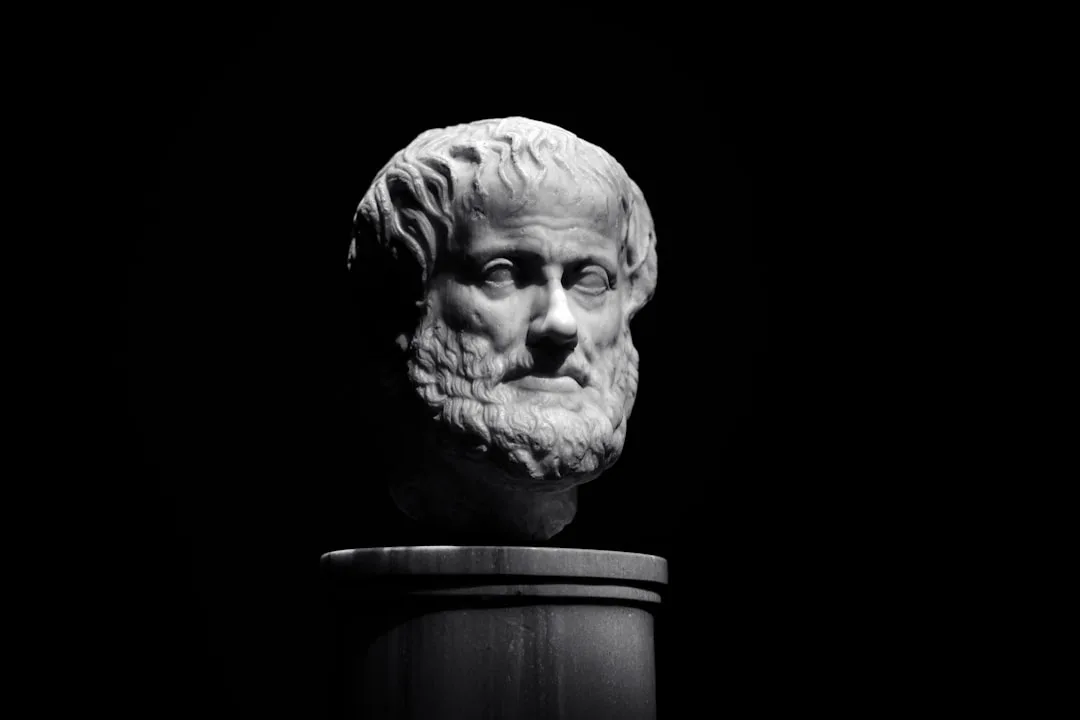
Logic is the systematic study of valid reasoning: the principles that distinguish arguments whose conclusions genuinely follow from their premises from arguments that merely appear to do so. An argument is valid if and only if it is impossible for the premises to be true and the conclusion false simultaneously - the truth of the premises guarantees, by the form of the argument alone, the truth of the conclusion.
Logic is concerned with this formal or structural property, not with whether the premises are actually true. In the classical example: "All men are mortal; Socrates is a man; therefore Socrates is mortal" - the argument is valid because if both premises were true, the conclusion could not be false. Whether Socrates was in fact a man and whether all men are in fact mortal are empirical questions; the logical relationship between the premises and conclusion is a matter of form alone.
The discipline has produced two of the most profound intellectual achievements of the twentieth century: Kurt Godel's incompleteness theorems (1931), which showed that no sufficiently powerful formal system can prove all mathematical truths, and Alan Turing's undecidability proofs (1936), which established theoretical limits on computation. Both grew directly from the logical investigations that Gottlob Frege began in 1879.
Aristotle: The Founder of Formal Logic
Aristotle (384-322 BCE) was the first thinker to systematize logic as an autonomous discipline, and his contributions - collected in six treatises known collectively as the Organon (instrument or tool) - dominated logical theory in Europe and the Islamic world for nearly two thousand years. The core of Aristotle's logic is the theory of the syllogism, presented in the Prior Analytics.
A syllogism is an argument consisting of two premises and a conclusion, where the premises share a common term (the middle term) that does not appear in the conclusion. The most famous syllogism in the teaching tradition is: "All men are mortal; Socrates is a man; therefore Socrates is mortal." Aristotle's own examples typically used letters rather than specific terms: "If A is predicated of all B, and B is predicated of all C, then A is predicated of all C."
Aristotle catalogued all possible combinations of four categorical proposition types and determined which combinations of two premises yielded valid conclusions:
| Label | Form | Example |
|---|---|---|
| A (universal affirmative) | All S are P | All humans are mortal |
| E (universal negative) | No S are P | No humans are immortal |
| I (particular affirmative) | Some S are P | Some humans are philosophers |
| O (particular negative) | Some S are not P | Some humans are not philosophers |
He identified 19 valid syllogistic forms distributed across four "figures" defined by the position of the middle term. This exhaustive cataloguing was a remarkable intellectual achievement - a complete analysis of a significant fragment of logical space.
Aristotle also formulated what he took to be the fundamental laws of logic: the law of non-contradiction (a proposition and its negation cannot both be true), the law of excluded middle (every proposition is either true or false), and the law of identity (each thing is identical to itself). These laws have been accepted as fundamental by most subsequent logical traditions, though both the law of non-contradiction and the law of excluded middle have been challenged in constructive and paraconsistent logics developed in the twentieth century.
Stoic Logic and the Medieval Tradition
While Aristotle's logic focused on relationships among terms within categorical propositions, the Stoic philosophers developed a complementary tradition: propositional logic, concerned with the logical relations among whole propositions rather than among the terms within them.
Chrysippus (c.279-206 BCE) - who according to ancient reports wrote over 700 logical treatises, virtually none of which survive - systematized inference patterns involving conditionals (if-then statements), disjunctions, and conjunctions of propositions. He identified five "indemonstrable" (axiomatic) argument forms.
The first, which corresponds to what modern logicians call modus ponens, runs: if the first, then the second; the first; therefore the second. The second, corresponding to modus tollens, runs: if the first, then the second; not the second; therefore not the first.
The Stoics also studied propositional paradoxes, including the famous Liar Paradox ("This statement is false"), which if true is false and if false is true. The Liar Paradox remains a genuine logical and semantic puzzle today, motivating entire theories of truth and self-reference. The Stoic contribution to propositional logic was largely lost in the medieval period, whose logicians worked primarily in the Aristotelian framework, but was rediscovered and recognized as anticipating modern propositional calculus in the twentieth century.
Medieval logic, flourishing particularly in the twelfth through fifteenth centuries at the newly founded European universities, produced sophisticated extensions of Aristotle's syllogistic. William of Ockham (c.1287-1347), famous for Ockham's Razor (the methodological principle that entities should not be multiplied beyond necessity), developed a highly systematic nominalist logic in his Summa Logicae. His theory of supposition - the theory of how terms in propositions stand for things in different ways depending on their grammatical context - was an important precursor to later theories of reference and quantification.
John Buridan's theory of valid inference (consequentia) and his semantic analysis of truth moved beyond Aristotle in ways that influenced the development of formal logic. The medievals also codified the analysis of fallacies more systematically than Aristotle, producing detailed taxonomies of invalid argument patterns.
Frege's Revolution: The Begriffsschrift and Modern Logic
Gottlob Frege's Begriffsschrift (Concept-Script) of 1879 is the most important single text in the history of logic after Aristotle, and it was almost entirely ignored at the time of its publication. Working as a professor of mathematics at the University of Jena, Frege was motivated by a philosophical and mathematical program: to demonstrate that arithmetic is purely logical - that all of its truths can be derived from logical axioms alone without appeal to intuition (the logicist program).
Frege's key innovation was the treatment of quantification - expressions like "for all x" and "there exists an x such that." Aristotle's logic could represent "All men are mortal" and "Some men are Greek," but it could not adequately represent claims like "Every natural number has a successor" or "There exists a prime number greater than any given prime number" - claims that require binding variables and expressing relations among multiple entities.
Frege introduced function-argument notation from mathematics into logic: just as a mathematical function f(x) takes an argument x and yields a value, a predicate P(x) takes an argument x and yields a truth value (true if x has property P, false otherwise). With the addition of universal and existential quantifiers (for all x and there exists an x), Frege's system could represent virtually any claim that could be expressed in mathematics.
Frege also axiomatized his system with basic logical laws from which all other logical truths could be derived by specified rules of inference. This idea - that logic can be fully formalized as an axiomatic system - proved transformative, inaugurating the era of mathematical logic.
Frege's later works, the Grundlagen der Arithmetik (1884) and the two-volume Grundgesetze der Arithmetik (1893, 1903), attempted to carry out the logicist reduction of arithmetic. This project was devastated in 1902 when Bertrand Russell, in a now-famous letter to Frege, showed that one of Frege's basic laws - Basic Law V, which allowed unrestricted comprehension of sets - led to a contradiction: Russell's paradox.
"A scientist can hardly meet with anything more undesirable than to have the foundations give way just as the work is finished." - Gottlob Frege, appendix to Grundgesetze der Arithmetik, Vol. II (1903), on learning of Russell's Paradox
Russell's paradox arises from considering the set of all sets that are not members of themselves. If such a set is a member of itself, then it is not (by definition). If it is not a member of itself, then it is (by definition). The contradiction is irreducible and showed that Frege's Basic Law V was inconsistent.
Russell's Paradox and the Foundations Crisis
The discovery of Russell's paradox precipitated a foundations crisis in mathematics, prompting intense efforts to reconstruct the logical foundations of mathematics on consistent principles.
Bertrand Russell and Alfred North Whitehead responded with their Principia Mathematica (1910-1913), which attempted to rebuild the logicist program using a theory of types that prevented self-referential constructions like the paradoxical set. The theory of types imposes a hierarchy on sets (individuals, sets of individuals, sets of sets of individuals, and so on) and prohibits sets from containing themselves, which blocks the paradox.
The resulting system was enormously complex and technically demanding, filling three large volumes to prove, among other things, that 1 + 1 = 2.
Ernst Zermelo took a different approach, developing an axiomatic set theory (later extended by Abraham Fraenkel to produce Zermelo-Fraenkel set theory or ZF) that carefully restricted which sets could be formed, avoiding the paradox without imposing type theory's hierarchical structure. ZF set theory, supplemented with the axiom of choice (giving ZFC), became the standard foundation for mathematics throughout the twentieth century and remains the dominant foundational system today.
A third response came from the intuitionists, led by L.E.J. Brouwer, who rejected the idea that mathematical truth was independent of mental construction. For intuitionists, a mathematical statement is true only if there is a constructive proof of it - a proof that exhibits the mathematical object in question.
This requires rejecting the law of excluded middle for statements about infinite objects, producing a significantly weaker but philosophically coherent mathematical system.
Godel's Incompleteness Theorems: The Limits of Formal Systems
Kurt Godel's incompleteness theorems, published in 1931 when Godel was twenty-five years old, are among the most profound and far-reaching results in the history of mathematics and philosophy. They answered, definitively and negatively, the program that David Hilbert had set for mathematics: to provide a complete and consistent formal axiomatization of all of mathematics, in which every mathematical truth could in principle be proven from the axioms.
The first incompleteness theorem states: any consistent formal system that is sufficiently powerful to express basic arithmetic contains true statements that cannot be proven within the system. For any such system S, there is a statement G that says (in effect) "This statement cannot be proven in S." If S is consistent, G cannot be proven in S (otherwise the proof would establish something false, since G says it cannot be proven).
But if G cannot be proven in S, then G is true. G is therefore a true statement that cannot be proven in S.
The second incompleteness theorem states: no consistent formal system strong enough to express arithmetic can prove its own consistency. If S is consistent, S cannot prove "S is consistent."
Godel's proof technique was brilliantly indirect. He showed how to assign natural numbers to the symbols, formulas, and proofs of the formal system - a procedure now called Godel numbering - so that statements about the formal system could be expressed as statements about numbers within the system. The self-referential statement "This statement is unprovable" was encoded as an arithmetical statement about its own Godel number, transforming the ancient Liar Paradox from a logical nuisance into a mathematical tool.
| Theorem | Statement | Implication |
|---|---|---|
| First incompleteness theorem | Any consistent system powerful enough to express arithmetic contains unprovable truths | Truth and provability are not the same |
| Second incompleteness theorem | No such system can prove its own consistency | Consistency proofs require external resources |
| Turing's undecidability (1936) | No algorithm can decide, for any mathematical statement, whether it is provable | There are computationally unsolvable problems |
Turing, Undecidability, and the Birth of Computer Science
The computer scientist Alan Turing showed in 1936 that the Entscheidungsproblem - Hilbert's question of whether there exists a mechanical procedure that can determine, for any mathematical statement, whether it is provable - has a negative answer. Turing's proof introduced two foundational concepts:
The Turing machine is an abstract model of computation: a device that reads and writes symbols on an infinite tape according to a finite table of rules. Turing showed that any computation that can be performed at all can in principle be performed by a Turing machine - making Turing machines the theoretical ancestor of all modern computers.
The halting problem is the question: given an arbitrary program and an arbitrary input, will the program eventually halt (terminate) or run forever? Turing proved that no algorithm can solve the halting problem for all possible programs and inputs. The proof uses a diagonalization argument structurally similar to Godel's - assuming such an algorithm exists leads to a contradiction.
The halting problem was the first example of a computationally undecidable problem - a problem for which no algorithm can always produce the correct answer.
These results established theoretical limits on what computers can do in principle, long before practical computers existed. Computer science, artificial intelligence, and formal verification all operate within the boundaries Turing's theorems delineate.
Modal Logic and Possible Worlds
Modal logic is the extension of classical propositional and predicate logic to include modal operators: expressions for necessity (necessarily true, could not be false) and possibility (possibly true, could be true). Classical logic evaluates statements as simply true or false; modal logic evaluates them with respect to their modal status.
The modern possible worlds semantics for modal logic was developed primarily by Saul Kripke in a series of papers beginning in 1959. The central idea is that a modal statement is evaluated not just at a single world but across a set of possible worlds - ways the world could be or could have been. "Necessarily P" is true at a world w if and only if P is true at all worlds accessible from w. "Possibly P" is true at w if and only if P is true at some world accessible from w.
Possible worlds semantics is not committed to the metaphysical view that other possible worlds literally exist - though the philosopher David Lewis defended exactly this view in his modal realism, arguing that all possible worlds are just as real as the actual world. More commonly, possible worlds are understood as abstract representations of how things could be, used to give precise semantic content to modal claims.
The framework has been applied to the analysis of counterfactuals (what would have happened if...), causation, knowledge, belief, obligation, and many other philosophically important concepts. Extensions include:
- Deontic logic - analysis of obligation, permission, and prohibition
- Epistemic logic - analysis of knowledge and belief
- Temporal logic - analysis of tense and time
- Dynamic logic - analysis of program execution (extensively used in formal verification)
Informal Fallacies: Logic in Everyday Argument
Informal logic is concerned with the analysis of arguments in natural language, including the identification of argument patterns that appear persuasive but are actually invalid or insufficient to establish their conclusions. These patterns are called informal fallacies to distinguish them from formal fallacies (arguments that violate the rules of a formal deductive system).
Among the most pervasive and important informal fallacies:
Ad hominem (attacking the person) occurs when an argument is dismissed based on characteristics of the person making it rather than on its merits. While the speaker's bias may sometimes be relevant evidence about their reliability, it is not by itself a reason to reject an argument.
Straw man involves misrepresenting an opponent's position to make it easier to attack - summarizing a nuanced argument in a simplified, exaggerated, or distorted form and then attacking the distortion rather than the actual claim.
False dilemma (false dichotomy) presents two options as exhaustive when there are in fact others - "Either you support this policy, or you want crime to increase."
Post hoc ergo propter hoc (after this, therefore because of this) infers causation from correlation in time - "Crime increased after the new law passed, so the law caused the increase."
Appeal to authority treats the testimony of an authority figure as decisive evidence regardless of the quality of the actual arguments. Expert consensus is genuine evidence that deserves weight, but it is not a substitute for understanding the reasons behind it.
Equivocation involves shifting the meaning of a key term between premises without acknowledging the shift.
Douglas Walton's extensive work on argumentation theory, including Fallacies Arising from Ambiguity (1996), and the pragma-dialectics tradition developed by Frans van Eemeren and Rob Grootendorst at the University of Amsterdam, have provided more sophisticated treatments of fallacies that situate them within the context of dialogical procedures - the norms that govern legitimate argumentative exchange.
Logic and Artificial Intelligence
The connection between logic and artificial intelligence is deep and historically important. Early AI researchers in the 1950s and 1960s hoped to build intelligent systems primarily through logical inference - representing knowledge as collections of logical formulas and reasoning by applying inference rules. John McCarthy's LISP programming language (1958) was designed partly around this vision, and Allen Newell and Herbert Simon's Logic Theorist (1956) proved 38 of the first 52 theorems in Russell and Whitehead's Principia Mathematica.
The limitations of purely logical approaches - particularly the frame problem (how to represent what does not change when something happens) and the difficulty of handling uncertainty - drove AI research toward probabilistic and statistical methods in subsequent decades. But logical methods have never disappeared. Formal verification - using logical proof to establish that computer programs or hardware designs have specified properties - has grown in importance as software systems become more critical and more complex.
The SAT problem (determining whether a propositional formula is satisfiable) is central to both computational complexity theory and practical applications ranging from chip design verification to automated planning.
Automated theorem proving and proof assistants like Coq, Isabelle, and Lean have made it possible to write and machine-check formal proofs of mathematical theorems with a degree of reliability that human checking alone cannot provide. The Flyspeck project, completed in 2014, provided a formal computer-verified proof of the Kepler conjecture (about sphere packing) - a theorem whose original human proof by Thomas Hales (1998) was so complex that reviewers spent years unable to fully verify it.
Logic, from Aristotle's syllogisms through Frege's predicate calculus to Godel's incompleteness theorems and Turing's undecidability results, represents one of the great continuous intellectual traditions in human history. Its central insights - that valid reasoning has a structure that can be made explicit, that this structure can be studied mathematically, and that formal systems have inherent limitations - remain as profound and practically relevant today as when they were first established.
Frequently Asked Questions
What is logic and what is it for?
Logic is the systematic study of valid reasoning: the principles that distinguish arguments whose conclusions genuinely follow from their premises from arguments that merely appear to do so. An argument is valid if and only if it is impossible for the premises to be true and the conclusion false simultaneously — the truth of the premises guarantees, by the form of the argument alone, the truth of the conclusion. Logic is concerned with this formal or structural property, not with whether the premises are actually true. In the classical example: ‘All men are mortal; Socrates is a man; therefore Socrates is mortal’ — the argument is valid because if both premises were true, the conclusion could not be false. Whether Socrates was in fact a man and whether all men are in fact mortal are empirical questions; the logical relationship between the premises and conclusion is a matter of form alone.Logic has been practiced since antiquity as both a philosophical discipline and a practical tool. As a philosophical discipline, it addresses foundational questions: what is it for an argument to be valid? What is the structure of a proof? Are the laws of logic themselves necessary truths or contingent features of the world? Can we have a complete and consistent formal system capable of proving all mathematical truths? This last question was answered definitively, and negatively, by Kurt Godel in 1931 in one of the most profound intellectual achievements in human history. As a practical tool, logic underpins mathematics (every valid mathematical proof is a logically valid argument), computer science (Boolean logic is the foundation of digital circuitry and programming), philosophy (logical analysis clarifies the structure of arguments), and increasingly artificial intelligence (automated reasoning, theorem proving, natural language understanding).The discipline splits broadly into formal logic, which develops precise mathematical systems for representing and evaluating arguments, and informal logic, which analyzes the patterns of reasoning used in natural language argumentation, including the identification of fallacies — patterns of apparently valid reasoning that actually fail. Formal and informal logic are not in competition but address different aspects of reasoning, and competence in both is required for sophisticated intellectual work.
What did Aristotle contribute to logic and what is a syllogism?
Aristotle (384-322 BCE) was the first thinker to systematize logic as an autonomous discipline, and his contributions — collected in a group of six treatises known collectively as the Organon (instrument or tool) — dominated logical theory in Europe and the Islamic world for nearly two thousand years. The core of Aristotle’s logic is the theory of the syllogism, presented in the Prior Analytics. A syllogism is an argument consisting of two premises and a conclusion, where the premises share a common term (the ‘middle term’) that does not appear in the conclusion, and where the truth of the premises guarantees the truth of the conclusion by virtue of the formal relations among the terms.The most famous syllogism — ‘All men are mortal; Socrates is a man; therefore Socrates is mortal’ — is actually not Aristotle’s own example but a later teaching tradition’s illustration of his system. Aristotle’s examples typically used letters rather than specific terms: ‘If A is predicated of all B, and B is predicated of all C, then A is predicated of all C.’ Aristotle catalogued all possible combinations of the four categorical proposition types — All S are P (universal affirmative, labeled A), No S are P (universal negative, E), Some S are P (particular affirmative, I), and Some S are not P (particular negative, O) — and determined which combinations of two premises yielded valid conclusions and which did not. He identified 19 valid syllogistic forms distributed across four ‘figures’ defined by the position of the middle term.Along with the syllogistic, Aristotle formulated the Square of Opposition, a diagram representing the logical relationships among the four categorical proposition types: A and O propositions are contradictories (they cannot both be true or both false); E and I propositions are contradictories; A and E propositions are contraries (they cannot both be true but can both be false); and I and O propositions are sub-contraries (they cannot both be false). These relationships specified the patterns of valid inference among categorical claims.Aristotle also articulated what he took to be the fundamental laws of logic: the law of non-contradiction (a proposition and its negation cannot both be true), the law of excluded middle (every proposition is either true or false), and the law of identity (each thing is identical to itself). These laws have been accepted as fundamental by most subsequent logical traditions, though both the law of non-contradiction and the law of excluded middle have been challenged in constructive and paraconsistent logics developed in the twentieth century.
How did Stoic logic and medieval logic extend Aristotle's framework?
While Aristotle’s logic focused on relationships among terms within categorical propositions, the Stoic philosophers of ancient Greece and Rome developed a complementary tradition: propositional logic, concerned with the logical relations among whole propositions rather than among the terms within them. The Stoics — especially Chrysippus (c.279-206 BCE), who according to ancient reports wrote over 700 logical treatises, virtually none of which survive — systematized inference patterns involving conditionals (if-then statements), disjunctions, and conjunctions of propositions.Chrysippus identified five ‘indemonstrable’ (axiomatic) argument forms. The first, which corresponds to what modern logicians call modus ponens, runs: if the first, then the second; the first; therefore the second. The second, corresponding to modus tollens, runs: if the first, then the second; not the second; therefore not the first. The Stoics also studied propositional paradoxes, including the famous Liar Paradox (‘This statement is false’), which if true is false and if false is true, and which remains a genuine logical and semantic puzzle today. The Stoic contribution to propositional logic was largely lost or unappreciated in the medieval period, whose logicians worked primarily in the Aristotelian framework, but was rediscovered and recognized as anticipating modern propositional calculus in the twentieth century.Medieval logic, flourishing particularly in the twelfth through fifteenth centuries at the newly founded European universities, produced sophisticated extensions of Aristotle’s syllogistic. William of Ockham (c.1287-1347), famous for ‘Ockham’s Razor’ (the methodological principle that entities should not be multiplied beyond necessity), developed a highly systematic nominalist logic in his Summa Logicae, arguing that universal terms like ‘humanity’ do not refer to abstract entities existing outside the mind but are mental concepts applied to individual things. His theory of supposition — the theory of how terms in propositions stand for (supposit for) things in different ways depending on their grammatical context — was an important precursor to later theories of reference and quantification. John Buridan’s theory of valid inference (consequentia) and his semantic analysis of truth moved beyond Aristotle in ways that influenced the development of formal logic. The medievals also codified the analysis of fallacies more systematically than Aristotle, producing detailed taxonomies of invalid argument patterns.
How did Frege revolutionize logic and what is the significance of his Begriffsschrift?
Gottlob Frege’s Begriffsschrift (Concept-Script) of 1879 is the most important single text in the history of logic after Aristotle, and it was almost entirely ignored at the time of its publication. Working as a professor of mathematics at the University of Jena, Frege was motivated by a philosophical and mathematical program: to demonstrate that arithmetic is purely logical — that all of its truths can be derived from logical axioms alone without appeal to intuition or spatial reasoning (the ‘logicist’ program). To execute this program, he needed a logical notation powerful enough to represent the kinds of quantificational reasoning that appear in mathematical proofs, and Aristotle’s syllogistic was inadequate for this purpose.Frege’s invention went far beyond a notation: it was a genuinely new logical system. The key innovation was the treatment of quantification — expressions like ‘for all x’ and ‘there exists an x such that.’ Aristotle’s logic could represent ‘All men are mortal’ and ‘Some men are Greek,’ but it could not adequately represent claims like ‘Every natural number has a successor’ or ‘There exists a prime number greater than any given prime number’ — claims that require binding variables and expressing relations among multiple entities. Frege introduced function-argument notation from mathematics into logic: just as a mathematical function f(x) takes an argument x and yields a value, a predicate P(x) takes an argument x and yields a truth value (true if x has property P, false otherwise). With the addition of universal and existential quantifiers (for all x and there exists an x), Frege’s system could represent virtually any claim that could be expressed in mathematics.Frege also axiomatized his system with a set of basic logical laws from which all other logical truths could be derived by specified rules of inference. This idea — that logic can be fully formalized as an axiomatic system — proved transformative, inaugurating the era of mathematical logic. Frege’s later works, the Grundlagen der Arithmetik (1884) and the two-volume Grundgesetze der Arithmetik (1893, 1903), attempted to carry out the logicist reduction of arithmetic. This project was devastated in 1902 when Bertrand Russell, in a now-famous letter to Frege, showed that one of Frege’s basic laws — Basic Law V, which allowed unrestricted comprehension of sets — led to a contradiction (Russell’s paradox), destroying the system’s consistency. Frege’s response to Russell’s letter, appended to the second volume of the Grundgesetze, acknowledged the catastrophe with remarkable intellectual honesty: ‘A scientist can hardly meet with anything more undesirable than to have the foundations give way just as the work is finished.’
What is Godel's incompleteness theorem and why does it matter?
Kurt Godel’s incompleteness theorems, published in 1931 when Godel was twenty-five years old, are among the most profound and far-reaching results in the history of mathematics and philosophy. They answered, definitively and negatively, the program that David Hilbert had set for mathematics in the early twentieth century: to provide a complete and consistent formal axiomatization of all of mathematics, in which every mathematical truth could in principle be proven from the axioms.The first incompleteness theorem states: any consistent formal system that is sufficiently powerful to express basic arithmetic contains true statements that cannot be proven within the system. For any such system S, there is a statement G that says (in effect) ‘This statement cannot be proven in S.’ If S is consistent, G cannot be proven in S (otherwise the proof would establish something false, since G says it cannot be proven). But if G cannot be proven in S, then G is true (that is exactly what it says about itself). G is therefore a true statement that cannot be proven in S. No matter how many axioms we add to the system, Godel’s construction generates a new unprovable truth.The second incompleteness theorem states: no consistent formal system strong enough to express arithmetic can prove its own consistency. If S is consistent, S cannot prove ’S is consistent.’ This means that any proof of mathematics’ consistency must appeal to resources outside the system being proven consistent — which is problematic, because those external resources then need their own consistency proof, and so on.Godel’s proof technique was brilliantly indirect. He showed how to assign natural numbers to the symbols, formulas, and proofs of the formal system — a procedure now called Godel numbering — so that statements about the formal system could be expressed as statements about numbers within the system. The self-referential statement ‘This statement is unprovable’ was encoded as an arithmetical statement about its own Godel number, using a technique that transformed the ancient Liar Paradox from a logical nuisance into a mathematical tool.The philosophical significance of the theorems is debated. They do not show that mathematics is unreliable or that logical reasoning is circular. What they show is that truth and provability are not the same thing in any sufficiently powerful formal system: there are truths that no formal system can capture. The computer scientist Alan Turing showed in 1936 that the Entscheidungsproblem — Hilbert’s question of whether there exists a mechanical procedure that can determine, for any mathematical statement, whether it is provable — has a negative answer. Turing’s proof introduced the concept of the Turing machine (the theoretical ancestor of all modern computers) and the concept of undecidable problems — problems for which no algorithm can always produce the right answer.
What is modal logic and what are possible worlds?
Modal logic is the extension of classical propositional and predicate logic to include modal operators: expressions for necessity (necessarily true, could not be false) and possibility (possibly true, could be true). The basic operators are typically symbolized as a box for ‘necessarily’ and a diamond for ‘possibly.’ Classical logic evaluates statements as simply true or false; modal logic evaluates them with respect to their modal status — whether they are necessarily true (true in all possible situations), contingently true (true in the actual world but false in some other possible situation), possibly true (true in at least one possible situation), or necessarily false (false in all possible situations).Modal concepts had been discussed by Aristotle and the medievals, and were formalized in various ways in the early twentieth century by C.I. Lewis and others. The modern possible worlds semantics for modal logic was developed primarily by Saul Kripke in a series of papers beginning in 1959. The central idea is that a modal statement is evaluated not just at a single world but across a set of possible worlds — ways the world could be or could have been. ‘Necessarily P’ is true at a world w if and only if P is true at all worlds accessible from w (where the accessibility relation determines which worlds count as genuinely possible relative to which other worlds). ‘Possibly P’ is true at w if and only if P is true at some world accessible from w.Possible worlds semantics is not committed to the metaphysical view that other possible worlds literally exist (though the philosopher David Lewis defended exactly this view, in his modal realism, arguing that all possible worlds are just as real as the actual world — the actual world is merely the world we happen to be in). More commonly, possible worlds are understood as mathematical constructs, abstract representations of how things could be, used to give precise semantic content to modal claims. The philosopher Alvin Plantinga used possible worlds in the analysis of the ontological argument for the existence of God, and the framework has been applied to the analysis of counterfactuals (what would have happened if…), causation, knowledge, belief, obligation, and many other philosophically important concepts.Deontic logic extends modal logic to the analysis of obligation, permission, and prohibition. Epistemic logic applies the possible-worlds framework to knowledge and belief. Temporal logic uses similar structures to analyze tense and time. These extensions have found substantial applications in computer science, particularly in program verification (proving that a computer program will always have certain properties), artificial intelligence (knowledge representation and automated reasoning), and formal linguistics.
What are informal fallacies and how does logic apply to everyday argument?
Informal logic is concerned with the analysis of arguments in natural language, including the identification of argument patterns that appear persuasive but are actually invalid or at least insufficient to establish their conclusions. These patterns are called informal fallacies to distinguish them from formal fallacies (arguments that violate the rules of a formal deductive system), since informal fallacies depend on the content and context of the argument rather than its pure form.The taxonomy of informal fallacies has been developed and refined from Aristotle’s Sophistical Refutations through medieval logic to modern textbooks of critical thinking. Among the most pervasive and important: Ad hominem (attacking the person) occurs when an argument is dismissed or accepted based on characteristics of the person making it rather than on its merits — ‘You shouldn’t trust his economic analysis because he’s a socialist.’ While the speaker’s bias may sometimes be relevant evidence about their reliability, it is not by itself a reason to reject an argument. Straw man involves misrepresenting an opponent’s position to make it easier to attack — summarizing a nuanced argument in a simplified, exaggerated, or distorted form and then attacking the distortion rather than the actual claim. Appeal to authority (argument from authority) treats the testimony of an authority figure as decisive evidence regardless of the quality of the actual arguments — ‘X percent of scientists agree’ or ‘Professor Smith says so.’ Expert consensus is genuine evidence that deserves weight, but it is not a substitute for understanding the reasons behind it, especially in contested cases. False dilemma (false dichotomy) presents two options as exhaustive when there are in fact others — ‘Either you support this policy, or you want crime to increase.’ Post hoc ergo propter hoc (after this, therefore because of this) infers causation from correlation in time — ‘Crime increased after the new law passed, so the law caused the increase.’ Equivocation involves shifting the meaning of a key term between premises without acknowledging the shift.The importance of informal logic for practical life is difficult to overstate. The quality of public political discourse, scientific communication, and personal decision-making depends substantially on the capacity to recognize these patterns. Douglas Walton’s extensive work on argumentation theory, including Fallacies Arising from Ambiguity (1996), and the pragma-dialectics tradition developed by Frans van Eemeren and Rob Grootendorst at the University of Amsterdam, have provided more sophisticated treatments of fallacies that situate them within the context of dialogical procedures — the norms that govern legitimate argumentative exchange.