
People coordinated large efforts long before management became a formal field, relying on overseers and practical habits rather than explicit theory. The history of management theory traces the later attempt to understand systematically how organisations direct work and people at scale.
Management theory barely existed before the twentieth century. For millennia, humans organized large-scale collective efforts, building pyramids, governing empires, fighting wars, constructing cathedrals, without any formal theory about how to manage the people doing the work.
Overseers supervised laborers. Military commanders directed troops. Merchants trained apprentices. But nobody sat down to systematically analyze the work of managing itself: what makes management effective, what principles govern the relationship between managers and workers, how organizations should be structured to achieve their goals.
Management was considered either a matter of personal charisma and common sense or an extension of ownership rights, not a subject amenable to systematic study.
That changed in the early twentieth century, when the enormous scale of industrial enterprises, the complexity of factory operations, and the social tensions between labor and capital created an urgent demand for a science of management.
What followed was one of the most prolific periods of theory development in the social sciences, producing a succession of management paradigms that reflected, and sometimes drove, fundamental changes in how work is organized, how workers are treated, and how organizations relate to their environments.
Each paradigm challenged the assumptions of its predecessors while building on their insights, creating a layered intellectual heritage that continues to shape management practice today.
Scientific Management: The Engineering of Work
The first coherent body of management theory emerged from the workshops and factories of the late nineteenth and early twentieth centuries.
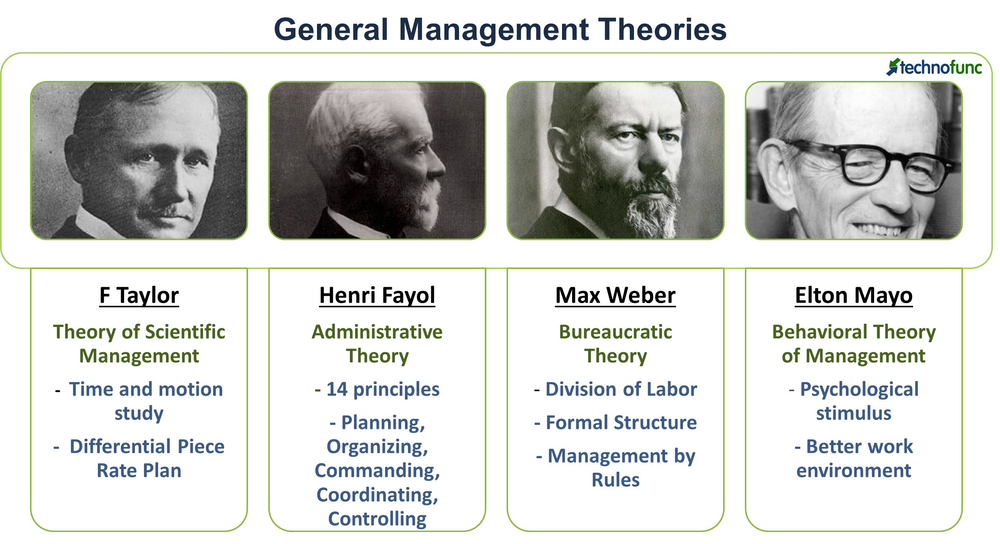
Scientific management, pioneered by Frederick Winslow Taylor and elaborated by his followers, proposed that management should be based on systematic observation, measurement, and optimization of work processes.
Taylor's Method
Taylor, a mechanical engineer who began his career as a machinist at the Midvale Steel Company in Philadelphia, was driven by a conviction that most industrial work was performed vastly less efficiently than it could be.
He observed that workers used idiosyncratic methods to perform tasks, that managers relied on tradition and rule of thumb rather than data, and that the resulting inefficiency wasted both the workers' effort and the company's resources.
"In the past the man has been first; in the future the system must be first." - Frederick Winslow Taylor
Taylor's solution was to apply scientific method to the study of work. His approach involved several key steps. First, time and motion studies: observe workers performing tasks, measure the time required for each component motion, identify the most efficient sequence of motions, and establish a standard time for the task.
Second, standardization: replace individual workers' idiosyncratic methods with the "one best way" identified through scientific study.
Third, selection and training: select workers who are physically and mentally suited to the task and train them in the standardized method. Fourth, differential piece rates: pay workers who exceed the standard output rate a significantly higher rate per piece, creating a strong financial incentive for efficiency.
Taylor's most famous case study was his analysis of pig iron handling at the Bethlehem Steel Company in 1899.
He claimed to have increased the average daily output of pig iron handlers from 12.5 tons to 47.5 tons per worker by selecting the strongest workers, training them in an optimized loading technique, and providing rest breaks calculated to minimize fatigue.
He then paid them a premium rate of $1.85 per day (compared to the previous $1.15) while reducing the total labor cost per ton.
The figures Taylor reported have been questioned by historians, and his methods were often more coercive than his published accounts suggested. But the underlying principle, that work processes can be systematically studied, optimized, and standardized, proved extraordinarily influential.
Scientific management spread rapidly through American industry in the 1910s and was adopted (and adapted) internationally, influencing industrial practices from Soviet factory management to Japanese manufacturing.
The Legacy and Critique of Taylorism
Scientific management achieved genuine improvements in industrial efficiency, and its core principle, that management decisions should be based on systematic analysis rather than tradition or intuition, remains fundamental to management practice.
But it also generated fierce criticism that anticipated many of the themes in subsequent management theory.
The most fundamental criticism was that scientific management dehumanized workers, treating them as interchangeable components of a machine rather than as human beings with psychological and social needs.
By separating planning (management's responsibility) from execution (workers' responsibility), Taylor created a rigid hierarchy that denied workers autonomy, creativity, and meaning in their work.
Workers became, in his framework, tools to be optimized, their every motion specified and measured, their every break calculated for maximum productive output.
"Taylor's system is not management at all; it is an ingenious scheme for making the workers the servants of the machine." - Louis Brandeis
Labor unions opposed scientific management vehemently, viewing it as a tool for extracting maximum work from minimum workers at minimum pay. A strike at the Watertown Arsenal in 1911, triggered by Taylor's time studies, led to a Congressional investigation that highlighted the human costs of scientific management.
Taylor testified before a Special House Committee in 1912, and the use of stopwatch time studies and bonus systems was subsequently banned in government arsenals by appropriations riders, though they continued to spread in the private sector.
Other Scientific Management Pioneers
Frank and Lillian Gilbreth extended Taylor's methods through more sophisticated motion study techniques, including the use of motion picture cameras to capture and analyze work movements.
Lillian Gilbreth, one of the first women to earn a PhD in industrial psychology, brought a more human-centered perspective, studying the psychological effects of fatigue, monotony, and work design on worker welfare and efficiency.
Henry Gantt, another Taylor associate, developed the Gantt chart, a scheduling tool that remains ubiquitous in project management more than a century later.
Gantt also moved beyond Taylor's pure efficiency focus to consider worker motivation, proposing bonus systems that rewarded both workers and supervisors for meeting production standards.
Henri Fayol, working independently in France, developed a more general theory of management that went beyond shop-floor operations to address organizational structure and administrative practice.
Fayol identified fourteen principles of management (division of work, authority and responsibility, discipline, unity of command, unity of direction, subordination of individual interests, remuneration, centralization, scalar chain, order, equity, stability of tenure, initiative, and esprit de corps).
He also identified five functions of management (planning, organizing, commanding, coordinating, and controlling) that provided a framework for thinking about management as a comprehensive organizational activity rather than just a production engineering exercise.
The Human Relations Movement: Discovering the Social Worker
The second major paradigm in management theory emerged from an unexpected source: a series of experiments at the Western Electric Company's Hawthorne Works near Chicago that were initially designed to test the effects of physical working conditions on productivity.
How the Hawthorne Studies Changed Management Thinking
The Hawthorne studies (1924-1932) began as straightforward scientific management experiments. Researchers from Harvard, led by Elton Mayo, manipulated physical conditions, including lighting levels, rest breaks, working hours, and payment methods, to determine their effects on worker productivity.
What they found surprised everyone: productivity improved regardless of whether conditions were made better or worse. Output went up when lighting was increased and when it was decreased. Output went up when rest breaks were added and when they were removed.
The researchers eventually concluded that the productivity improvements were not caused by the specific physical changes but by the social dynamics of the experimental situation.
Workers responded to the fact that they were being observed, that management seemed to care about their welfare, that they had been selected as special participants, and that they had formed a cohesive group during the experiment.
These social and psychological factors, which scientific management had completely ignored, appeared to affect productivity more powerfully than any physical variable.
The Hawthorne studies have been extensively reanalyzed and criticized in subsequent decades.
The methodological rigor of the original studies was uneven, the researchers' interpretations were sometimes driven by their theoretical commitments rather than by the data, and the famous "Hawthorne effect" (improvement caused merely by being observed) may be less robust than originally claimed.
But the studies' broader influence on management theory was enormous and largely positive: they directed attention to the social, psychological, and relational dimensions of work that scientific management had overlooked.
The Human Relations School
The Hawthorne studies launched the human relations movement, which argued that effective management requires attending to workers' social and psychological needs, not merely their economic incentives and physical working conditions.
Abraham Maslow's hierarchy of needs (1943) provided a theoretical framework for understanding worker motivation beyond economics.
Maslow proposed that human needs are arranged in a hierarchy: physiological needs (food, shelter), safety needs (security, stability), social needs (belonging, love), esteem needs (recognition, respect), and self-actualization needs (personal growth, fulfillment).
Once lower-level needs are adequately met, they cease to motivate, and higher-level needs become dominant.
For management, this implied that workers whose basic economic needs are met are not primarily motivated by additional pay but by social relationships, recognition, meaningful work, and opportunities for personal growth.
"A musician must make music, an artist must paint, a poet must write, if he is to be ultimately at peace with himself. What a man can be, he must be." - Abraham Maslow
Douglas McGregor crystallized the contrast between scientific management and human relations in his famous distinction between Theory X and Theory Y (1960). Theory X assumes that workers are inherently lazy, dislike work, must be coerced and controlled, and prefer to be directed rather than take initiative.
Theory Y assumes that work is as natural as play, that workers are capable of self-direction and creative problem-solving, and that management's job is to create conditions that allow workers to fulfill their potential.
McGregor argued that Theory X was a self-fulfilling prophecy: if you treat workers as lazy and irresponsible, they will behave that way, because the work environment gives them no reason to do otherwise.
Frederick Herzberg's two-factor theory (1959) added empirical nuance to the motivation discussion.
Herzberg found that the factors that cause job satisfaction (which he called motivators: achievement, recognition, the work itself, responsibility, advancement) are different from the factors that cause dissatisfaction (which he called hygiene factors: company policy, supervision, salary, working conditions, interpersonal relations).
Improving hygiene factors prevents dissatisfaction but does not create satisfaction; creating satisfaction requires attending to the motivators.
This implied that management cannot motivate workers simply by providing good pay and comfortable conditions; motivation requires meaningful work, autonomy, and recognition.
Peter Drucker and the Professionalization of Management
No single figure had a greater influence on the development of management as a professional discipline than Peter Drucker, an Austrian-born American who wrote prolifically on management from the 1940s through the 2000s.
Drucker did not develop a single theory so much as he articulated a comprehensive vision of what management is, what it should do, and why it matters.
Management as a Professional Discipline
Drucker's most fundamental contribution was his insistence that management is a distinct professional discipline with its own body of knowledge, its own skills, and its own ethical responsibilities.
Before Drucker, management was typically viewed as either a natural extension of ownership (the owner manages because they own the business) or a technical function (the manager optimizes production).
Drucker argued that management is a social function: the task of making organizations productive and workers effective, with responsibilities that extend beyond shareholders to include employees, customers, communities, and society.
"Management is doing things right; leadership is doing the right things." - Peter Drucker
Management by Objectives
Drucker introduced Management by Objectives (MBO) in his 1954 book The Practice of Management.
MBO proposed that managers and employees should collaboratively set clear, measurable objectives for each role; that performance should be evaluated against these objectives; and that objectives should be aligned across the organization so that individual, departmental, and organizational goals reinforce each other.
MBO represented a significant departure from both scientific management (where objectives were set entirely by management) and the human relations movement (which sometimes seemed to prioritize worker satisfaction over organizational performance).
Drucker argued that effective management requires both: clear direction and accountability (from scientific management) and respect for worker intelligence and initiative (from human relations).
The Knowledge Worker
Drucker was among the first to recognize the emergence of what he called the "knowledge worker," an employee whose primary contribution is not manual labor but knowledge, expertise, and judgment.
In his 1959 book Landmarks of Tomorrow, Drucker argued that the most important economic shift of the twentieth century was not the rise of manufacturing (which scientific management had addressed) but the rise of knowledge work (which required entirely different management approaches).
Knowledge workers cannot be managed through time-and-motion studies, standardized procedures, or direct supervision. Their work involves judgment, creativity, and specialized expertise that managers often do not share.
Managing knowledge workers requires providing clear objectives, adequate resources, and appropriate autonomy, and then evaluating results rather than monitoring processes.
This insight anticipated the management challenges of the technology industry, professional services, and the broader shift toward an information-based economy.
Systems Thinking and Contingency Theory
By the 1960s, the accumulation of management theories, each claiming to have identified the key to effective management, generated a natural question: Why do different theories work in different situations? This question drove two related developments: systems thinking in management and contingency theory.
How Did Systems Thinking Influence Management?
The systems approach, drawing on Ludwig von Bertalanffy's general systems theory and Norbert Wiener's cybernetics, reconceptualized organizations as open systems that interact with their environments through inputs, transformation processes, outputs, and feedback loops.
This was a fundamental shift from the closed-system perspective of scientific management (which focused on internal efficiency) and human relations (which focused on internal social dynamics).
The systems perspective highlighted several important insights. Organizations are interconnected: changes in one part of the system affect other parts in ways that may not be immediately obvious. Optimizing one department may degrade the performance of the whole organization if the optimization disrupts interdependencies.
Organizations exist within environments: competitive pressures, regulatory changes, technological developments, and cultural shifts all affect organizational performance and require adaptive responses.
Organizations operate through feedback loops: information about outcomes feeds back to influence future decisions, creating both stabilizing (negative feedback) and destabilizing (positive feedback) dynamics.
What Is Contingency Theory in Management?
Contingency theory, developed in the 1960s and 1970s by researchers including Joan Woodward, Tom Burns and G.M. Stalker, Paul Lawrence and Jay Lorsch, and Fred Fiedler, argued that there is no single best way to manage.
The most effective management approach depends on the specific circumstances, including the nature of the task, the characteristics of the workforce, the competitive environment, the organization's technology, and the organization's size and age.
Woodward's research on manufacturing firms in Essex, England, showed that organizational structure was related to production technology: firms using unit production (custom manufacturing) were most effective with organic, flexible structures; firms using mass production were most effective with mechanistic, hierarchical structures; and firms using process production (continuous flow, like chemical plants) were again most effective with organic structures.
This finding directly contradicted the assumption, shared by both scientific management and administrative theory, that one type of organizational structure is optimal for all situations.
Burns and Stalker distinguished between mechanistic organizations (hierarchical, formal, rule-bound, appropriate for stable environments) and organic organizations (flat, informal, flexible, appropriate for dynamic environments).
Lawrence and Lorsch showed that organizations operating in complex, uncertain environments need both differentiation (specialized departments adapted to different environmental demands) and integration (coordination mechanisms that link the differentiated departments).
| Management Paradigm | Period | Key Focus | View of Workers | Key Figures |
|---|---|---|---|---|
| Scientific Management | 1900s-1930s | Efficiency and optimization | Economic actors responding to pay | Taylor, Gilbreth, Fayol |
| Human Relations | 1930s-1960s | Social and psychological needs | Social beings needing belonging | Mayo, Maslow, McGregor |
| Systems/Contingency | 1960s-1980s | Environment and adaptation | Components of complex system | Woodward, Lawrence, Lorsch |
| Quality/Lean | 1980s-2000s | Continuous improvement | Problem-solvers with expertise | Deming, Ohno, Womack |
| Agile/Knowledge | 2000s-present | Speed, learning, innovation | Creative knowledge workers | Drucker, Sutherland, Ries |
The Quality Revolution and Lean Thinking
The 1980s brought a management revolution driven by the stunning competitive success of Japanese manufacturers, particularly Toyota, Honda, and Sony, which had achieved levels of quality, efficiency, and innovation that American and European competitors struggled to match.
The intellectual frameworks that explained Japanese success, quality management and lean thinking, became among the most influential management theories of the late twentieth century.
How Did Agile and Lean Thinking Emerge?
Lean production emerged from the Toyota Production System (TPS), developed by Taiichi Ohno and Shigeo Shingo at Toyota over several decades beginning in the 1950s.
TPS was built on two pillars: just-in-time production (producing only what is needed, when it is needed, in the quantity needed) and jidoka (automation with a human touch, meaning machines that detect defects and stop automatically).
These technical principles were embedded in a broader management philosophy that emphasized continuous improvement (kaizen), respect for people, elimination of waste (muda), and learning from the shop floor up.
The quality management component of this revolution was heavily influenced by two American statisticians, W.
Edwards Deming and Joseph Juran, who had taught quality methods in Japan in the 1950s (where they were enthusiastically adopted) but had been largely ignored in the United States (where mass production and inspection-based quality control dominated).
Deming's fourteen points for management and his emphasis on reducing variation, improving processes, and creating a culture of quality provided a philosophical framework that influenced an entire generation of management practice.
"Quality is everyone's responsibility." - W. Edwards Deming
The terms "lean production" and "lean thinking" were popularized by James Womack, Daniel Jones, and Daniel Roos in their 1990 book The Machine That Changed the World and its 1996 sequel Lean Thinking.
They codified the principles of TPS into a general management framework applicable beyond manufacturing: identify value from the customer's perspective, map the value stream (all activities required to deliver value), create flow (eliminate delays and batching), establish pull (produce only in response to customer demand), and pursue perfection (continuous improvement never ends).
The agile movement in software development, formalized in the 2001 Agile Manifesto, applied many of the same principles to knowledge work.
Agile methodologies like Scrum, Extreme Programming, and Kanban emphasized iterative development, rapid feedback, cross-functional teams, customer collaboration, and adaptation to change over rigid planning and documentation.
The agile approach represented a fundamental rejection of the "waterfall" model of software development (in which requirements are defined completely upfront, designed, built, tested, and delivered in a linear sequence) in favor of an iterative, incremental approach that acknowledges uncertainty and leverages learning.
The connection between lean and agile is direct and acknowledged. Both frameworks reject the scientific management assumption that optimal processes can be designed in advance and then executed by workers who follow specifications.
Both emphasize learning through doing, adapting based on feedback, and empowering the people closest to the work to make decisions. Both prioritize delivering value to the customer over maximizing internal efficiency metrics.
And both represent a fundamental shift from management as control to management as enabling, from the manager as commander to the manager as coach and facilitator.
Contemporary Management Challenges
Management theory in the 2020s faces challenges that none of the classic paradigms were designed to address.
Remote and hybrid work, accelerated by the COVID-19 pandemic, has disrupted the spatial assumptions that underlie most management theory. Scientific management assumed workers in a factory. Human relations assumed workers in a shared social space.
Even agile assumes co-located teams. Managing distributed teams requires new approaches to communication, coordination, culture building, and performance evaluation that the existing paradigms address only partially.
Artificial intelligence and automation are reshaping the nature of work in ways that echo and extend the transformations that scientific management addressed a century ago.
But while Taylor's automation eliminated manual skill, AI automation is eliminating cognitive skill: routine analysis, pattern recognition, and decision-making that were once the exclusive province of knowledge workers.
This raises fundamental questions about the role of human workers and therefore about the role of management.
Stakeholder capitalism and social responsibility challenge the assumption, implicit in much management theory, that the purpose of management is to maximize organizational performance (usually measured by financial returns to shareholders).
Increasing pressure from employees, customers, regulators, and society demands that management consider environmental sustainability, social equity, worker welfare, and community impact alongside financial performance.
The history of management theory suggests that these challenges will produce new paradigms rather than minor adjustments to existing ones.
Each major paradigm shift in management theory, from scientific management to human relations to systems thinking to quality/lean to agile, was driven by changes in the nature of work, the characteristics of workers, the competitive environment, and the broader social and cultural context.
The changes now underway in all four of these dimensions suggest that the next paradigm shift is already beginning, even if its full contours are not yet visible.
Landmark Studies That Changed Management Practice
Several specific research programs produced findings that moved from academic journals into mainstream management practice within years of publication, often because they challenged beliefs that practitioners held with great confidence.
The Hawthorne Studies Reassessed: Richard Gillespie's Archival Investigation (1991). The Hawthorne studies at Western Electric, which launched the human relations movement, were revisited with fresh eyes by sociologist Richard Gillespie, who published Manufacturing Knowledge: A History of the Hawthorne Experiments in 1991 based on access to Western Electric's archives that previous researchers had not examined.
Gillespie found that the original researchers - particularly Elton Mayo's team - had significantly shaped their findings through their interpretation of ambiguous data.
The famous relay assembly test room experiments, which purported to show productivity rising regardless of physical conditions, actually showed a more complicated pattern: two workers were dismissed from the study group for insubordination and replaced by more cooperative ones, and productivity figures were calculated using methods that changed mid-study.
The workers themselves reported that their main motivation was economic - they had been promised their base pay would be unaffected by the experimental conditions and were competing among themselves.
Gillespie's reanalysis did not eliminate the human relations insights (that social dynamics and management attention matter) but showed that the original evidence was far weaker than the decades of textbook citations suggested.
A subsequent statistical reanalysis by Steven Levitt and John List at the University of Chicago, published in the American Economic Review in 2011, used archival productivity data to test the Hawthorne effect experimentally and found that the effect did exist but was modest: workers in the original studies increased output by approximately 5-10% when observed by supervisors, not the dramatic and sustained improvements reported by Mayo's team.
This revisionist work was practically significant because many management consulting interventions had been sold on the basis of large Hawthorne effects that the archival data did not support.
Tom Peters and Robert Waterman's "In Search of Excellence" - and What Happened Next (1982-1992). Tom Peters and Robert Waterman at McKinsey & Company published In Search of Excellence in 1982, a book that sold 3 million copies in its first four years and introduced the concept of "excellent companies."
These companies were defined by eight management practices: a bias for action, closeness to the customer, autonomy and entrepreneurship, productivity through people, hands-on value-driven management, staying close to core business, simple form and lean staff, and simultaneous loose-tight properties.
The book was based on case studies of 43 companies that Peters and Waterman identified as excellent, drawn from interviews and publicly available information.
Two years after publication, Business Week ran a cover story reporting that at least 14 of the 43 "excellent" companies had experienced significant performance problems - Atari, Wang Laboratories, and Levi Strauss among them.
Michelle Clayman published a rigorous follow-up study in the Financial Analysts Journal in 1987, tracking the stock performance of the 29 "excellent" companies that were publicly traded.
She found that over the five years following the book's publication, the "excellent" companies underperformed the S&P 500 index by an average of 2.6 percentage points annually, while a set of "unexcellent" companies she constructed with opposite characteristics outperformed by 12.4 percentage points annually.
The In Search of Excellence episode became a textbook case in management research methodology: the selection of companies based on recent success, without a control group or objective performance criteria, produced a sample subject to regression to the mean that made subsequent underperformance virtually inevitable regardless of management practices.
Jeffrey Pfeffer and Robert Sutton's Hard Facts Research (1998-2006). Jeffrey Pfeffer at Stanford Business School and Robert Sutton at Stanford Engineering launched a sustained research program into the gap between what management research shows is effective and what practicing managers actually do, culminating in their 2006 book Hard Facts, Dangerous Half-Truths, and Total Nonsense: Profiting from Evidence-Based Management.
One of their most cited findings concerned the effects of layoffs - one of the most common managerial interventions of the 1990s and 2000s.
Standard management theory predicted that downsizing would improve organizational performance by reducing costs and forcing efficiency.
Pfeffer and Sutton reviewed 14 studies of large-scale layoffs published between 1987 and 2005, finding that the majority showed either no improvement in financial performance or actual deterioration following layoffs, primarily because of increased turnover among surviving employees who feared being next, loss of institutional knowledge concentrated in longer-tenured employees selected for redundancy, and customer relationship disruption.
Their 2002 Harvard Business Review article synthesizing this evidence estimated that companies announcing layoffs experienced an average stock price drop of 8% in the following year, controlling for industry performance - the opposite of the anticipated signal that management was taking decisive action.
The research did not stop layoffs from accelerating through the 2000s and 2010s, demonstrating a phenomenon Pfeffer and Sutton called the "knowing-doing gap": organizations routinely fail to act on available evidence because prevailing management fashions and institutional pressures are stronger than research findings.
Management Theory Failures and What They Revealed
The history of management theory includes high-profile failures that exposed the gap between theoretical assumptions and organizational reality, and these failures have often been more instructive than successes.
Management by Objectives in Practice: The GE Experience (1960s-2000s). General Electric under Jack Welch (CEO 1981-2001) implemented one of the most aggressive Management by Objectives systems ever deployed at scale, famously "rank and yank" - annual performance ranking of all employees with the automatic dismissal of the bottom 10%.
GE's market capitalization grew from about $14 billion to about $400-500 billion during Welch's tenure.
But subsequent research told a more complicated story. Dylan Minor at Kellogg School and Michael Housman published a study in 2015 examining personnel data from 58,542 workers at 11 companies, finding that "superstar" workers - the top 1% by productivity - generated about $5,303 in additional value annually, while avoiding a single "toxic worker" saved approximately $12,489 in productivity losses, turnover, and human resources costs.
Rank-and-yank systems, by creating cultures of internal competition and fear, tended to increase toxic behavior because employees had strong incentives to undermine peers.
A 2012 article in Scientific American by organizational psychologist Tomas Chamorro-Premuzic reviewed evidence from companies that adopted forced ranking and found that most abandoned it within five years due to excessive infighting, reluctance to collaborate across teams, and difficulty retaining high performers who could find less adversarial workplaces.
GE itself abandoned the rank-and-yank system under Jeffrey Immelt, Welch's successor, and its stock price declined by over 70% between 2001 and 2018, raising questions about whether Welch's performance had been driven by management practices or by macroeconomic tailwinds and accounting choices.
Toyota's U.S. Quality Crisis (2009-2010) and What It Revealed About Lean Implementation. Toyota's recall of 8.5 million vehicles in 2009-2010 for unintended acceleration problems was particularly damaging because Toyota had spent decades positioning itself as the global exemplar of lean production and quality management.
The recall crisis exposed a problem that management theorists had identified but underestimated: the difficulty of transferring context-dependent organizational practices across cultural and organizational boundaries.
Jeffrey Liker, who studied Toyota intensively and published The Toyota Way in 2004, subsequently argued that the crisis resulted from Toyota's rapid global expansion overwhelming its ability to train workers and suppliers in the genuine philosophy of the Toyota Production System - the "thinking" behind the tools - rather than merely the surface-level tools themselves.
A subsequent NHTSA investigation found that the acceleration problems were caused partly by floor mat design and pedal design defects (which Toyota had known about for years) and partly by electronic throttle control software (which NHTSA ultimately did not find technically defective, though the investigation was inconclusive).
The episode illustrated a recurring theme in management theory: practices that appear to be universal principles often turn out to be deeply embedded in specific organizational cultures, and their transfer requires replicating the cultural context, not just the procedures.
This insight had been anticipated by Ikujiro Nonaka and Hirotaka Takeuchi in The Knowledge-Creating Company (1995), which argued that the tacit knowledge embedded in Japanese organizational practices was the source of competitive advantage precisely because it resisted imitation.
Sources & Further Reading
Taylor, F. W. (1911). The Principles of Scientific Management. Harper & Brothers.
Mayo, E. (1933). The Human Problems of an Industrial Civilization. Macmillan. View source
Drucker, P. F. (1954). The Practice of Management. Harper & Row. View source
McGregor, D. (1960). The Human Side of Enterprise. McGraw-Hill. View source
Womack, J. P., Jones, D. T., & Roos, D. (1990). The Machine That Changed the World. Free Press. View source
Fayol, H. (1916/1949). General and Industrial Management. Pitman Publishing.
Maslow, A. H. (1943). A theory of human motivation. Psychological Review, 50(4), 370-396. DOI: 10.1037/h0054346
Deming, W. E. (1986). Out of the Crisis. MIT Press. View source
Herzberg, F. (1968). One more time: How do you motivate employees? Harvard Business Review, 46(1), 53-62. View source
Lawrence, P. R. & Lorsch, J. W. (1967). Organization and Environment. Harvard Business School Press. View source
Woodward, J. (1965). Industrial Organization: Theory and Practice. Oxford University Press. View source
Ohno, T. (1988). Toyota Production System: Beyond Large-Scale Production. Productivity Press. View source
Beck, K., et al. (2001). Manifesto for Agile Software Development. View source
Burns, T. & Stalker, G. M. (1961). The Management of Innovation. Tavistock Publications. View source
Wren, D. A. & Bedeian, A. G. (2009). The Evolution of Management Thought (6th ed.). John Wiley & Sons.
Brandeis, L. D. (1914). Business - A Profession. Small, Maynard & Company.
Kanigel, R. (1997). The One Best Way: Frederick Winslow Taylor and the Enigma of Efficiency. Viking.
Liker, J. K. (2004). The Toyota Way: 14 Management Principles from the World's Greatest Manufacturer. McGraw-Hill.
Drucker, P. F. (1959). Landmarks of Tomorrow. Harper & Row.
Bertalanffy, L. von (1968). General System Theory: Foundations, Development, Applications. George Braziller.