
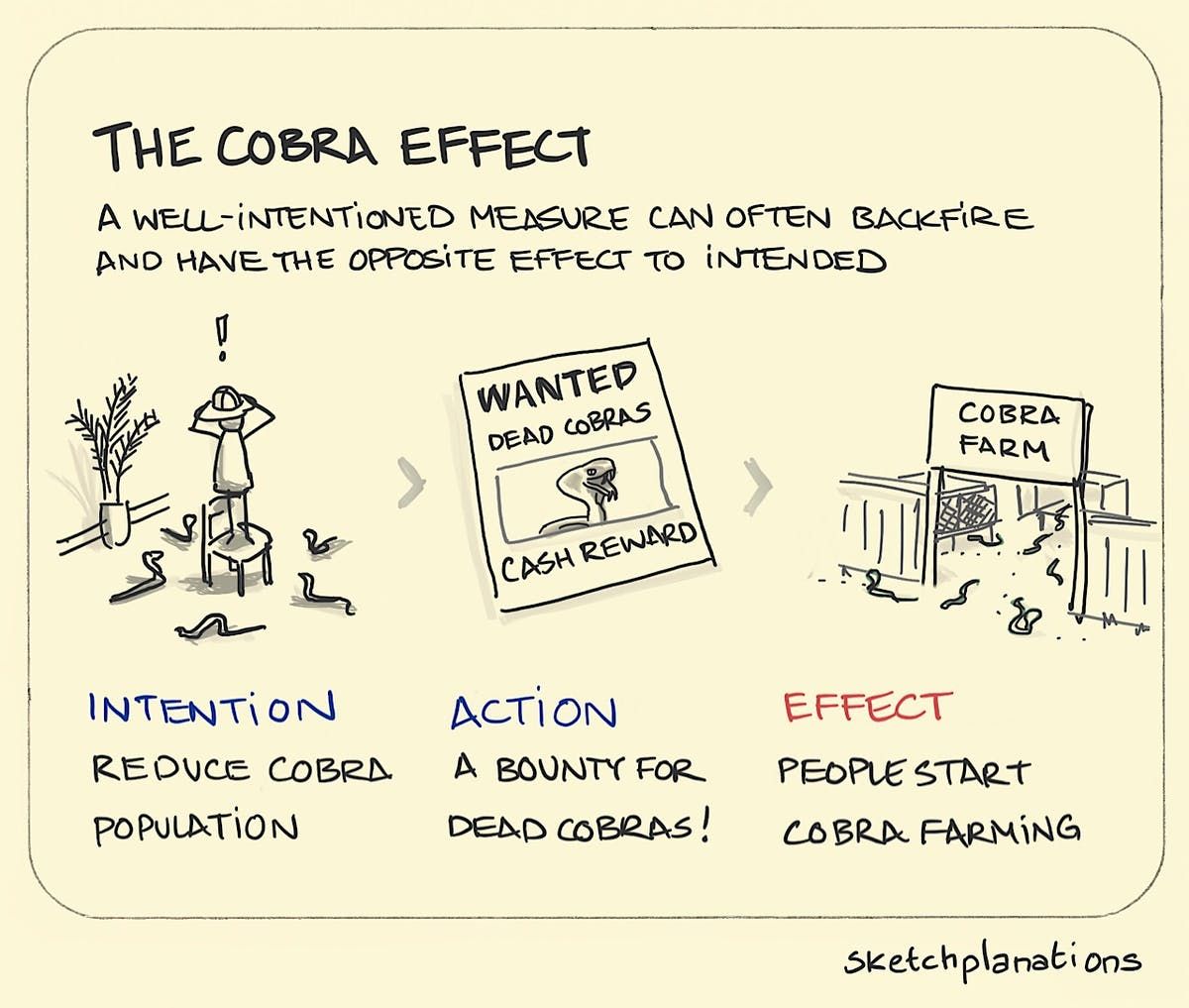
Drug prohibition tends to backfire through a predictable mechanism known as the cobra effect: an incentive structure that makes the problem it targets worse. Enforcement pressure pushes producers toward smaller, more potent, more profitable substances, pushes production and trafficking into new regions rather than eliminating it, and rarely produces a lasting drop in use.
Portugal's 2001 decriminalization, paired with treatment investment, is the most studied counter-example: drug use did not spike, and overdose deaths and HIV infections fell.
The term "cobra effect" comes from a story, likely apocryphal but useful, about colonial Delhi: the British government, alarmed by the city's cobra population, offered a bounty for every dead cobra turned in. Enterprising residents responded by breeding cobras to collect the bounty. When the government caught on and cancelled the program, the breeders released their now-worthless snakes, leaving Delhi with more cobras than before the policy began.
The pattern the story describes, a well-intentioned intervention that changes incentives in a way that makes the underlying problem worse, shows up repeatedly in real drug policy, and it is the central reason prohibition has such a poor track record of eliminating the substances it targets.
The Iron Law of Prohibition
Drug policy analyst Richard Cowan coined the term "iron law of prohibition" in 1986 to describe a specific version of the cobra effect: the more intense the enforcement, the more potent the prohibited substance becomes.
The logic is about risk per unit. When transporting and concealing a drug is dangerous, producers and traffickers have a strong incentive to concentrate potency, since a smaller, more valuable shipment is easier to hide and more profitable per unit of legal risk.
Alcohol Prohibition in the United States (1920-1933) illustrates the pattern: beer, bulky and low in alcohol content, mostly disappeared from the black market, while distilled spirits, easier to transport and far more potent per volume, dominated it.
The same dynamic has played out with opioids. As enforcement targeted heroin supply chains, illicit fentanyl, vastly more potent and far easier to smuggle in small quantities, displaced much of the heroin market. The resulting product is significantly more dangerous to the people using it, which is the opposite of what the enforcement was intended to achieve.
The Balloon Effect
A related and equally well-documented pattern is the balloon effect: suppressing drug production or trafficking in one location tends to displace it elsewhere rather than eliminate it, the way squeezing one part of a balloon just pushes the air somewhere else.
Decades of counter-narcotics spending aimed at Colombian and Peruvian cocaine production illustrate the pattern. Sustained enforcement in one growing region has repeatedly been followed by production shifting to a different region, or trafficking routes shifting to a different corridor, rather than the overall supply meaningfully shrinking. The problem gets redistributed geographically more often than it gets solved.
Does Prohibition Actually Reduce Drug Use?
The evidence on this question is unflattering to strict prohibition. Comparing countries by the severity of their drug laws does not reliably predict their rate of drug use. The United States, with one of the world's most punitive enforcement regimes, has also had among the world's highest rates of drug use, which is difficult to reconcile with the idea that criminalization is the primary lever controlling consumption.
What criminalization reliably does change is the risk environment around use and treatment: people who fear legal consequences are less likely to seek medical help for an overdose, to use in the presence of others who could intervene, or to access clean equipment, all of which raises the health cost of a given level of drug use even when it does not change how many people are using.
The Portugal Case
In 2001, Portugal decriminalized personal possession of all drugs, replacing criminal penalties with an administrative process (a panel that can recommend treatment) and redirected enforcement resources toward treatment and harm reduction. It remained illegal to sell or produce drugs; the change applied specifically to personal use and possession.
The predicted surge in drug use that critics warned about did not materialize. Instead, Portugal saw a substantial decline in HIV infections among people who use drugs, a drop in drug-related deaths, and use rates that stayed stable or declined relative to other EU countries over subsequent years.
Portugal's results are now among the most frequently cited pieces of evidence in the argument that treatment-oriented drug policy outperforms criminalization on public health outcomes without the predicted increase in use.
The Broader Lesson
The cobra effect is not a claim that all enforcement is useless, or that legalization is automatically safe. It is a narrower and more useful warning: any policy that changes incentives without accounting for how the people affected will actually respond can produce the opposite of its intended effect.
Prohibition regimes that focus purely on supply-side punishment, without addressing the underlying demand or the incentives they create for producers to concentrate potency and shift geography, tend to reproduce the Delhi cobra problem: more of exactly what they were trying to eliminate.
Sources & Further Reading
- Cowan, R. (1986). How the Narcs Created Crack. National Review.
- European Monitoring Centre for Drugs and Drug Addiction. Portugal Country Drug Report.
- United Nations Office on Drugs and Crime. World Drug Report.