
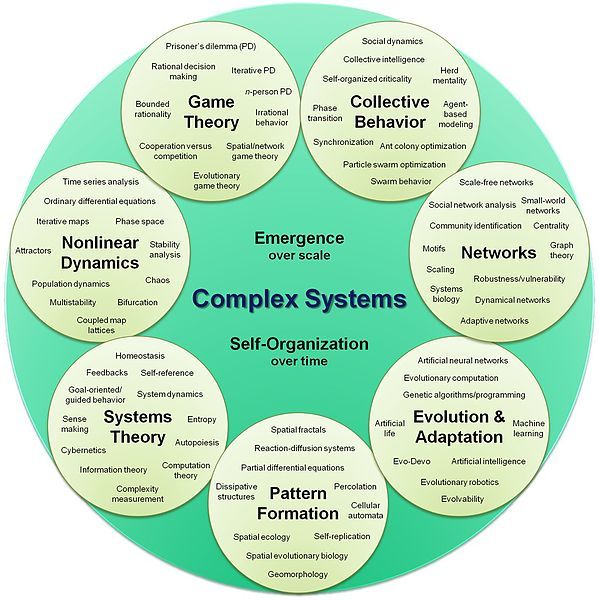
Mapping complex systems makes components, flows, connections, delays, and feedback loops visible so that recurring behavior can be understood structurally. A useful map begins with a specific question, includes only the elements relevant to it, and is tested against observed patterns. It does not predict every event; it reveals why effects become causes and where interventions may address the system rather than a symptom.
When people encounter a system that behaves in confusing, counterintuitive, or frustrating ways, their instinct is almost always to focus on individual components. The marketing team blames the sales team for poor lead quality. The operations team blames the software for being unreliable.
The executives blame middle management for failing to execute the strategy. Each diagnosis focuses on a part, and each proposed fix targets that part in isolation.
Replace the sales process. Upgrade the software. Train the managers. And yet, after the fix is implemented, the system continues to misbehave, often in new and equally frustrating ways. The problem was never the part.
The problem was the connections between parts, the feedback loops, the delays, the structural patterns that cause the system to generate the behavior everyone finds so perplexing.
System mapping is the discipline of making these invisible structures visible. A system map is a visual representation of the components, connections, flows, and feedback loops that constitute a complex system.
When done well, a system map reveals why the system behaves the way it does, not by identifying a single cause but by exposing the structural patterns that generate behavior over time.
It transforms vague complaints ("things keep getting worse") into precise structural diagnoses ("there's a reinforcing loop between customer churn and support overload that accelerates decline once it starts") that point toward interventions that actually address root causes rather than symptoms.
This guide walks through the complete process of building a system map, from defining the problem and identifying components through drawing connections, finding feedback loops, and validating the map against reality.
The process is iterative and messy, as all genuine thinking about complex systems must be, but the steps provide a reliable scaffolding that keeps the work productive and prevents the common failure modes that derail most system mapping efforts.
Why Map Systems at All?
Before diving into the mechanics of system mapping, it is worth understanding why this activity produces insights that other forms of analysis miss. The fundamental reason is that human cognition is naturally linear and event-focused, while complex systems are circular and structure-driven.
When we observe a problem, our cognitive default is to construct a linear causal chain: A caused B, which caused C.
This linear framing works well for simple, mechanical systems but fails catastrophically when applied to complex systems where effects feed back to become causes, where delays separate actions from consequences by weeks or months, and where the same structure generates radically different behavior depending on initial conditions and parameter values.
System mapping externalizes the structure that our minds cannot easily hold. The human working memory can track about four to seven items simultaneously, which is woefully insufficient for understanding a system with dozens of components and hundreds of connections.
By putting the structure on paper (or screen), we extend our cognitive capacity and can see patterns that would be invisible if we tried to hold the entire system in our heads. The map becomes a thinking tool, a way to reason about the system that is more reliable than unaided intuition.
"You think that because you understand 'one' that you must therefore understand 'two' because one and one make two. But you forget that you must also understand 'and'." - Donella Meadows
Donella Meadows, one of the foundational thinkers in systems dynamics, emphasized that the purpose of system mapping is not prediction but understanding. A good system map does not tell you exactly what will happen next month.
What it does tell you is why the system generates the patterns of behavior you observe, and, crucially, where in the system's structure you might intervene to change those patterns.
This distinction between prediction and structural understanding is essential: system maps are tools for identifying leverage points, the places where small changes in structure can produce large changes in behavior, rather than forecasting tools for predicting specific outcomes.
What Should I Include in a System Map?
The question of what to include in a system map is simultaneously the most important and the most difficult question in the entire mapping process. Include too little and the map is too simple to explain the behavior you are trying to understand.
Include too much and the map becomes an incomprehensible tangle of lines and arrows that obscures rather than reveals structure.
The answer lies in your purpose. Every system map should be built to answer a specific question or explain a specific behavior pattern. The question determines what is relevant and what can be excluded.
A system map of a hospital built to answer "Why do emergency room wait times keep increasing?" will include different components than a system map of the same hospital built to answer "Why is nurse turnover so high?" Both maps describe the same physical system, but they foreground different structures because they serve different purposes.
A well-constructed system map includes several categories of elements:
Key entities (stocks) are the things that accumulate in the system: inventory in a warehouse, money in a budget, customers in a market segment, morale in a team, trust in a relationship, knowledge in an organization. Stocks change slowly because they represent accumulations that build up or deplete over time.
This slow-changing nature is precisely what makes stocks important: they represent the system's "memory" and determine how the system responds to events.
Flows are the rates at which stocks change: the rate of new customer acquisition, the rate of employee turnover, the rate at which inventory is consumed, the rate at which trust builds or erodes. Every stock is changed by inflows (which increase it) and outflows (which decrease it).
The distinction between stocks and flows is one of the most powerful concepts in systems thinking because it reveals where delays and accumulations exist in the system, which are often the root causes of counterintuitive behavior.
Causal relationships are the connections between elements that show how one element influences another.
These connections should indicate the direction of influence (A affects B, not vice versa) and the polarity of influence (does an increase in A cause an increase in B, called a same-direction or positive link, or does an increase in A cause a decrease in B, called an opposite-direction or negative link?).
Getting the polarity right is essential because the polarities of individual links determine the behavior of the feedback loops they form.
Feedback loops are the circular chains of causation that drive system behavior over time.
There are two types: reinforcing loops (where a change in one direction amplifies itself through the loop, creating growth or collapse) and balancing loops (where a change in one direction triggers corrective forces that push back toward equilibrium).
Identifying feedback loops is the central skill of system mapping because feedback loops, not individual causes, are what generate the patterns of behavior you are trying to understand.
Delays are the time lags between cause and effect that are present in virtually every real system but are routinely overlooked in mental models. The delay between hiring a new employee and that employee becoming productive. The delay between launching a marketing campaign and seeing its effect on sales.
The delay between cutting a budget and experiencing the consequences of that cut. Delays are among the most important structural features to include in a system map because they create oscillation, overshoot, and instability, behaviors that are almost impossible to understand without explicitly mapping the delays that cause them.
External influences are factors outside the system's boundaries that affect its behavior but are not themselves affected by the system (at least within the timeframe and scope of the analysis). Exchange rates, regulatory requirements, weather, demographic trends, and competitor actions are common external influences.
Mapping these as external inputs rather than internal variables clarifies where the system's behavior is driven by internal structure versus external forces.
Step 1: Define the Purpose and Boundaries
Before putting pen to paper (or cursor to screen), answer two questions that will shape every subsequent decision in the mapping process.
What Behavior Are You Trying to Explain?
Be specific. "Our business is struggling" is too vague to guide a system map. "Customer churn has increased from 5% to 12% per month over the past year while our acquisition costs have doubled" is specific enough to guide your mapping.
The behavior you are trying to explain determines which components are relevant, which connections matter, and where the map's boundaries should fall.
The behavior should ideally be described as a pattern over time rather than a single event. System maps explain dynamic behavior (growth, decline, oscillation, stagnation, S-shaped transitions) rather than one-time events.
If you find yourself trying to explain a single event ("why did we lose that client?"), consider whether there is an underlying pattern ("why do we keep losing our largest clients after the first renewal?") that represents a systemic issue rather than an isolated occurrence.
Where Are the System's Boundaries?
Every system map requires boundaries: a definition of what is inside the system (and therefore modeled in detail) and what is outside (and therefore treated as external inputs or ignored entirely). Boundary decisions are consequential because they determine what the map can and cannot explain.
Place your boundaries wide enough to include the feedback loops that drive the behavior you are studying, but narrow enough to keep the map manageable.
A common mistake is drawing boundaries too tightly, which excludes feedback loops that pass through "external" elements and makes the system's behavior appear driven by external forces rather than internal structure.
If your map suggests that the system's behavior is primarily caused by external factors, consider whether widening the boundaries would reveal internal feedback loops that are actually driving the pattern.
For example, if you are mapping why employee turnover is increasing, a narrow boundary might include only the HR department: hiring, compensation, exit interviews.
But turnover is driven by factors outside HR: workload from project management, culture from leadership, career development from the training department, and competitive job offers from the labor market.
Drawing the boundary too tightly around HR produces a map that suggests turnover is caused by "external forces" (bad management, no career development) when in reality these are part of the same system and are often connected to turnover through feedback loops.
Step 2: Identify the Key Components
"The most important choice you will ever make about a system is where to draw its boundary." - Jay Forrester
With your purpose and boundaries defined, begin identifying the key entities, variables, and stocks that populate the system. There are several approaches that work well, and combining multiple approaches produces the most comprehensive inventory.
Brainstorming from the Behavior
Start with the behavior you are trying to explain and work backward. If the behavior is "customer churn is increasing," ask: what directly causes customers to leave? (Dissatisfaction with service, better competitor offers, unresolved complaints, price increases, product not meeting needs.) What causes each of those factors?
(Dissatisfaction might be caused by slow response times, which might be caused by understaffing, which might be caused by high employee turnover, which might itself be caused by overwork from handling too many customer complaints.)
This backward-chaining approach naturally generates the components that are most relevant to your purpose. It also begins to reveal causal connections, which is useful groundwork for Step 3.
Interviewing Stakeholders
Different people in the system see different parts of it. The customer service team knows what customers complain about. The operations team knows where processes break down. The finance team knows where costs are rising fastest. Sales knows what competitors are doing.
Each perspective illuminates components and connections that the others miss. A system map built from a single perspective will be systematically incomplete in predictable ways: it will over-represent the mapper's own area of expertise and under-represent areas they interact with only indirectly.
Examining Data
Historical data can reveal components that stakeholders may not mention because they have become so accustomed to them that they are invisible.
A time-series graph of customer satisfaction scores might reveal a seasonal pattern that no one mentioned because they have always just accepted it as "how things are." A correlation analysis between employee tenure and customer retention might surface a connection that everyone vaguely suspects but that no one has articulated explicitly.
What's the Difference Between Stocks and Flows?
This distinction is fundamental to system mapping and worth understanding through concrete examples.
Stocks are quantities that accumulate over time. Think of them as nouns, things that you can measure at a point in time. A bank account balance is a stock: at any given moment, the balance has a specific value. The number of customers is a stock.
The level of employee morale is a stock (even though it is harder to measure precisely). The amount of inventory in a warehouse is a stock. The level of trust between two teams is a stock.
Flows are rates that change stocks over time. Think of them as verbs, actions that happen over a period. Deposits and withdrawals are flows that change the bank account stock. Customer acquisitions and customer departures are flows that change the customer count stock.
Praise and criticism are flows that change the morale stock. Production and consumption are flows that change the inventory stock.
The distinction between stocks and flows is important because it reveals where delays and inertia exist in the system. Stocks change slowly because they represent accumulations: you cannot instantly change a bank balance, employee morale, organizational culture, or market reputation.
This inertia means that actions taken today may not produce visible effects for weeks, months, or even years. System maps that fail to distinguish stocks from flows miss these delays and therefore cannot explain the system's dynamic behavior.
Consider a concrete example. A software company notices declining code quality. The stock is the quality level of the codebase. The inflows that increase quality include code reviews, refactoring sessions, and testing.
The outflows that decrease quality include adding features under time pressure, skipping tests, and accumulating technical debt.
A system map that captures only the level of code quality (the stock) without the rates of quality-improving and quality-degrading activities (the flows) cannot explain why quality is declining or what might reverse the trend.
But a map that shows both reveals: the outflows (feature pressure, skipped tests, technical debt) are increasing faster than the inflows (code reviews, refactoring), and the gap between them is what drives the decline.
Step 3: Draw the Connections
With your key components identified, begin drawing the causal connections between them.
For each connection, you need to determine three things: the direction (which element influences which), the polarity (does an increase in the cause produce an increase or decrease in the effect?), and, where relevant, the delay (how long between the cause changing and the effect responding?).
Direction
Causal connections have a direction: A influences B, not the other way around. In some cases, the direction is obvious: hiring more employees increases headcount (not the reverse). In other cases, the direction is ambiguous or bidirectional: does employee morale affect productivity, or does productivity affect morale?
Often, the answer is "both," which means there are actually two separate causal connections, one from morale to productivity and one from productivity to morale, that together form a feedback loop.
When you encounter a bidirectional relationship, resist the temptation to draw a single double-headed arrow. Instead, draw two separate arrows, one in each direction, each with its own polarity.
This discipline forces you to think about the mechanism of each direction separately, which often reveals that the two directions have different polarities, different delays, or different strengths, information that a single double-headed arrow would obscure.
Polarity
Each causal connection has a polarity: same direction (an increase in A causes an increase in B, or a decrease in A causes a decrease in B) or opposite direction (an increase in A causes a decrease in B, or a decrease in A causes an increase in B).
In system dynamics notation, same-direction links are marked with a "+" and opposite-direction links with a "-". In causal loop diagrams, the convention is similar: "S" for same direction and "O" for opposite direction.
Getting polarities right is essential because they determine the behavior of the feedback loops the connections form. A loop with an even number of opposite-direction links (including zero) is a reinforcing loop; a loop with an odd number of opposite-direction links is a balancing loop.
Misidentifying a single polarity can change a reinforcing loop into a balancing loop or vice versa, which completely changes the behavior the map predicts.
To verify polarity, use this test: "If A increases, all else being equal, does B increase (same direction) or decrease (opposite direction)?" The phrase "all else being equal" is crucial because in a real system, many things change simultaneously, and the effect of A on B may be obscured by other influences.
The polarity represents the direct effect of A on B, holding everything else constant.
Delay
Many causal connections involve significant delays between cause and effect. Hiring a new employee takes weeks; the new employee becoming fully productive takes months. Launching a marketing campaign produces inquiries within days but closed sales within quarters. Building organizational trust takes years; destroying it takes moments.
Mark delays explicitly on your system map with a notation (a double line crossing the arrow, or the word "delay" beside the connection). Delays are among the most important structural features in any system because they are the primary cause of oscillation and overshoot.
When people take actions to correct a problem but the effect of those actions is delayed, they often conclude that their actions aren't working and intensify them, leading to overshooting the correction and creating a new problem in the opposite direction.
Step 4: Identify Feedback Loops
"Complex systems are prone to failure in ways that are rarely anticipated by their designers, because the interactions between components are non-linear, tightly coupled, and often invisible until they produce catastrophe." - Charles Perrow
This is the most important step in the system mapping process and the one that most distinguishes system mapping from other forms of analysis. Feedback loops are the engines of system behavior: they are the structural patterns that cause growth, decline, oscillation, stagnation, and all the other dynamic patterns that systems exhibit.
How Do I Identify Feedback Loops?
To find feedback loops, trace paths through the map where a variable affects itself through a chain of intermediaries. Start at any variable and follow the arrows forward through the map. If you return to your starting variable, you have found a feedback loop.
Repeat from other starting variables until you have identified all significant loops.
For each feedback loop, determine its type:
Reinforcing loops amplify change. If you trace around the loop and the net effect of a small increase is a further increase, the loop is reinforcing. Reinforcing loops generate exponential growth when running in the "positive" direction and accelerating collapse when running in the "negative" direction.
The classic example is compound interest: more money earns more interest, which produces more money, which earns more interest.
In organizational systems, reinforcing loops drive phenomena like the "death spiral" (losing customers reduces revenue, which reduces service quality, which loses more customers) and the "success spiral" (happy customers generate referrals, which brings more customers, which increases revenue, which allows investment in better service, which makes customers happier).
Balancing loops resist change and seek equilibrium. If you trace around the loop and the net effect of a small increase is a subsequent decrease (pushing back toward the starting point), the loop is balancing. Balancing loops are the system's corrective mechanisms: they maintain stocks near target values and dampen disturbances.
A thermostat is the prototypical balancing loop: when the temperature drops below the set point, the heater turns on, which raises the temperature, which turns the heater off.
In organizational systems, balancing loops include performance reviews (poor performance triggers coaching, which improves performance), budget controls (overspending triggers cuts, which reduces spending), and market equilibrium (high prices attract competitors, which increases supply, which reduces prices).
Mark reinforcing loops with "R" (or a snowball icon, suggesting growing momentum) and balancing loops with "B" (or a scale icon, suggesting equilibrium-seeking).
Give each loop a descriptive name that captures its behavioral story: "Customer Death Spiral," "Word-of-Mouth Growth Engine," "Budget Correction Cycle." These names make the loops memorable and communicable, which matters because the ultimate value of a system map lies in its ability to be shared and discussed.
Looking for Delays Within Loops
Pay particular attention to delays within feedback loops, because delays fundamentally alter loop behavior. A balancing loop without delay smoothly corrects deviations: the thermostat keeps the temperature close to the set point.
A balancing loop with delay oscillates: the temperature overshoots the set point before the heater shuts off, then undershoots before the heater turns back on.
The longer the delay, the wider the oscillation. In organizational contexts, these oscillations manifest as boom-bust hiring cycles, inventory oscillations, and the recurring overreaction and underreaction patterns that plague many management processes.
Step 5: Identify Leverage Points
With the feedback loops mapped, you can begin identifying leverage points: places in the system's structure where interventions can produce significant changes in behavior. Not all interventions are equally effective. Some target symptoms rather than causes.
Some weaken beneficial loops. Some create unintended consequences by triggering feedback loops that the intervener did not consider.
Donella Meadows proposed a hierarchy of leverage points, ranging from least to most effective:
- Parameters (numbers, budgets, quotas) are the least powerful leverage points because they change the system's behavior quantitatively without changing its structure. Increasing a marketing budget within an existing strategy is a parameter change.
- Buffers (the sizes of stabilizing stocks) provide more leverage because larger buffers absorb shocks and reduce oscillation. Maintaining higher inventory levels, for example, buffers against supply chain disruptions.
- Structure (the physical and informational connections between components) offers more leverage because structural changes alter which feedback loops operate and how strongly they operate.
- Delays (the lengths of time between cause and effect) can be powerful leverage points because reducing delays in balancing loops reduces oscillation and overshoot.
- Feedback loops (creating new ones or changing the strength of existing ones) offer significant leverage because feedback loops drive the system's dynamic behavior.
- Information flows (who has access to what information) can be remarkably powerful because information determines how actors in the system respond to conditions.
- Rules (the incentives, punishments, and constraints that govern behavior) shape the system's behavior by determining how actors make decisions.
- Goals (the purpose the system serves) represent one of the highest-leverage points because changing the system's goal changes the direction of all its self-correcting mechanisms.
- Paradigms (the mindsets and mental models that shape how people understand the system) are the most powerful leverage points because they determine which goals, rules, and structures are even considered possible.
The practical implication is that system maps should direct your attention away from parameter-level interventions (which are easiest to implement but least effective) and toward structural and informational interventions (which are harder to implement but far more powerful).
Step 6: Validate the Map
A system map is a hypothesis about the system's structure. Like any hypothesis, it needs to be tested against evidence before it can be trusted as a guide for action.
How Do I Validate My System Map?
There are several validation approaches, and using multiple approaches provides more confidence than any single test.
Does the map explain observed behaviors? The most basic test is whether the map's structure, when you mentally "run" it forward in time, generates the behavior patterns you observe in the real system. If the map contains a reinforcing loop that should produce exponential growth, do you see exponential growth in the data?
If the map contains a balancing loop with delay that should produce oscillation, do you see oscillation? If the map's predicted behavior does not match observed behavior, something in the map is wrong: a missing component, a misidentified polarity, an overlooked feedback loop, or an underestimated delay.
Can the map predict system response to changes? A stronger test is whether the map predicts how the system will respond to perturbations. If you increase marketing spend, what does the map predict will happen to sales, customer satisfaction, and employee workload?
Does this match what actually happens? Predictive validation is more demanding than explanatory validation because it requires the map to work for conditions that were not used to build it.
Does the map make sense to people who know the system? Show the map to people who work in the system and ask whether it captures the dynamics they experience. Practitioners often have deep intuitive understanding of system behavior that they have never articulated explicitly.
When they see a system map that captures their experience, they typically respond with recognition: "Yes, that's exactly what happens." When they do not recognize the dynamics, either the map is wrong or the practitioner is seeing only part of the system.
Look for contradictions between map and reality. Systematically search for aspects of the real system's behavior that the map cannot explain. If the real system shows stable behavior but the map predicts oscillation, there may be a stabilizing mechanism (a balancing loop) that the map has not captured.
If the real system shows sudden phase transitions (abrupt shifts from one behavioral pattern to another) but the map predicts smooth, continuous change, there may be a threshold effect or a reinforcing loop that the map has not included.
Step 7: Refine Iteratively
System mapping is inherently iterative. Your first map will be incomplete, partially wrong, and oversimplified. This is expected and acceptable. The purpose of the first map is not to be correct but to organize your current understanding well enough to identify where it is wrong or incomplete, so that subsequent iterations can improve it.
How Detailed Should My Map Be?
The question of detail level is one that mappers wrestle with continuously. The answer depends on your purpose, your audience, and the specific areas where you need deeper understanding.
Detail enough to answer your key questions. If your question is "why is customer churn increasing?", the map needs enough detail in the customer experience domain to reveal the feedback loops that drive churn.
It does not need the same level of detail in areas that are peripheral to the question (the company's financial accounting structure, for example, unless financial decisions are directly driving the churn).
Simple enough to understand at a glance. A system map that contains 50 variables and 200 connections may be comprehensive, but it is also incomprehensible. The map's value lies in its ability to reveal structure, and a map that is too complex to understand reveals nothing.
As a practical guideline, the core of a system map (the feedback loops that drive the behavior you are studying) should contain no more than 15 to 20 variables.
If you need more detail, create nested maps: a high-level map that shows the major feedback loops and their relationships, with detailed sub-maps for each loop that show the internal mechanics.
Start high-level, then zoom in on problem areas. Your first iteration should capture the broadest structural features: the major stocks, the most important flows, and the dominant feedback loops. Once this high-level structure is validated, zoom in on the areas where the map's predictions diverge most from reality.
These divergence points are where the map's structure is most wrong or incomplete, and they are therefore where additional detail will produce the greatest improvement in the map's accuracy.
A good system map highlights structure that explains behavior. It does not attempt to reproduce every detail of the real system.
Just as a good geographical map omits billions of details about the terrain it represents (individual blades of grass, the exact position of every pebble) while preserving the structural features that serve the map's purpose (roads, rivers, elevation contours, city boundaries), a good system map omits most of the details of the real system while preserving the structural features (feedback loops, delays, stocks, flows) that explain the behavior you are studying.
What Are the Best Tools for System Mapping?
The choice of tools should match the phase of the mapping process, the complexity of the system, and the audience for the map.
Early-Stage Mapping: Paper and Whiteboard
For the initial phases of system mapping, paper, whiteboards, and sticky notes remain the best tools. They are fast (there is no software to learn or manipulate), flexible (you can draw, erase, rearrange, and annotate without constraints), and collaborative (multiple people can work on the same whiteboard simultaneously).
The physical act of drawing also engages different cognitive processes than typing, which often produces more creative and intuitive insights.
Use sticky notes for components (one per note) so they can be easily rearranged as you discover new connections. Draw connections with markers directly on the whiteboard or on flip chart paper. Use different colors for different types of elements: one color for stocks, another for flows, a third for external inputs.
Mid-Stage Mapping: Digital Diagramming Tools
Once the map's basic structure is established, transfer it to a digital tool for cleaner presentation, easier iteration, and broader sharing. General-purpose diagramming tools like Miro, Mural, Lucidchart, or draw.io work well for causal loop diagrams and simple stock-and-flow maps.
They offer enough flexibility to represent system mapping conventions while being accessible to people who are not systems dynamics specialists.
For causal loop diagrams specifically, Kumu is a purpose-built tool that handles network-style maps elegantly, with features for color-coding loop types, annotating connections with polarity and delay information, and presenting interactive maps that stakeholders can explore.
Loopy is a simpler, web-based tool specifically designed for causal loop diagrams that is excellent for education and quick exploration because it allows you to "run" the loops and see the resulting behavior in real time.
Advanced Modeling: Simulation Software
For maps that need to be simulated, to generate quantitative predictions of behavior over time, specialized system dynamics software is required. Vensim and Stella (also called iThink) are the two most widely used platforms.
They allow you to build stock-and-flow models, parameterize the relationships with mathematical equations, and simulate the model's behavior over time.
The output is a set of time-series graphs showing how each stock changes, which can be compared directly against historical data for validation.
Simulation modeling is substantially more demanding than qualitative mapping because it requires specifying the precise mathematical form of each relationship, estimating parameter values, and validating the model against historical data.
This level of rigor is warranted for high-stakes decisions where the cost of being wrong is large enough to justify the investment in quantitative modeling, but it is overkill for most system mapping applications, where the qualitative insight of identifying feedback loops and leverage points is sufficient.
| Tool Category | Examples | Best For | Limitations |
|---|---|---|---|
| Paper/Whiteboard | Sticky notes, markers, flip charts | Initial brainstorming, group mapping sessions | Not shareable digitally, hard to iterate cleanly |
| General Diagramming | Miro, Lucidchart, draw.io | Clean diagrams for presentations and sharing | No simulation, limited systems-specific features |
| Systems-Specific | Kumu, Loopy | Causal loop diagrams, interactive exploration | Limited simulation, may require learning curve |
| Simulation | Vensim, Stella/iThink | Quantitative modeling, scenario testing | Steep learning curve, requires parameterization |
Common System Mapping Mistakes
System mapping has characteristic failure modes that are worth understanding because recognizing them allows you to avoid them.
Mapping Everything
The most common mistake, particularly among enthusiastic beginners, is trying to map the entire system at once. The result is a sprawling diagram with dozens of variables and hundreds of connections that obscures rather than reveals structure.
Remember: the map is built to answer a specific question. Include only the components and connections that are relevant to that question. If you find yourself adding variables that are three or four causal steps removed from the behavior you are studying, you have probably gone too far.
Confusing Correlation with Causation
When drawing connections, ensure that you are representing genuine causal relationships, not mere correlations. The fact that two variables tend to move together does not mean one causes the other. They might both be caused by a third variable, or the correlation might be coincidental.
For each connection on the map, you should be able to articulate the mechanism by which the cause produces the effect. If you cannot, the connection may not belong on the map.
Ignoring Delays
Inexperienced mappers routinely omit delays, which are among the most important structural features in any system. The result is a map that implies instantaneous cause-and-effect relationships where the real system has significant lags.
This omission is particularly harmful because delays are the primary cause of oscillation and overshoot, two of the most common and puzzling patterns in complex system behavior.
Static Thinking
A system map is a representation of dynamic structure, structure that generates behavior over time. But it is easy to read a system map statically, as a snapshot of the system at a moment in time, rather than dynamically, as a set of mechanisms that will produce changes over time.
When interpreting a system map, always ask: "If I mentally 'run' this structure forward in time, what behavior does it generate?" This mental simulation is the key skill of systems thinking.
Missing Feedback Loops
If your map has no feedback loops, something is almost certainly wrong. Complex systems are defined by their feedback structure, and any real complex system contains multiple reinforcing and balancing loops.
A map without feedback loops is essentially a linear causal chain, which is a fundamentally different (and much less useful) type of model.
If you cannot find feedback loops, widen your boundaries, add more components, or look for indirect effects where a downstream variable influences an upstream variable through an intermediary that you have not yet included.
From Map to Action: Using System Maps for Decision-Making
"We can't solve problems by using the same kind of thinking we used when we created them. A system map forces us into a fundamentally different mode of thinking." - Peter Senge
The ultimate purpose of a system map is to guide better decisions. A map that stays on the wall (or in the file) without influencing action is an intellectual exercise, not a practical tool. Here is how to translate map insights into actionable interventions.
Identify Where You Are Intervening Now
Before proposing new interventions, map where the organization is currently intervening in the system.
Often, current interventions are concentrated on low-leverage points (parameter changes like budget adjustments) or are targeting symptoms rather than causes (firefighting problems that are generated by structural patterns that the interventions leave untouched).
Seeing current interventions plotted on the system map often reveals why they are ineffective and suggests where alternative interventions might be more productive.
Design Interventions That Address Structure
The most effective interventions change the system's structure rather than merely adjusting parameters within the existing structure.
Structural interventions include: creating new feedback loops (adding a customer feedback mechanism that did not previously exist), changing the strength of existing feedback loops (increasing the frequency of performance reviews to strengthen a learning loop), reducing delays (shortening the time between a customer complaint and a response to that complaint), and changing information flows (making data visible to people who need it for decision-making but currently do not have access to it).
Anticipate Unintended Consequences
One of the greatest values of system maps is their ability to reveal the unintended consequences of proposed interventions. Before implementing an intervention, trace its effects through the system map: not just the direct, intended effect, but the secondary and tertiary effects that propagate through the system's feedback loops.
If a proposed intervention to improve customer satisfaction involves hiring more support staff, trace the effects of the additional hiring on the budget, on the workload of existing staff (who must train the new hires), on the timeline (new staff take time to become productive), and on other departments (who may not receive the hires they requested because the budget was allocated to support).
Communicate Through Stories
System maps are powerful communication tools, but they require translation for audiences that are not accustomed to systems thinking. The most effective translation is through stories: narrative descriptions of how the system's feedback loops generate behavior over time.
"Here's what happens when we lose a key customer: the revenue drop triggers a budget cut, which reduces marketing spend, which slows new customer acquisition, which further reduces revenue, creating a downward spiral that accelerates until we either find new customers or make deeper cuts." Stories engage people's narrative cognition and make the map's abstract structure concrete and memorable.
A Worked Example: Mapping Employee Turnover
To illustrate the complete process, consider a moderately complex example: mapping employee turnover in a technology company that is experiencing accelerating attrition.
Step 1: Purpose and boundaries. The behavior to explain is: employee turnover has increased from 12% to 25% per year over the past two years, with the highest turnover among the most experienced engineers. Boundaries: include everything within the company that affects engineer retention, plus the external labor market.
Step 2: Key components. Stocks: experienced engineers (headcount), junior engineers (headcount), organizational knowledge, codebase quality, employee morale, project backlog, company reputation in the labor market. Flows: hiring rate, departure rate, knowledge transfer rate, quality improvement rate, quality degradation rate.
Step 3: Connections. Experienced engineer departures decrease organizational knowledge (same direction, with delay). Lower organizational knowledge decreases codebase quality (same direction, with delay). Lower codebase quality increases time-to-fix for bugs and incidents (opposite direction).
Increased time-to-fix increases workload for remaining engineers (same direction). Increased workload decreases morale (opposite direction). Decreased morale increases departure rate (opposite direction, with delay). Higher departure rate decreases experienced engineer headcount (same direction).
Step 4: Feedback loops. The connections above form a classic reinforcing "death spiral": experienced engineers leave, which increases workload and decreases knowledge, which lowers morale, which causes more experienced engineers to leave.
There is also a balancing loop: departures trigger hiring, which adds junior engineers, who eventually gain experience and partially replace the knowledge that was lost.
But this balancing loop operates much more slowly than the reinforcing loop (it takes 12-18 months for a junior engineer to become fully productive, while the morale and workload effects of a departure are felt within weeks).
Step 5: Leverage points. The map reveals that the most effective interventions are those that slow the reinforcing loop or speed up the balancing loop.
Slowing the reinforcing loop: reduce workload per engineer (hire contractors for routine work), improve morale through non-workload means (compensation, autonomy, recognition), or accelerate knowledge documentation (reducing the knowledge loss from each departure).
Speeding the balancing loop: improve onboarding to reduce the time for new hires to become productive, or hire experienced engineers from outside rather than relying solely on developing junior hires internally.
This worked example illustrates how system mapping transforms a vague concern ("turnover is too high") into a structural diagnosis (the reinforcing departure-workload-morale loop is overpowering the balancing hiring-development loop) that points toward specific, high-leverage interventions.
How the US Opioid Crisis Revealed Invisible System Structures
The opioid epidemic that killed more than 500,000 Americans between 1999 and 2023 is one of the most thoroughly documented cases of a complex system producing catastrophic outcomes through structures that were invisible to the policymakers trying to address the problem.
In 1996, Purdue Pharma launched OxyContin with marketing that described the drug as having low addiction potential. Prescriptions surged. Addiction rates surged. States responded by restricting opioid prescriptions.
Addicted patients, denied prescriptions, turned to cheaper, more available heroin and later fentanyl. Overdose deaths accelerated rather than decreased following prescription restrictions.
Epidemiologist Andrew Kolodny of Brandeis University, who runs the Opioid Policy Research Collaborative, has argued that policymakers repeatedly intervened on the visible symptom-prescription volume-without mapping the underlying system.
A system map would have revealed the critical balancing and reinforcing loops: the pharmaceutical marketing loop (more sales reps + more prescriptions + more revenue = more sales reps), the addiction transition loop (prescription restriction + existing addiction + heroin availability = transition to street drugs), and the supply loop (demand for illicit opioids + profit margin + cartels = fentanyl supply expansion).
Each intervention that targeted prescription volume without addressing addiction treatment availability, illicit supply, or demand simply activated the transition loop, moving addicted individuals from monitored pharmaceutical channels to unmonitored street channels where overdose risk was far higher.
The 2017 report by the President's Commission on Combating Drug Addiction and the Opioid Crisis, chaired by Governor Chris Christie, was one of the first federal documents to explicitly acknowledge the systemic nature of the problem-that demand-side interventions (prescription limits) alone would drive behavior through alternative system pathways.
The report recommended simultaneous intervention on multiple nodes: prescription monitoring, addiction treatment expansion, naloxone distribution, and supply disruption.
This multi-node approach reflects the core principle of system mapping: effective leverage points address structural causes, not just symptoms, and must account for the feedback loops that route behavior around single-point interventions.
"Every time we restricted prescriptions without expanding treatment, we didn't solve the problem. We redirected it to a more dangerous part of the system." - Andrew Kolodny, Director, Opioid Policy Research Collaborative, Brandeis University, 2018
Toyota's Production System: A Map of Feedback and Continuous Learning
Toyota's Production System (TPS)-the manufacturing approach that spawned the global lean manufacturing movement-is best understood not as a set of techniques but as a deliberately designed system map made operational. W.
Edwards Deming's influence on Toyota's post-war manufacturing is well documented; less noted is that Deming's core contribution was system-level thinking: the idea that variation in outcomes was almost always a property of the system rather than the behavior of individual workers.
Toyota's andon cord mechanism-the pull-cord that any assembly line worker can use to stop the entire production line when they detect a quality problem-is a designed feedback loop that makes quality problems immediately visible at their point of origin.
Before andon, quality problems propagated through the production system and were detected downstream, where the cause was difficult to identify.
After andon, the system halted at the exact location and moment of the problem, providing both the information (what failed) and the context (exactly what was happening in the surrounding production environment) needed to identify and fix root causes.
MIT researchers John Paul MacDuffie and Fritz Pil, in their landmark 1996 paper "The Adoption of High-Involvement Work Practices" in Industrial Relations, documented that plants using TPS-style feedback mechanisms had significantly higher quality outcomes than plants using traditional top-down quality control-not because TPS workers were more skilled but because TPS created information flows that allowed the system to learn about its own failures in real time.
The key variable was system map design: where in the production system did quality information get generated, who received it, and what authority did they have to act on it?
Jeffrey Liker's The Toyota Way (2004) synthesizes the system mapping principle explicitly: Toyota's production system is organized to make problems visible rather than hiding them behind buffer stocks, rework loops, and late-stage inspection.
The design principle is that a system that can see its own failures is a system that can correct them. A system that hides failures through workarounds accumulates structural dysfunction until it breaks catastrophically.
"The goal of the Toyota Production System is not to eliminate waste from a fixed process. It is to build a process that continuously reveals waste so that it can be continuously eliminated." - Jeffrey Liker, The Toyota Way, 2004
Sources & Further Reading
Research Evidence: What Studies Tell Us About System Mapping Effectiveness
The empirical literature on systems thinking and system mapping as a tool for understanding and improving complex systems spans several decades and multiple disciplines.
John Sterman's research on dynamic decision-making failures (1989-2002) at MIT's Sloan School of Management provided some of the most rigorous experimental evidence that human intuition systematically fails in complex systems and that structural mapping can compensate for these failures.
In a series of experiments using the "Beer Game" supply chain simulation, Sterman found that participants without systems training consistently produced large oscillations in inventory levels and order quantities even in response to simple, steady demand patterns.
The oscillations, which arose from participants' failure to account for delays in the supply chain, were not corrected through experience: players who ran the same simulation multiple times continued to produce similar oscillations because they attributed the results to external variability rather than to their own responses to feedback delays.
In contrast, participants who received training in systems thinking, including instruction on identifying delays and feedback loops before making decisions, showed significantly reduced oscillation and higher average performance.
Sterman's 1989 paper in Management Science, "Modeling Managerial Behavior: Misperceptions of Feedback in a Dynamic Decision Making Experiment," identified misperceptions of feedback delays as the systematic cause of these costly oscillations, a pattern later popularized as the "bullwhip effect." The research directly supports the guide's emphasis on identifying and explicitly modeling delays as a critical mapping step.
Dietrich Dörner's cognitive science research on complex system management (1979-1996), reported in The Logic of Failure (1996), used computer-simulated complex systems to study how people make decisions in environments with multiple interacting variables, delays, and feedback.
Dörner and colleagues at the University of Bamberg tested hundreds of participants in simulated governance, city management, and ecological management scenarios, tracking both their decisions and their reasoning processes.
The research identified several characteristic failure patterns: participants focused on individual variables rather than on the relationships between variables, applied linear thinking to systems with circular causation, reacted to immediate symptoms while ignoring structural causes, and made sweeping interventions without tracking their second-order effects.
Critically, expertise in the domain (political science for the governance simulation, ecology for the environmental simulation) did not predict better management performance.
The best performers were those who invested time in mapping the system's structure before intervening, who tracked the effects of their interventions systematically, and who revised their mental models based on unexpected outcomes.
Dörner's research provides experimental evidence that the mapping process itself, separate from any specific map content, improves decision quality by changing how decision-makers think about complex problems.
Peter Senge and colleagues' Action Research on organizational learning interventions (1990-2005), reported in The Fifth Discipline Fieldbook (1994) and subsequent publications, documented the real-world effects of systems thinking and system mapping interventions in organizational settings.
Senge and colleagues worked with organizations including Ford and Harley-Davidson, introducing causal loop diagramming, stock-and-flow modeling, and systems archetypes as tools for organizational problem-solving.
Across these engagements, a recurring pattern emerged: leaders who mapped the reinforcing and balancing loops driving a problem, rather than treating each contributing factor as an independent lever, consistently identified higher-leverage interventions than leaders working from conventional single-cause analysis.
Dana Meadows's leverage point research (1999), published as "Leverage Points: Places to Intervene in a System," synthesized decades of system dynamics modeling experience into a taxonomy of twelve categories of intervention, ranked by their effectiveness at changing system behavior.
Meadows's analysis, based on examination of dozens of real-world system models, found that the interventions most commonly attempted by managers and policymakers (adjusting constants, subsidies, and taxes) consistently ranked among the least effective, while the interventions that most reliably produced large behavior changes (changing the rules of the system, changing the goals of the system, and changing the mindset that gives rise to the system's goals) were rarely attempted because they required structural and cultural changes that were politically or organizationally difficult.
Meadows's framework has been applied in environmental policy, organizational design, public health, and economic development, providing a structured basis for prioritizing interventions once a system map has been constructed.
Case Studies: System Mapping Transforming Organizational Decision-Making
Beyond the opioid crisis and Toyota examples discussed earlier in this guide, several additional cases illustrate how system mapping produces insights that conventional analysis misses.
Urban dynamics modeling and unintended consequences of housing policy (1969) provides one of the earliest documented cases of system mapping revealing policy failures that linear analysis had missed.
Jay Forrester's 1969 book Urban Dynamics modeled the factors driving urban decline and renewal, including housing density, job availability, skilled and unskilled population dynamics, and tax base.
The model, which incorporated feedback loops and delays that linear policy analysis had ignored, produced the counterintuitive finding that many standard urban renewal interventions, including low-income housing construction, were not just ineffective but actively harmful to the communities they were intended to help.
Forrester's model showed that adding low-income housing without addressing job creation actually accelerated urban decline by increasing population without increasing economic base, reducing per-capita tax revenue, and reducing pressure on existing employers to offer adequate wages.
The analysis was controversial when published and remains so, because its policy implications were politically uncomfortable.
Forrester's specific predictions about housing subsidies remain debated among urban economists, and later research on sprawl and urban growth by economists including Edward Glaeser and Matthew Kahn has continued to examine how housing and development policy can produce effects that run counter to policymakers' intentions, though not as a direct test of Forrester's original model.
The case illustrates both the power of system mapping to reveal non-obvious policy effects and the political resistance that often greets insights that challenge preferred interventions.
Alcoholics Anonymous's application of systems thinking to addiction recovery (1930s-present) represents an early intuitive application of systems mapping principles that preceded formal system dynamics by decades.
The twelve-step model developed by Bill Wilson and Bob Smith in the 1930s implicitly mapped the feedback loops driving addiction: the reinforcing loop between alcohol use, relief from withdrawal symptoms, tolerance development, and increased consumption; the balancing loop between social consequences and attempted control; and the delay between consumption and the social consequences that might motivate cessation.
The program's design reflects an implicit system map that identifies the key leverage points: the reinforcing loop can be broken by complete abstinence (which prevents tolerance from developing), the delay between consumption and consequences can be shortened through community accountability structures, and the social isolation that enables continued use can be interrupted by group membership.
Charles Duhigg's analysis in The Power of Habit (2012) provides a modern systems thinking interpretation of AA's design, showing how it addresses the habit loop (cue-routine-reward) at a structural level rather than through willpower alone.
Clinical psychologist William R. Miller's research on motivational interviewing, developed and published from 1983 onward, provided empirical evidence that approaches addressing the structural determinants of addiction behavior were substantially more effective than approaches targeting individual motivation or decision-making, consistent with the system mapping principle that behavior change requires structural change rather than individual-level intervention.
New York City's CompStat crime mapping system (1994-2010) provides a case study of system visualization producing measurable short-term improvements while revealing the complexity of attributing changes in dynamic social systems.
The CompStat approach, introduced by Police Commissioner William Bratton and Deputy Commissioner Jack Maple, used geographic crime mapping combined with frequent command accountability meetings to make crime patterns visible across the city in near-real-time.
Before CompStat, crime data was aggregated at the borough level and reviewed quarterly; after CompStat, crime data was mapped at the precinct and block level and reviewed weekly.
The feedback loop was designed to close rapidly: commanders who saw crime patterns in their precinct were expected to deploy resources in response within days, not months.
New York City experienced one of the steepest sustained homicide declines of any major American city between 1990 and 2010, well over a 70 percent reduction, with the most rapid decline occurring in the mid-1990s around the time CompStat was introduced, though some research has found the decline was already underway before CompStat's rollout, complicating simple causal attribution.
Criminologists Franklin Zimring and Bernard Harcourt have debated the extent to which CompStat versus other factors (demographic changes, crack cocaine epidemic decline, increased incarceration) drove the crime decline, with Zimring's The City That Became Safe (2012) attributing a substantial portion to policing strategy changes enabled by better data visualization.
The ongoing debate about attribution illustrates a fundamental challenge in evaluating system mapping interventions: in complex systems with multiple simultaneous changes, identifying the causal contribution of any single structural change is inherently difficult, and confident attribution claims should be treated with appropriate skepticism.
Meadows, D. H. (2008). Thinking in Systems: A Primer. Chelsea Green Publishing. View source
Sterman, J. D. (2000). Business Dynamics: Systems Thinking and Modeling for a Complex World. McGraw-Hill. View source
Senge, P. M. (2006). The Fifth Discipline: The Art and Practice of the Learning Organization (revised edition). Currency/Doubleday. View source
Meadows, D. H. (1999). Leverage Points: Places to Intervene in a System. The Sustainability Institute. View source
Kim, D. H. (1992). Systems Archetypes: Diagnosing Systemic Issues and Designing High-Leverage Interventions. Pegasus Communications. View source
Forrester, J. W. (1961). Industrial Dynamics. MIT Press. View source
Stroh, D. P. (2015). Systems Thinking for Social Change. Chelsea Green Publishing. View source
Goodman, M. (1997). Systems thinking: What, why, when, where, and how. The Systems Thinker, 8(2). View source
Richmond, B. (1993). Systems thinking: Critical thinking skills for the 1990s and beyond. System Dynamics Review, 9(2), 113-133. DOI: 10.1002/sdr.4260090203
Cabrera, D. & Cabrera, L. (2015). Systems Thinking Made Simple: New Hope for Solving Wicked Problems. Odyssean Press.
Anderson, V. & Johnson, L. (1997). Systems Thinking Basics: From Concepts to Causal Loops. Pegasus Communications. View source
Maani, K. E. & Cavana, R. Y. (2007). Systems Thinking, System Dynamics: Managing Change and Complexity. Pearson Education.
Perrow, C. (1984). Normal Accidents: Living with High-Risk Technologies. Basic Books.
Gharajedaghi, J. (2011). Systems Thinking: Managing Chaos and Complexity. Morgan Kaufmann.
Checkland, P. (1999). Systems Thinking, Systems Practice. Wiley.
Ackoff, R. L. (1999). Re-Creating the Corporation: A Design of Organizations for the 21st Century. Oxford University Press.
Bar-Yam, Y. (2004). Making things work: Solving complex problems in a complex world. New England Complex Systems Institute.
Sherwood, D. (2002). Seeing the Forest for the Trees: A Manager's Guide to Applying Systems Thinking. Nicholas Brealey Publishing.
Stacey, R. D. (2007). Strategic Management and Organisational Dynamics: The Challenge of Complexity. Prentice Hall.
Holland, J. H. (1998). Emergence: From Chaos to Order. Oxford University Press.
Kauffman, S. (1995). At Home in the Universe: The Search for the Laws of Self-Organization and Complexity. Oxford University Press.