
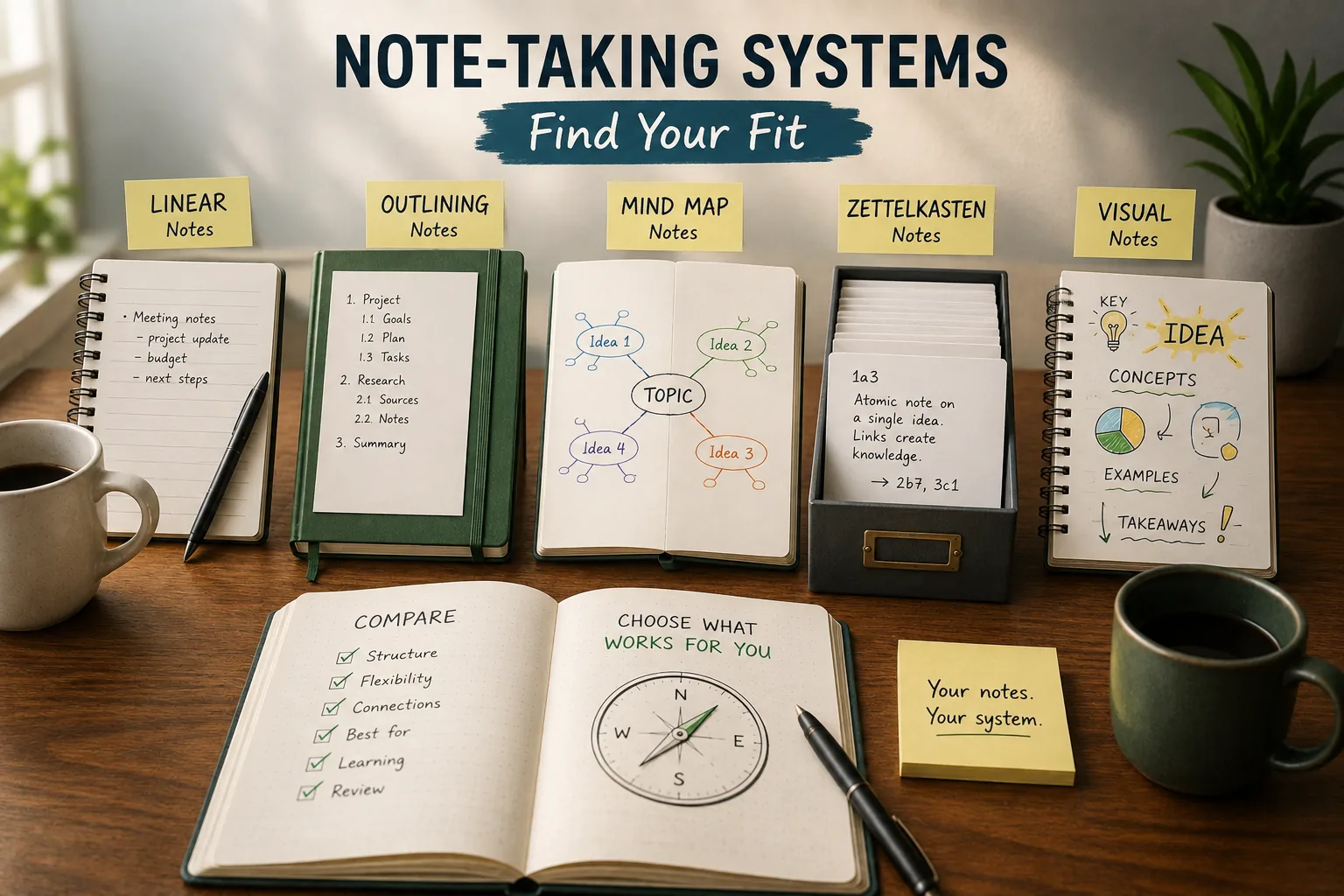
A comparative overview of note-taking systems shows that each solves a different retrieval problem. Zettelkasten emphasizes linked, atomic ideas; PARA organizes information by actionability; Cornell supports structured study; chronological notes reduce capture friction; and folders provide hierarchy. A system succeeds when it supports finding, reviewing, synthesizing, and using notes, rather than merely accumulating an elaborate archive.
What Is a Note-Taking System?
A note-taking system is a structured, intentional approach to capturing, organizing, and retrieving information consistently over time, as opposed to ad-hoc note-taking that records information without a governing logic for how it will be stored or found later.
What distinguishes a system from a collection of notes is the retrieval mechanism: a system answers the question "how will I find this when I need it?" before the note is ever created.
The major systems in use today - Zettelkasten, PARA, Cornell, chronological daily notes, and hierarchical folder structures - differ primarily in what they optimize for: Zettelkasten for emergent connections between ideas, PARA for actionability across active projects, Cornell for structured study and review, and chronological capture for low-friction daily recording.
Introduction: The Note-Taking Paradox
Meet Alex and Jordan. Both take extensive notes. Radically different outcomes.
Alex's note-taking:
- Takes detailed notes in every meeting
- Highlights extensively while reading
- Clips web articles to Evernote
- Has thousands of notes accumulated over 5 years
- Rarely references any of them
- Result: Graveyard of unused information
Jordan's note-taking:
- Selective about what to capture
- Writes synthesis, not transcripts
- Regularly reviews and connects notes
- Has a few hundred well-organized notes
- Frequently references and builds on them
- Result: Living knowledge system
Same activity. Opposite value.
The note-taking problem:
Everyone takes notes. Few get value from them.
Common patterns:
- Beautiful, elaborate systems that get abandoned
- Notes captured but never reviewed
- Perfect organization preventing actual capture
- Switching systems frequently, losing information
- Confusion about which system to use
"Your mind is for having ideas, not holding them." - David Allen
This article compares:
- Major note-taking systems (Zettelkasten, PARA, Cornell, Johnny Decimal, chronological)
- Digital vs. analog methods
- Organization strategies that actually work
- How to choose and implement a system
- Common mistakes and how to avoid them
| System | Core Principle | Best For | Key Limitation |
|---|---|---|---|
| Zettelkasten | Atomic, interconnected notes with bidirectional links | Researchers, writers, long-term knowledge building | High overhead; requires significant maintenance discipline |
| PARA (Projects, Areas, Resources, Archives) | Organize by actionability, not by topic | Professionals managing multiple active projects | Does not foster emergent connections between notes |
| Cornell | Cue-note-summary structure for each page | Students; structured study and review | Designed for linear note pages, not digital retrieval |
| Chronological (daily notes) | Capture everything by date; review later | Journaling; capturing without deciding structure upfront | Discovery requires date-based search; poor for retrieval |
| Analog (paper notebooks) | Physical capture for retention and focus | Meetings; ideation; sketch-based thinking | Not searchable; no integration with digital workflow |
Part 1: The Major Note-Taking Systems
1. Zettelkasten (Slip Box Method)
Origin: Developed by German sociologist Niklas Luhmann, who published 70 books and 400 articles using this method.[6]
Core concept: Build interconnected knowledge through atomic, linked notes.
How it works:
1. Atomic notes
- Each note contains one idea
- Should be understandable in isolation
- Typically 100-300 words
2. Unique identifiers
- Each note gets permanent ID (e.g., 202601151435)
- ID never changes even if content updates
- Enables permanent linking
3. Explicit links
- Notes link to related notes
- Links explain the relationship
- Creates knowledge graph, not hierarchy
4. Progressive emergence
- Structure emerges from connections
- No predetermined categories
- Patterns reveal themselves over time
Example Zettelkasten note:
# 202601151435 - Deliberate Practice Requires Feedback

Deliberate practice (202601141220) is ineffective without
feedback loops.
Practice reinforces both correct and
incorrect patterns-without feedback, you may be
practicing mistakes.

Related concepts:
- Feedback loops in learning [[202601131015]]
- Expert-novice differences [[202601121430]]
- Mindless vs mindful repetition [[202601101145]]

Source: Ericsson, Peak (2016), Chapter 4
When Zettelkasten works best:
- Long-term knowledge building (researchers, writers, academics)
- Synthesizing ideas across domains (connecting disparate concepts)
- Deep thinking and theory building (philosophy, research)
- Writing books or long-form content (notes become source material)
When it doesn't work:
- Project management (not designed for tasks and deadlines)
- Quick reference (requires understanding connection structure)
- Simple capture (overhead of linking and atomicity)
Strengths:
- Reveals non-obvious connections
- Knowledge compounds over time
- Flexible, no rigid structure
- Supports creative thinking
Weaknesses:
- High initial friction (discipline required)
- Takes time to see value (months, not days)
- Not intuitive for most people
- Requires consistent practice
2. PARA Method (Projects, Areas, Resources, Archives)
Creator: Tiago Forte (Building a Second Brain)[2]
Core concept: Organize information by actionability, not topic.
The four categories:
Projects: Active work with deadlines
- Has clear end goal
- Time-bound (usually completing in next few months)
- Examples: "Q1 Marketing Campaign," "Website Redesign," "Conference Talk Prep"
Areas: Ongoing responsibilities without end dates
- Require maintenance over time
- No completion point
- Examples: "Health," "Finances," "Professional Development," "Team Management"
Resources: Topics of interest for future reference
- Not currently active
- May be useful someday
- Examples: "Marketing Ideas," "Design Inspiration," "Leadership Articles"
Archives: Inactive items from other three categories
- Completed projects
- Areas no longer responsible for
- Resources no longer interested in
PARA note structure:
Projects/
  ├── Q1-Marketing-Campaign/
  ├── Website-Redesign/
  └── Conference-Talk-Prep/

Areas/
  ├── Health/
  ├── Professional-Development/
  └── Team-Management/

Resources/
  ├── Marketing-Ideas/
  ├── Design-Inspiration/
  └── Leadership-Articles/

Archives/
  └── 2025-Projects/
When PARA works best:
- Knowledge workers juggling multiple projects
- Need quick retrieval (find relevant info fast)
- Action-oriented work (getting things done over pure thinking)
- Clear projects and responsibilities
When it doesn't work:
- Pure research or learning (no clear projects)
- Long-term knowledge building (optimized for current action, not future synthesis)
- Highly interconnected knowledge (hierarchical, not networked)
Strengths:
- Clear, actionable organization
- Easy to understand and implement
- Reduces "where should this go?" friction
- Aligns notes with actual work
Weaknesses:
- Rigid categories (some notes fit multiple places)
- Doesn't encourage connections between notes
- Optimized for short-term retrieval, not long-term knowledge
3. Cornell Method
Origin: Developed at Cornell University in the 1950s for student note-taking.[4]
Core concept: Structured page layout for active learning and review.
The layout:
┌─────────────────────────────────────────┐
│  Cornell Notes - Lecture Title - Date   │
├─────────────┬───────────────────────────┤
│             │                           │
│   Cues      │   Notes                   │
│  (Questions │   (Main content from      │
│   and       │    lecture or reading)    │
│   Keywords) │                           │
│             │                           │
│             │                           │
├─────────────┴───────────────────────────┤
│  Summary                                │
│  (Main points in 2-3 sentences)         │
└─────────────────────────────────────────┘
How to use:
1. During lecture/reading:
- Take notes in main "Notes" section (right side, largest area)
- Capture key concepts, facts, examples
- Don't try to transcribe everything
2. After lecture/reading:
- Add "Cues" (left column): Questions that notes answer, keywords to trigger memory
- Write "Summary" (bottom): Main points in your own words
3. For review:
- Cover notes section
- Use cues to test recall
- Check notes to verify
Example:
Cues:                    Notes:
─────────────────────   ─────────────────────────────
What is spaced           Spaced repetition: reviewing
repetition?              information at increasing
                         intervals. More effective than
Why does it work?
massed practice (cramming).

                         Works by: forcing retrieval
When to review?           strengthens memory.
Spacing
                         allows forgetting, making
                         retrieval effortful (desirable
                         difficulty).

                         Optimal intervals: 1 day, 3 days,
                         1 week, 2 weeks, 1 month, 3 months
                         (exponentially increasing).

─────────────────────────────────────────────────────
Summary: Spaced repetition improves retention by
reviewing at increasing intervals.
Effortful retrieval
strengthens memory more than easy repetition.
When Cornell works best:
- Students taking lecture notes
- Learning new material that requires memorization
- Studying for exams
- Reading textbooks or educational content
When it doesn't work:
- Brainstorming or creative ideation
- Project management
- Long-term knowledge building (not designed for synthesis)
Strengths:
- Structured approach reduces cognitive load
- Built-in review mechanism
- Promotes active learning (cues and summary)
- Simple to implement
Weaknesses:
- Rigid format (not flexible for all content types)
- Time-consuming (requires review and cue/summary creation)
- Better for linear learning than interconnected knowledge
4. Johnny Decimal System
Core concept: Numeric hierarchical organization preventing folder chaos.
Structure:
Level 1: 10 main categories (10-19, 20-29, ..., 90-99)
Level 2: 10 subcategories within each (11, 12, 13, ..., 19)
Level 3: Items within subcategories (11.01, 11.02, ..., 11.10)
Example:
10-19: Personal
  11: Finance
    11.01: Budget 2026
    11.02: Tax documents
    11.03: Investment portfolio
  12: Health
    12.01: Medical records
    12.02: Fitness tracking

20-29: Work
  21: Active projects
    21.01: Project Alpha
    21.02: Project Beta
  22: Team management
    22.01: 1-on-1 notes
    22.02: Team goals

30-39: Learning
  31: Technical skills
    31.01: Python learning
    31.02: AWS certification
  32: Professional development
    32.01: Leadership courses
Rules:
- Only 10 categories (forces focused organization)
- Only 10 subcategories per category
- Decimal items clearly belong to subcategory
- No ambiguity about where things go
When Johnny Decimal works best:
- People who think hierarchically
- Clear, distinct categories
- Need consistent organization across devices
- Managing files and documents
When it doesn't work:
- Items fitting multiple categories
- Highly interconnected knowledge (hierarchy limits)
- Rapidly changing organization needs
Strengths:
- No folder chaos (strict limits)
- Unambiguous location (clear numbering)
- Works across any system (files, notes, bookmarks)
- Fast navigation (know exactly where to look)
Weaknesses:
- Rigid structure (must fit into hierarchy)
- Limit of 10 can be constraining
- Requires upfront planning
- Changes are disruptive (renumbering)
5. Chronological/Daily Notes
Core concept: Notes organized primarily by date, with minimal additional structure.
How it works:
Daily notes:
- One note per day (e.g., "2026-01-15")
- Everything from that day goes there
- Simple, friction-free capture
Linking and tagging:
- Link to people, projects, or concepts
- Tags for categories
- Search as primary retrieval
Example structure:
# 2026-01-15

## Meeting with Sarah - Product Roadmap
- Discussed Q2 priorities
- Decision: Focus on [[Feature X]] over [[Feature Y]]
- Action: Draft requirements by Friday
- #product #meetings

## Reading: Atomic Habits
- Key insight: Environment design > willpower
- Link to [[Habit Formation]] note
- #learning #books

## Idea: Content series on [[Career Capital]]
- Break down into 5 articles
- Start with fundamentals
- #ideas #writing
When chronological works best:
- Daily journaling and reflection
- Capture without overthinking
- Meeting notes and day-to-day work
- People who resist complex systems
When it doesn't work:
- Need hierarchical organization
- Long-form, structured knowledge
- Strict project management
Strengths:
- Minimal friction (just capture)
- Temporal context automatic
- Simple to understand
- Search handles retrieval
Weaknesses:
- Can become scattered
- Requires good search and tagging
- No inherent structure (can feel chaotic)
- Information spread across many daily notes
Part 2: Digital vs. Analog Note-Taking
Digital Note-Taking
Popular tools:
- Notion: Database-powered, highly flexible
- Obsidian: Markdown-based, local files, linking focus
- Roam Research: Outliner, bidirectional links
- Evernote: Traditional note-taking, web clipping
- Apple Notes: Simple, integrated with Apple ecosystem
- OneNote: Freeform canvas, Microsoft integration
Digital advantages:
1. Search and retrieval
- Find anything instantly
- Full-text search across all notes
- Critical for large collections (1000+ notes)
2. Unlimited capacity
- Never run out of space
- Store images, PDFs, links
- No physical constraints
3. Linking and connections
- Link related notes
- Backlinks show what references this note
- Build knowledge graphs
4. Sync and access
- Access from any device
- Never forget notebook at home
- Backup automatic
5. Reorganization
- Move notes without rewriting
- Change structure easily
- No commitment to initial organization
6. Collaboration
- Share notes with others
- Real-time collaboration
- Comments and feedback
Digital disadvantages:
1. Distraction
- Other apps and notifications
- Internet rabbit holes
- Multitasking temptation
2. Tool complexity
- Learning curve
- Feature overwhelm
- Decision fatigue (which tool?)
3. Platform lock-in
- Data trapped in proprietary formats
- Risk of tool shutdown or changes
- Migration pain
4. Typing vs. handwriting
- Potentially less retention
- Harder to sketch diagrams
- Less kinesthetic engagement
5. Analysis paralysis
- Tool choice paralysis
- Setup time before using
- Temptation to perfect system
Analog Note-Taking
Common methods:
- Traditional notebooks
- Index cards (Zettelkasten style)
- Bullet journals
- Field notes / pocket notebooks
Analog advantages:
1. Friction-free capture
- Grab notebook and write
- No app to open or organize
- Immediate start
2. Spatial memory
- Remember location on page
- Physical browsing
- "That idea was top-right of the page with coffee stain"
3. Zero distraction
- No notifications
- No internet
- Complete focus
4. Handwriting benefits
- Better retention (research-backed)
- Kinesthetic learning
- Sketching and diagrams natural
5. No platform risk
- Never obsolete
- Never shut down
- Total control
Analog disadvantages:
1. No search
- Finding old notes requires memory or index
- Painful with large collections
- Information effectively lost if forgotten
2. No backup
- Loss is permanent
- Fire, water, theft = gone
- Single point of failure
3. Limited capacity
- Notebooks fill up
- Multiple notebooks hard to manage
- Physical storage required
4. Location-bound
- Can't access remotely
- Must carry physically
- Left at home = inaccessible
5. Hard to reorganize
- Stuck with chronological order
- Can't move notes
- Integration across notebooks difficult
6. No sharing
- Can't easily collaborate
- Photos/scans required to share
- Handwriting may be illegible to others
The Hybrid Approach
Many knowledge workers use both:
Analog for:
- Initial capture and brainstorming (meetings, ideation)
- Creative thinking (drawing, mindmapping)
- Learning and studying (better retention)
- Journaling and reflection
Digital for:
- Permanent storage (transfer important analog notes)
- Reference material (need search)
- Project notes (need to update and share)
- Long-term knowledge building (linking and synthesis)
Workflow example:
- Meeting: Take notes in notebook (fast, no device barrier)
- Review: Same day, transfer key points to digital system
- Process: Add links, context, and tasks
- Discard: Analog notes (already processed)
Benefits of hybrid:
- Best of both worlds
- Analog for capture, digital for organization
- Flexibility by context
Downside:
- Additional processing step
- Information in two places temporarily
- Not fully integrated
Part 3: Organization Strategies That Actually Work
The Linking Approach (Network Structure)
Principle: Organize through connections, not categories.
Implementation:
1. Unique IDs for each note
- Timestamp-based (202601151435)
- Or descriptive slugs (deliberate-practice-feedback)
2. Explicit links between related notes
This concept relates to [[spaced-repetition]]
and [[deliberate-practice]].
3. Backlinks showing what references this note
- Automatic in tools like Obsidian, Roam
- Manual index in analog systems
4. Tags for broad themes
- #learning #productivity #psychology
- Cross-cutting categories
When linking works:
- Long-term knowledge building
- Interconnected concepts
- Creative thinking and synthesis
When it doesn't:
- Need clear hierarchy
- Action-oriented work (projects and tasks)
- Simple reference material
The Hierarchical Approach (Folder Structure)
Principle: Organize by category and subcategory.
Implementation:
1. Clear top-level categories
- Projects, Areas, Resources (PARA)
- Or: Work, Personal, Learning
- Or: By major life domains
2. Subcategories within each
- Projects → Individual projects
- Areas → Specific responsibilities
- Resources → Topic areas
3. Tags as secondary organization
- Cross-cutting themes
- Multiple perspectives
Example:
Work/
  ├── Active-Projects/
  ├── Team-Management/
  └── Professional-Development/

Personal/
  ├── Health/
  ├── Finances/
  └── Relationships/

Learning/
  ├── Technical-Skills/
  └── Books-Read/
When hierarchy works:
- Clear categories
- Action-oriented work
- Need to browse and navigate
- Most people's default mental model
When it doesn't:
- Notes fitting multiple categories
- Highly interconnected knowledge
- Rapid changes requiring reorganization
The Hybrid Approach (Folders + Links + Tags)
Principle: Use hierarchy for broad organization, links for connections, tags for themes.
Implementation:
1. Broad folder structure
- Projects, Areas, Resources (prevents note explosion)
- Or: Work, Personal, Learning
2. Links within and across folders
- Connect related notes
- Create knowledge pathways
3. Tags for cross-cutting themes
- #important, #idea, #follow-up
- Complement folders and links
4. Search as ultimate fallback
- Good naming and content enable search
- When hierarchy and links fail
Example:
Note location: Projects/Website-Redesign/Design-Research.md

Content:
# Design Research for Website Redesign

Research on design trends and user preferences.

Related: [[User-Research-Methods]] [[Design-Systems]]
Tags: #design #research #website-project
This combines:
- Clear location (folder hierarchy)
- Conceptual connections (links)
- Thematic grouping (tags)
- Discoverability (search)
Retrieval Cues: Making Notes Findable
The problem: Perfect organization is useless if you can't find notes.
Retrieval strategies:
1. Descriptive titles
Bad: "Meeting notes" (which meeting?)
Good: "Product Roadmap Meeting with Sarah - 2026-01-15"
2. Context in first paragraph
- Why does this note exist?
- What problem does it address?
- When/where was it created?
3. Dates and people
- Date created/updated
- People involved or mentioned
- Project or area it belongs to
4. Keywords for search
- What terms would you search?
- Include them in the note
- Think like future you
Question to ask: "What will I search for when I need this information?"
Progressive Summarization
Concept: Create layers of highlight so you can quickly scan notes.
Process:
Layer 1: Capture
- Everything verbatim
- Complete information
Layer 2: Bold key points
- Highlight important sentences
- 10-20% of content
Layer 3: Highlight critical insights
- Highlight within bold
- 2-3% of content
Layer 4: Summary at top
- Main points in 1-3 sentences
- Executive summary
Example:
# Article: Deep Work by Cal Newport

**Summary:** Deep work (focused, undistracted work) is increasingly
rare and valuable.
Build deep work practice through: blocking time,
eliminating distraction, and training attention.

## Notes

In today's economy, **deep work-the ability to focus without
distraction-is both rare and valuable**.
Most knowledge workers
operate in state of semi-distraction.

Three types of deep work schedules:
- Monastic: Eliminate all shallow work (Knuth, no email)
- Bimodal: Dedicate clear periods to deep work (professors)
- **Rhythmic: Deep work same time daily (most practical for most people)**

The key is **training attention like a muscle**.
Can't expect to focus
deeply if you spend rest of day in distraction. Avoid context switching.
Benefit: Quick scan reveals most important information without rereading everything.
Part 4: Common Mistakes and How to Avoid Them
Mistake 1: Premature Optimization
The trap: Spending weeks designing perfect system before having notes to organize.
Why it fails:
- Don't know what organization you need yet
- Theoretical perfect does not equal practical useful
- Time spent organizing > time capturing
Better approach:
- Start with simple capture (chronological or basic folders)
- Accumulate 50-100 notes
- Notice where friction occurs
- Add organization to solve actual problems
- Evolve system based on usage
Principle: Let system emerge from use, don't design elaborate system prematurely.
Mistake 2: Copying Someone Else's System
The trap: Importing popular YouTuber's elaborate Notion setup or rigid Zettelkasten implementation.
Why it fails:
- Their system evolved for their specific needs
- Their work type does not equal your work type
- Their thinking style does not equal your thinking style
- Complexity without understanding
Example:
- Researcher's Zettelkasten (building theory over decades) does not equal Product manager's needs (juggling projects with deadlines)
Better approach:
- Understand principles of system
- Adapt to your context
- Start minimal (10% of their complexity)
- Add features only when you feel friction
- Make it yours
Principle: Learn from others but customize to your actual needs.
Mistake 3: Write-Only Notes (Never Reviewing)
The trap: Capturing everything but never reviewing or using notes.
Symptoms:
- 5,000 highlights from books never referenced
- Meeting notes from 2 years ago untouched
- Beautiful notes never looked at again
Why it fails:
- Capture without processing does not equal learning or knowledge
- Accumulation without use provides no value
- Graveyard of unused information
Better approach:
- Reduce capture to information you'll actually use
- Review notes regularly (weekly, monthly)
- Create outputs from notes (writing, decisions, projects)
- Delete notes proven unnecessary after 6-12 months
Principle: Notes should be used, not just collected. If not reviewing, either reduce capture or improve retrieval.[8]
Mistake 4: Mixing Different Note Types
The trap: Active tasks mixed with reference information mixed with personal reflections.
Example chaotic note:
# Random Monday Note
- Remember to call dentist (task)
- Meeting with boss: discussed project timeline (meeting note)
- Idea for blog post on productivity (idea)
- Quote from book: "Focus is rare and valuable" (reference)
- Feeling stressed about deadline (journal)
- Budget numbers for Q1 (data)
Why it fails:
- Hard to find anything
- Different note types need different organization
- Signal drowned in noise
Better approach:
Separate by type:
- Tasks: In task management system (Todoist, Things)
- Meeting notes: In meetings folder or project
- Ideas: In ideas folder for future development
- Reference: In reference system (with links)
- Journal: In daily notes or journal
- Data: In appropriate project or area
Principle: Different note types have different lifecycles and uses. Don't mix them.
Mistake 5: System Hopping
The trap: Switching note tools frequently (Evernote → OneNote → Notion → Roam → Obsidian).
Why it fails:
- Time wasted migrating and rebuilding
- Notes fragmented across platforms
- Information lost in transitions
- Never become proficient with any tool
Better approach:
- Choose "good enough" tool
- Commit for 1-2 years minimum
- Focus on content, not container
- Make notes portable (Markdown, plain text)
- Switch only when clear, significant limitations
Principle: Any decent tool is better than constantly switching. Mastery of simple system beats perpetual beginner in complex systems.
Mistake 6: Perfectionism Preventing Capture
The trap: Waiting for perfect organization before creating notes.
Symptoms:
- "I need to set up my system first"
- "Not sure where this goes, I'll file it later" (never does)
- "My notes aren't pretty enough"
Why it fails:
- Perfect is enemy of good
- Information lost waiting for perfect system
- Capture is more important than organization
Better approach:
- Capture imperfectly > not capturing at all
- Accept "messy" notes initially
- Refine during review, not during capture
- Good enough organization that enables capture
Principle: Imperfect notes you actually take beat perfect system you never use.
Part 5: Choosing and Implementing Your System
The Decision Framework
Consider:
1. What's your primary use case?
- Long-term knowledge building → Zettelkasten or linked notes
- Active project management → PARA or hierarchical folders
- Learning and studying → Cornell Method or structured notes
- Daily capture and reflection → Chronological/daily notes
2. What's your thinking style?
- Associative thinker (connections between ideas) → Linking approach
- Hierarchical thinker (categories and structure) → Folder-based
- Flexible/experimental → Hybrid approach
3. What's your volume?
- Heavy note-taker (100+ notes/month) → Need robust organization and search
- Light note-taker (10-20 notes/month) → Simple system sufficient
4. What's your technical comfort?
- Tech-savvy → Can handle tools like Obsidian, Roam
- Prefer simple → Apple Notes, Notion, or analog
5. What's your work type?
- Researcher, writer, academic → Zettelkasten
- Knowledge worker, PM → PARA
- Student → Cornell or structured notes
- Creative, reflective → Daily notes or journal
Implementation: Start Simple
Phase 1: Capture (Week 1-4)
- Choose one tool (doesn't have to be perfect)
- Start with chronological or basic folders
- Focus on capturing, not organizing
- Use consistent date format and titles
Phase 2: Review (Week 5-8)
- Weekly review of recent notes
- Notice patterns in what you capture
- Identify friction points
- Add basic organization (1-3 main folders)
Phase 3: Structure (Week 9-12)
- Implement lightweight system based on actual usage
- Add links, tags, or hierarchy as needed
- Create review habit (weekly, monthly)
Phase 4: Evolve (Month 4+)
- Refine based on what works
- Add complexity only when simple approach creates friction
- Develop personal style
Principle: Start minimal, let system grow organically, add structure as needs become clear.
"Simplicity is the ultimate sophistication." - Leonardo da Vinci
Conclusion: The Note-Taking System That Works is the One You'll Actually Use
Remember Alex and Jordan from the introduction?
Alex took thousands of unused notes. Elaborate system. No value.
Jordan took hundreds of connected, reviewed notes. Simple system. High value.
The difference wasn't the system-it was the practice.
Key principles:
1. Capture selectively
- Not everything needs to be noted
- Capture what you'll actually use
- Quality over quantity
2. Review regularly
- Notes without review = unused information
- Weekly review minimum
- Create outputs from notes
3. Start simple
- Basic system beats elaborate unfinished system
- Add complexity only when needed
- Let structure emerge from usage
4. Make it yours
- Copy principles, not exact systems
- Adapt to your work and thinking
- Evolve based on actual needs
5. Focus on content, not container
- Good notes in simple system > perfect empty system
- Tool matters less than consistent practice
- Don't let tool choice prevent starting
Choosing your system:
If you're a researcher, writer, or deep thinker: Start with Zettelkasten (linked, atomic notes)
If you're a knowledge worker juggling projects: Start with PARA (organize by actionability)
If you're a student or learning new material: Start with Cornell Method (structured review)
If you prefer simplicity: Start with daily/chronological notes
If you're not sure: Start with chronological notes + basic folders. Evolve from there.
The best note-taking system is the one you'll actually use consistently.
Stop optimizing. Start capturing. Review regularly. Let your system evolve.
Your knowledge is only as valuable as your ability to access and use it.
Build a system that serves that goal-not a system that becomes the goal itself.
What Research Says About Handwriting, Retention, and Method Selection
The empirical case for note-taking format choices is more nuanced than popular productivity writing suggests.
Pam Mueller and Daniel Oppenheimer's widely cited 2014 study in Psychological Science, "The Pen Is Mightier Than the Keyboard," found that students who took notes by hand on lectures showed better conceptual understanding on delayed tests than students who typed.[3]
The mechanism was not the physical act of handwriting itself but the processing constraint it imposed: because handwriting is slower, note-takers could not transcribe verbatim and were forced to listen, synthesize, and record only what they understood well enough to compress.
Laptop note-takers, able to type at near-speech speed, tended toward transcription rather than synthesis - capturing words without necessarily encoding meaning.
However, a 2019 replication and extension by Morehead, Dunlosky, and Rawson (Educational Psychology Review) complicated the finding: the original conceptual-question advantage for longhand did not reliably replicate once additional note-taking conditions were tested. This is useful information for choosing note-taking systems: the question is less about which medium is inherently betterand more about whether a given medium pushes you toward synthesizing information rather than transcribing it verbatim.
For most people in most contexts, handwriting imposes the synthesis constraint automatically; typed note-taking requires it to be deliberately imposed.
Niklas Luhmann's Zettelkasten output is frequently cited as evidence that the method enables extraordinary intellectual productivity. He wrote 70 books and over 400 scholarly papers across a 40-year career using a physical card file containing approximately 90,000 notes.
What is less often discussed is the specific mechanism he described: the value was not in any individual note but in the note-making process itself.
Writing a note required him to articulate a single idea clearly and precisely, and to find its connection to existing notes - a process that externalized the intellectual work of theoretical development and allowed him to see the structure of his thinking rather than just hold it internally.
Productivity researchers Snke Ahrens, who analyzed Luhmann's methods in How to Take Smart Notes (2017), emphasizes that Luhmann's output was enabled by the note-making process, not just note retrieval.[1] The system worked because making notes was thinking, not recording thinking.
The Organizational Dimension: When Note Systems Need to Scale
Individual note-taking systems work well until knowledge needs to flow between people.
The failure mode is predictable: what works as a personal cognitive system - idiosyncratic organization, personal notation conventions, associative linking that maps to the individual's own mental model - becomes opaque and inaccessible when others need to use it.
Google's internal engineering documentation culture provides a studied example of this transition. Google maintains a system called g3doc, integrated directly into its code repository, that requires engineers to document systems adjacent to the code implementing them.
Unlike wiki-based documentation that sits in a separate system, g3doc documentation is updated in the same commit as code changes, making it structurally harder to let documentation lag behind implementation.
Google engineering-productivity research (Murphy-Hill et al., published in IEEE Transactions on Software Engineering, 2019) on what predicts developer productivity has found that factors like peer support, clear feedback, and low friction in daily workflows matter more than any single tool choice - consistent with the idea that documentation integrated into the existing workflow gets maintained, while documentation that requires a separate step tends to go stale.
The note system worked not because of its organizational structure but because of its integration with the workflow that generated and used the knowledge.
Notion, used by companies including Figma, Pitch, and Loom as their primary knowledge infrastructure, is built around the same underlying problem: organizational wikis tend to go stale when note creation and note maintenance are treated as separate workflows handled by different people with different incentives.
The organizations that maintain high documentation quality share a structural feature: they close the loop between the person with the knowledge and the maintenance of the document representing that knowledge.
This argues for note systems that minimize the distance between doing the work and documenting it - the more steps between working and noting, the larger the maintenance gap becomes.
Sources & Further Reading
Ahrens, S. "How to Take Smart Notes: One Simple Technique to Boost Writing, Learning and Thinking." CreateSpace, 2017.
Forte, T. "Building a Second Brain: A Proven Method to Organize Your Digital Life and Unlock Your Creative Potential." Atria Books, 2022.
Mueller, P. A., & Oppenheimer, D. M. "The Pen Is Mightier Than the Keyboard: Advantages of Longhand Over Laptop Note Taking." Psychological Science, 25(6), 1159-1168, 2014.
Pauk, W., & Owens, R. J. Q. "How to Study in College." Cengage Learning, 2013.
Karpicke, J. D., & Roediger, H. L. "The Critical Importance of Retrieval for Learning." Science, 319(5865), 966-968, 2008.
Luhmann, N. "Communicating with Slip Boxes." In A. Kieserling (Ed.), Universitat als Milieu. Haux, 1992.
Dunlosky, J., Rawson, K. A., Marsh, E. J., Nathan, M. J., & Willingham, D. T. "Improving Students' Learning With Effective Learning Techniques." Psychological Science in the Public Interest, 14(1), 4-58, 2013.
Brown, P. C., Roediger, H. L., & McDaniel, M. A. "Make It Stick: The Science of Successful Learning." Harvard University Press, 2014.
Further Reading
Talarico, J. M., LaBar, K. S., & Rubin, D. C. "Emotional Intensity Predicts Autobiographical Memory Experience." Memory & Cognition, 32(7), 1118-1132, 2004.
Newport, C. "Deep Work: Rules for Focused Success in a Distracted World." Grand Central Publishing, 2016.