
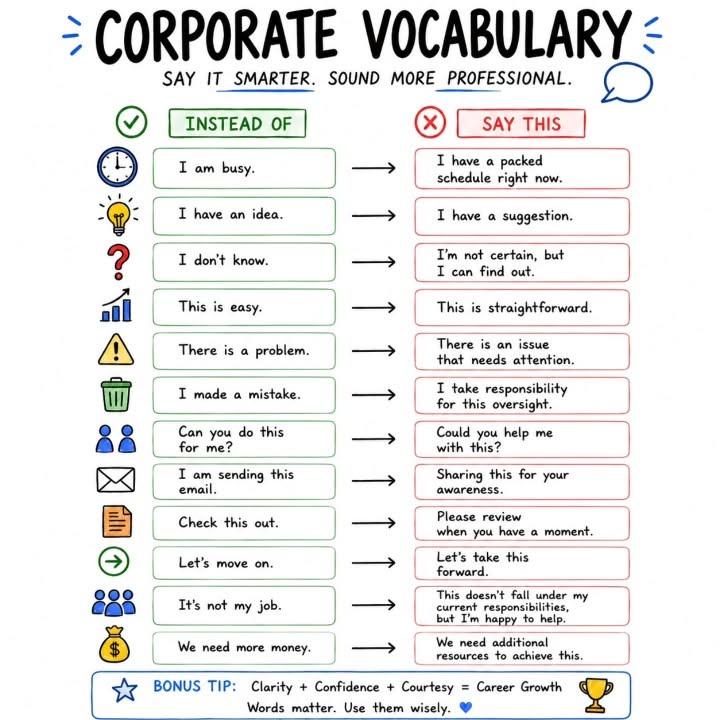
Euphemistic language can make decisions that affect real people sound passive, abstract, and unavoidable. Corporate speak analyzed this way is not merely jargon: it can obscure who acted, who was harmed, and what responsibility the organisation is trying to describe.
In November 2022, Mark Zuckerberg announced that Meta would lay off approximately 11,000 employees-13% of the company's workforce. The announcement, posted on Meta's website, contained this passage: "I want to take accountability for these decisions and for how we got here.
I know this is tough for everyone, and I'm especially sorry to those impacted."
The phrase "those impacted" is a masterpiece of corporate speak. It transforms the act of firing 11,000 people-each with a name, a family, a mortgage, a career built at the company-into a passive, impersonal event that simply happened to them.
Nobody fired them; they were "impacted." The word "impacted" suggests a natural phenomenon, like a meteor strike, rather than a deliberate decision by a specific person. Zuckerberg expresses sorrow but not responsibility.
He "takes accountability" (a phrase so overused in corporate contexts as to be meaningless) while using language designed to minimize the emotional reality of what he is describing.
This is corporate speak at its most characteristic: language that sounds professional, measured, and appropriate while systematically distancing the speaker from the uncomfortable reality of what they are saying. Corporate speak is not merely an aesthetic annoyance or a source of office humor.
It is a linguistic system that shapes how organizations think, communicate, and make decisions. It obscures difficult truths, signals group membership, distributes and avoids accountability, and creates a persistent gap between what organizations say and what they mean.
What Is Corporate Speak?
Corporate speak is the specialized vocabulary, phrasing, and communication style used in professional business contexts, also called business jargon, corporatese, or management-speak. It spans technical jargon, euphemisms, filler phrases, status-signaling buzzwords, and abstraction that converts concrete actions into vague concepts. Not all of it is harmful, but much of it works to soften bad news, signal group membership, or create plausible deniability.
Defining the Language
Corporate speak (also called business jargon, corporatese, or management-speak) is the specialized vocabulary, phrasing, and communication style used in professional business contexts. It encompasses several overlapping categories:
Technical jargon: Specialized terms that describe specific business concepts with precision. "Burn rate" (the rate at which a company spends cash), "run rate" (annualized revenue based on current performance), and "churn" (customer attrition rate) are examples.
These terms serve a legitimate function: they enable efficient, precise communication among people who share the relevant knowledge.
Euphemisms: Indirect expressions that soften unpleasant realities. "Right-sizing" (laying off employees), "sunset" (discontinuing a product), "transition" (being fired), and "headcount reduction" (also firing people) replace direct language with terms that obscure what is actually happening.
Filler phrases: Expressions that sound substantive but communicate little or nothing.
"Let's circle back on that," "we need to move the needle," "let's take this offline," and "I want to socialize this idea" are used so reflexively that speakers and listeners may not notice they convey no specific meaning.
Status signaling: Language used to demonstrate membership in a professional community, signal seniority or expertise, or claim authority. Using current buzzwords (synergy, alignment, disrupt, leverage, ecosystem, north star, value proposition) signals that the speaker is current, sophisticated, and professionally engaged.
Abstraction and nominalization: The conversion of concrete actions into abstract concepts.
"We need to action this" (instead of "we need to do this"), "the decision-making process" (instead of "how we decide"), "the onboarding experience" (instead of "how we train new employees").
These abstractions remove human agency from descriptions of organizational activity.
"Good prose is like a windowpane." - George Orwell
The Linguistic Features
Corporate speak has identifiable linguistic characteristics that distinguish it from plain language:
| Feature | Corporate Speak | Plain Language |
|---|---|---|
| Voice | Passive ("Mistakes were made") | Active ("We made mistakes") |
| Agency | Absent ("The decision was reached") | Present ("The committee decided") |
| Specificity | Vague ("We're exploring opportunities") | Concrete ("We're considering entering the UK market") |
| Emotional tone | Neutral/euphemistic ("Those impacted") | Direct ("The people we're firing") |
| Length | Verbose ("At this point in time") | Concise ("Now") |
| Complexity | Complex ("Leverage core competencies to drive synergistic value creation") | Simple ("Use our strengths to create something worth more together") |
Why Does Corporate Speak Exist?
Corporate speak exists because it serves several purposes at once: it softens messages that would be painful or damaging if stated directly, it signals membership in a professional community through shared vocabulary, and it creates plausible deniability by staying vague enough that any outcome remains consistent with what was said. These functions make it resistant to elimination even when it obscures meaning.
Softening Difficult Messages
The most significant function of corporate speak is softening messages that would be painful, controversial, or damaging if stated directly.
Consider the difference between:
- "We're firing 11,000 people because we hired too many and our revenue predictions were wrong" (direct)
- "We are right-sizing our organization to better align our resources with our strategic priorities in the current macroeconomic environment" (corporate speak)
The direct version acknowledges human suffering, assigns responsibility (we hired too many, our predictions were wrong), and implies management failure.
The corporate speak version transforms a human event into a strategic abstraction, replaces "firing" with "right-sizing," and attributes the cause to external forces ("current macroeconomic environment") rather than internal decisions.
This softening serves several purposes:
- Legal protection: Carefully worded communications reduce the risk of lawsuits. Direct statements about management failures could become evidence in wrongful termination or shareholder suits.
- Emotional management: Leaders delivering bad news may find it psychologically easier to use euphemistic language. Saying "we're right-sizing" is less emotionally taxing than saying "we're firing thousands of people."
- Audience management: Corporate communications must address multiple audiences simultaneously-employees, investors, media, regulators, customers-each with different information needs and emotional reactions. Corporate speak's vagueness allows the same message to be interpreted differently by different audiences.
"The great enemy of clear language is insincerity. When there is a gap between one's real and one's declared aims, one turns as it were instinctively to long words and exhausted idioms." - George Orwell
Signaling Group Membership
Corporate speak functions as a tribal language that signals membership in professional communities. The way language frames meaning determines not just what is communicated but who is recognized as an insider.
Using the current vocabulary-"leverage," "alignment," "ecosystem," "north star," "value proposition," "disrupt," "at scale"-demonstrates that the speaker is a member of the business community, stays current with professional trends, and shares the values and assumptions of their professional peers.
This signaling function explains why corporate speak evolves: as specific terms become widely known (and mocked), they lose their value as in-group signals and are replaced by new terms.
"Synergy" was a prestigious business term in the 1990s and 2000s; by the 2010s, it had been so widely parodied that using it unironically signaled being out of touch.
It was replaced by newer terms ("alignment," "integration," "force multiplier") that served the same function.
The linguistic evolution follows a pattern similar to fashion: new terms emerge, are adopted by early adopters who want to signal currency, spread to the mainstream, become overused, are mocked, and are replaced by new terms.
The cycle ensures that corporate speak is always evolving, always requiring participants to update their vocabulary, and always functioning as a barrier to those who are not immersed in the professional culture.
Creating Plausible Deniability
Corporate speak provides plausible deniability: the ability to claim that a statement meant something other than what a reasonable listener would understand it to mean.
When a manager says "we're exploring options for the team's future," this could mean anything from "nothing will change" to "everyone will be fired next month." The vagueness is not accidental.
If the manager later fires the team, they can claim to have provided warning ("I said we were exploring options").
If they don't, they can claim to have been describing a benign process. The ambiguity protects the speaker from accountability for specific commitments.
This deniability function is particularly important in environments where commitments are risky:
- Executives who make specific predictions about future performance face liability if those predictions are wrong
- Managers who make specific promises about job security face legal and ethical consequences if those promises are broken
- Politicians and regulators who make specific commitments about policy face accountability if those commitments are not fulfilled
Corporate speak provides a linguistic escape route: by being vague enough that any outcome is consistent with what was said, the speaker avoids the risks of specificity.
"Bullshit is a greater enemy of truth than lies are. The liar knows the truth and chooses to contradict it; the bullshitter simply does not care." - Harry Frankfurt
What Are Common Corporate Euphemisms?
Common corporate euphemisms cluster into a few categories: employment euphemisms like "right-sizing" and "headcount optimization" for layoffs, business decision euphemisms like "sunset" and "pivot," communication euphemisms like "circle back" and "take this offline," and assessment euphemisms like "growth opportunities" for weaknesses and "learnings" for failures. Each replaces a direct term with a softer, vaguer alternative.
The Euphemism Dictionary
Corporate speak has developed an extensive vocabulary of euphemisms that replace direct language with sanitized alternatives. Understanding these patterns is part of learning how discourse and power operate in organizational life.
Employment euphemisms:
- "Right-sizing" / "restructuring" / "reduction in force" = laying off employees
- "Let go" / "separated from the company" / "transitioned out" = fired
- "Pursuing other opportunities" = was fired (when said by the company about a departing employee)
- "Mutual decision" = the company decided
- "Headcount optimization" = firing people to reduce costs
Business decision euphemisms:
- "Sunset" / "end of life" = discontinuing a product or service
- "Pivot" = changing strategy (often because the original strategy failed)
- "Realign" = change direction, often dramatically
- "Streamline" = cut costs, reduce complexity, often by eliminating jobs or services
- "Strategic review" = considering whether to sell, close, or dramatically change a business unit
Communication euphemisms:
- "Let's take this offline" = stop talking about this in this meeting (often because it's contentious or because the speaker wants to control the conversation)
- "Circle back" = discuss later (often never)
- "Touch base" = have a brief conversation (about what is left unspecified)
- "Socialize" = share an idea informally to build support before proposing it formally
- "Unpack" = explain or discuss in more detail (implies the topic is complex)
- "Deep dive" = examine in detail (implies thoroughness without committing to it)
Assessment euphemisms:
- "Growth opportunities" / "areas for development" = weaknesses or failures
- "Challenging" = bad or very difficult
- "Robust" = adequate (or sometimes: exists at all)
- "Best practices" = what other companies do (whether or not it's actually best)
- "Learnings" = lessons from failures (the noun form avoids saying "we failed and learned from it")
Is All Business Jargon Bad?
No, not all business jargon is bad. Terms like "burn rate," "EBITDA," or "product-market fit" offer genuine precision and shared frameworks among people who understand them, saving lengthy explanations. Jargon becomes problematic corporate speak specifically when it obscures rather than clarifies, excludes rather than includes, hides rather than reveals, or aims to impress rather than inform.
Legitimate Uses
Not all specialized business language is harmful. Some corporate vocabulary serves genuine communicative purposes:
Precision: Terms like "burn rate," "EBITDA," "churn rate," "CAC" (customer acquisition cost), and "LTV" (lifetime value) describe specific concepts with precision that would require lengthy explanations in plain language.
Among people who share the relevant knowledge, these terms enable efficient communication.
Shared frameworks: Terms like "product-market fit," "minimum viable product," "jobs to be done," and "competitive moat" describe conceptual frameworks that would be cumbersome to explain from scratch in every conversation.
When all participants understand the framework, the shorthand term is genuinely useful.
Technical necessity: Some business activities are genuinely complex and require specialized vocabulary. Financial accounting, legal compliance, software engineering, and supply chain management all have legitimate technical vocabularies that enable precise communication about complex topics.
The Problem Boundary
The boundary between legitimate jargon and problematic corporate speak is not always clear, but several indicators suggest when language has crossed from useful to harmful. The ability to communicate complex ideas clearly is a genuine skill-and corporate speak often substitutes the performance of expertise for its substance.
- Obscuring rather than clarifying: If the jargon makes the meaning less clear than plain language would, it is corporate speak rather than useful terminology
- Excluding rather than including: If the jargon's primary function is to signal membership and exclude non-members rather than to communicate efficiently, it is corporate speak
- Hiding rather than revealing: If the euphemism exists to avoid saying something directly that should be said directly, it is harmful corporate speak
- Impressing rather than informing: If the language's primary purpose is to make the speaker sound sophisticated rather than to communicate information, it is corporate speak
How Does Corporate Speak Harm Organizations?
Corporate speak harms organizations in three main ways: it causes communication breakdown as messages become unclear or empty of meaningful content while passing through layers of management, it impairs decision-making by making problems like declining revenue harder to identify and discuss urgently, and it produces cultural effects such as inauthenticity, conformity pressure, and erosion of trust between employees and leadership.
Communication Breakdown
The most direct harm of corporate speak is communication failure: messages that are misunderstood, unclear, or empty of meaningful content.
When a CEO tells employees "we need to leverage our core competencies to drive synergistic value creation across our ecosystem," what should employees do differently on Monday morning? The statement contains no specific information: no actions, no priorities, no deadlines, no metrics, no definition of success.
It sounds like strategy but is actually noise. This is precisely the signal vs. noise problem that degrades organizational decision-making over time.
The communication failure compounds in organizations where multiple layers of corporate speak filter information as it moves through the hierarchy:
- The CEO articulates a vague strategic vision using corporate speak
- Vice presidents interpret the vision using their own corporate speak, adding new layers of abstraction
- Directors translate the vice presidents' directives using additional corporate speak
- Managers attempt to convert the accumulated abstraction into concrete team objectives
- Individual contributors receive instructions that bear little resemblance to the original strategic intent
Each translation layer introduces distortion, and each layer's corporate speak adds ambiguity. By the time the message reaches the people who must act on it, the original intent may be unrecognizable.
Decision-Making Impairment
Corporate speak impairs organizational decision-making by making problems harder to identify and discuss:
When declining revenue is described as "headwinds" and failing products are described as "experiencing challenges in the current market environment," the language obscures the urgency and nature of the problems. A team discussing "headwinds" may respond with moderate concern and incremental adjustments.
The same team discussing "we're losing customers because our product is worse than the competition" would respond with urgency and fundamental changes.
Corporate speak's tendency to soften bad news creates organizations where problems are acknowledged only after they become crises. The euphemistic language provides just enough cognitive distance that decision-makers can defer action, reassuring themselves that the situation is "challenging" rather than dire.
"Organizations have a remarkable ability to maintain collective fictions. The language of management often exists precisely to make those fictions sustainable." - Andre Spicer
Cultural Effects
Corporate speak shapes organizational culture in ways that extend beyond individual communications. These dynamics intersect closely with how social influence shapes behavior inside institutions.
Inauthenticity: Organizations steeped in corporate speak develop cultures of inauthenticity where people say what sounds right rather than what they believe. Employees learn to perform the language of corporate values (collaboration, innovation, integrity) without necessarily practicing those values.
Conformity: Corporate speak rewards linguistic conformity and penalizes directness. Employees who speak plainly may be perceived as unsophisticated, blunt, or lacking political awareness. Employees who master corporate speak are perceived as polished, strategic, and leadership-ready.
The incentive structure pushes everyone toward performative language.
Trust erosion: When employees consistently experience a gap between what the organization says (corporate speak) and what actually happens (reality), trust erodes. "We value our people" rings hollow when followed by unexplained layoffs.
"We're committed to transparency" rings hollow when accompanied by vague, euphemistic communications. Over time, employees learn to discount organizational communications entirely, assuming that the reality is always worse than the language suggests.
Why Is Plain Language Resisted?
Plain language is resisted for both psychological and structural reasons. Psychologically, euphemisms offer emotional buffering, a performance of competence, and a way to avoid conflict. Structurally, promotion criteria reward sophisticated corporate language over clarity, legal departments replace direct wording with protective phrasing, and meeting culture rewards speaking even when there is nothing specific to say.
Psychological Functions
Corporate speak serves psychological functions that make it resistant to elimination:
Emotional buffering: Using euphemistic language to describe difficult realities is a form of emotional self-protection.
The manager who says "we're transitioning some team members" finds it easier to get through the day than the manager who says "I'm firing people I've worked with for years." Corporate speak provides a linguistic layer of insulation between the speaker and the emotional reality of what they are describing.
Competence performance: In many professional environments, speaking in sophisticated, jargon-laden language is equated with competence.
The executive who says "we need to create alignment around our go-to-market strategy" sounds more authoritative than the one who says "we need to agree on how to sell this." The corporate speak version signals strategic thinking; the plain version sounds simple.
Conflict avoidance: Direct language often precipitates conflict. "This plan won't work" is more confrontational than "I have some concerns about the plan's feasibility." "You're wrong" is more combative than "I see this differently." Corporate speak provides a less confrontational mode of communication that allows disagreement to be expressed without direct challenge.
Structural Reinforcement
Corporate speak is structurally reinforced by organizational systems:
- Promotion criteria reward the ability to communicate in corporate language, not the ability to communicate clearly
- Legal departments review communications and replace direct language with protective euphemisms
- Communications teams craft messages designed to satisfy multiple constituencies, which inevitably produces vagueness
- Meeting norms reward participation and contribution, incentivizing people to speak even when they have nothing specific to say-and corporate speak provides the vocabulary for substantive-sounding but empty contributions. This dynamic is examined in detail in the analysis of meeting culture.
How Can You Communicate More Clearly?
You can communicate more clearly by applying a few concrete tests and habits: run statements through a "translation test" and an "action test" to check they say something specific, replace abstractions with concrete measurable language, use active voice to assign responsibility, and state difficult things directly. Organizations reinforce this by adopting writing cultures, plain language policies, and leaders who model direct communication.
Individual Practices
Individuals can resist corporate speak through deliberate communication choices:
The translation test: After writing a communication, try translating it into the simplest possible language. If the translation reveals that the original said nothing specific, revise until it does. "We need to leverage synergies across our platform" translates to... what, exactly?
If you cannot translate it, it probably does not mean anything.
The action test: For every communication, ask: "What should the reader do differently after reading this?" If the answer is "nothing specific," the communication is not doing its job.
Concrete language: Replace abstractions with specifics. Instead of "we need to improve our customer experience," say "we need to reduce support ticket response time from 48 hours to 12 hours." The specific version is measurable, actionable, and meaningful.
Active voice: Replace passive constructions with active ones. Instead of "the decision was made to restructure," say "the leadership team decided to restructure." Active voice assigns responsibility and makes the human agents visible.
Direct statements: Say difficult things directly. "We are laying off 200 people because our revenue declined 30% and we cannot sustain our current headcount" is more honest, more respectful, and more useful than "we are right-sizing our organization to align with current market realities."
"If you can't explain it simply, you don't understand it well enough." - Albert Einstein
Organizational Practices
Organizations that want clearer communication can implement structural changes:
Writing culture: Companies like Amazon have adopted "writing cultures" in which meetings begin with participants silently reading a written memo rather than watching a PowerPoint presentation. Written memos require clarity and specificity that slide decks do not.
Plain language policies: Some organizations have adopted explicit plain language guidelines for internal and external communications, requiring writers to use specific, concrete, active-voice language and prohibiting common euphemisms and filler phrases.
Communication training: Training programs that focus on clarity, specificity, and honesty (rather than polish, sophistication, and corporate vocabulary) can shift communication norms over time. The codes of professionalism that govern workplaces often treat clarity as subordinate to polish-but that priority can be deliberately reversed.
Leadership modeling: The most powerful driver of communication culture is leadership behavior. When leaders communicate clearly and directly, they give permission to everyone else to do the same. When leaders communicate in corporate speak, they establish it as the organizational norm.
Corporate speak will not disappear. It serves too many functions-psychological, social, legal, political-to be eliminated by clarity campaigns alone. But it can be recognized for what it is: a linguistic system that serves specific purposes, many of which conflict with the stated values of the organizations that use it.
Understanding corporate speak-its functions, its costs, and its alternatives-allows individuals and organizations to make conscious choices about how they communicate, rather than defaulting to a language that sounds professional while saying as little as possible.
The Lifecycle of Corporate Buzzwords
Corporate speak is not static. Individual terms follow a predictable arc from novelty to ubiquity to parody, and understanding this lifecycle reveals how the language perpetually renews itself.
Emergence: A new term appears-often coined at a consultancy, in a business school paper, or at a high-profile conference. In the early 1990s, "synergy" was a technically precise term from organizational theory, describing measurable value created when combined operations exceed what each would produce separately.
"Disruption" entered business vocabulary through Clayton Christensen's 1997 book The Innovator's Dilemma as a specific analytical concept describing how low-end competitors unseat incumbents.
Prestige phase: Early adopters use the new term precisely, and doing so signals fluency with current thinking. The term carries intellectual weight because not everyone knows it. Using it demonstrates that you read the right books and attend the right conferences.
Diffusion and dilution: As the term spreads, its meaning loosens. "Synergy" migrated from a measurable post-merger concept to a vague gesture at "working together." "Disruption" migrated from Christensen's specific mechanism to mean any change in any industry.
"Ecosystem" left biology and entered business to describe any loosely related set of products or partners. The term's precision was the casualty of its popularity.
Parody and exhaustion: By the 2010s, "synergy" had become a reliable source of office jokes.
"Disruption" was applied to so many things-artisanal mayonnaise startups described themselves as "disrupting" condiments-that Christensen himself publicly complained the word had lost all meaning.
At this stage, using the term unironically signals that the speaker is out of touch.
Replacement: New terms emerge to serve the same in-group signaling function. "Synergy" was replaced by "alignment," "integration," and "force multiplier." Each replacement is initially more precise, more current, more useful as a signal until the cycle repeats.
The sociologist Pierre Bourdieu described cultural capital as knowledge and vocabulary that confers status within a field. Corporate buzzwords function as a form of linguistic cultural capital: their value comes not from what they mean but from who uses them and when.
This explains why the vocabulary must constantly evolve: as soon as everyone has the capital, it loses its value as a signal.
Corporate Speak Across Industries and Cultures
Corporate speak is not monolithic. It varies significantly across industries, organizational cultures, and national business cultures-and these variations reflect the different pressures and values operating in each context.
Technology industry: Silicon Valley developed a distinctive dialect that blends startup mythology with engineering culture.
Terms like "move fast and break things," "10x engineer," "hockey stick growth," "pivot," and "product-market fit" originated in technology contexts and carry specific meanings within them.
The culture valorizes disruption, speed, and scale; the language reflects those values.
When technology companies use terms like "moonshot" (from Google's X division) or "dent in the universe" (Steve Jobs), they are invoking an aspirational narrative that is specific to tech culture's self-conception.
Financial services: Finance developed its own dialect that emphasizes risk management, fiduciary responsibility, and regulatory compliance.
Terms like "prudent portfolio construction," "appropriate risk-adjusted returns," and "alignment with client objectives" are partly genuine technical vocabulary and partly the product of an industry that operates under intense legal scrutiny.
The language is calibrated to satisfy regulators and protect firms from liability, which produces a particular kind of careful, hedged, technical corporate speak.
Consulting: McKinsey, Bain, and BCG each developed house dialects-"MECE" (mutually exclusive, collectively exhaustive), "boiling the ocean," "hypothesis-driven analysis"-that function as tribal languages distinguishing consultants from clients and signaling analytical sophistication.
When consultants present recommendations using their firm's proprietary frameworks and vocabulary, the jargon serves partly to justify fees: language that sounds sophisticated suggests the analysis behind it was equally sophisticated.
Cross-cultural variation: Corporate speak is not culturally universal. Japanese business culture developed its own conventions around indirect communication and hierarchical language. German business culture tends toward more direct, specification-heavy communication.
British corporate culture developed particular forms of understatement ("that's quite challenging" meaning "this is a disaster").
American corporate speak-optimistic, forward-looking, action-oriented, heavy on sports metaphors ("ballpark," "move the needle," "step up to the plate")-can be disorienting to international colleagues who interpret it more literally.
These cultural variations mean that corporate speak fluency is partly language fluency and partly cultural fluency.
Sources & Further Reading
Swaab, R.I. et al. (2012). "The Language of Coordination." Journal of Personality and Social Psychology, 102(5), 955-972. DOI: 10.1037/a0027413
Lutz, W. (1989). Doublespeak. Harper & Row. View source
Orwell, G. (1946). "Politics and the English Language." View source
Spicer, A. (2018). Business Bullshit. Routledge. View source
Frankfurt, H. (2005). On Bullshit. Princeton University Press. View source
Lakoff, G. & Johnson, M. (1980). Metaphors We Live By. University of Chicago Press. View source
Magretta, J. (2002). "Why Business Models Matter." Harvard Business Review. View source
Bezos, J. (various). Amazon shareholder letters on writing culture.
Williams, J.M. & Bizup, J. (2017). Style: Lessons in Clarity and Grace. 12th ed. Pearson. View source
Pinker, S. (2014). The Sense of Style. Viking. View source
Cialdini, R. (2001). Influence: The Psychology of Persuasion. HarperCollins. View source
Fairclough, N. (1992). Discourse and Social Change. Polity Press. View source