
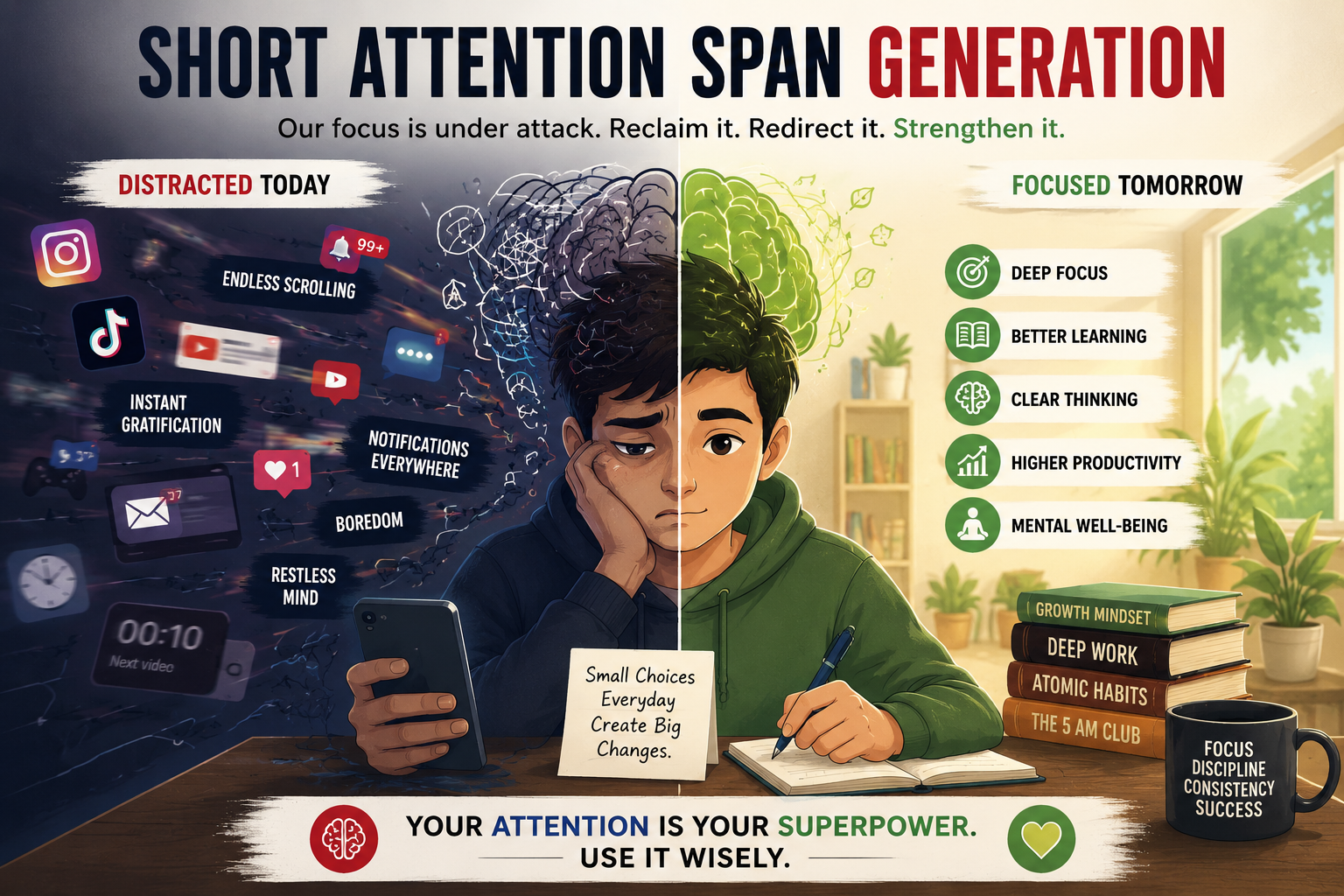
Human attention has not simply weakened, but online environments place finite attention in competition with an effectively unlimited supply of content. Attention dynamics online determine how attention is captured, directed, monetized, and manipulated, shaping not only what people consume but also what they think about and value.
In 2004, the average American television commercial was 30 seconds long, and advertisers considered this a constrained format that forced brutal compression of their message.
By 2020, TikTok had trained hundreds of millions of users to evaluate content within the first one to three seconds and swipe away anything that failed to grab them instantly.
YouTube pre-roll ads of five seconds felt like an eternity. Instagram Stories, designed to be consumed in 15-second increments, were considered a long-form format compared to the feed of images users scrolled past in fractions of a second.
This is not a story about shrinking attention spans, despite what countless think-pieces claim. Human attention has not deteriorated as a biological capacity. People still binge eight-hour television series, spend hours absorbed in video games, and read 800-page novels.
What has changed is the competitive environment in which attention operates online.
The internet has created a marketplace of functionally infinite content competing for functionally finite human attention, and the dynamics of that marketplace-how attention is captured, directed, monetized, and manipulated-shape not just what we consume but how we think, what we care about, and how we understand the world.
Understanding these dynamics matters because they are not natural forces like weather. They are designed systems built by companies with specific business incentives, and they produce specific cultural effects that are neither inevitable nor neutral.
The attention economy rewards certain kinds of content (emotional, provocative, simple, novel) and penalizes others (nuanced, complex, slow-developing, uncertain). Over time, this reward structure reshapes the information environment that entire societies rely on for knowledge, deliberation, and collective decision-making.
The Economics of Attention: How a Scarce Resource Gets Allocated
The concept of an attention economy was first articulated by the economist and Nobel laureate Herbert Simon in 1971, decades before the internet made it viscerally real:
"In an information-rich world, the wealth of information means a dearth of something else: a scarcity of whatever it is that information consumes. What information consumes is rather obvious: it consumes the attention of its recipients. Hence a wealth of information creates a poverty of attention."
Simon's insight was prophetic. The internet has made information production nearly free and distribution essentially unlimited. Anyone can publish anything to a potential global audience at effectively zero marginal cost. The result is an environment where:
- Over 500 hours of video are uploaded to YouTube every minute
- Over 6,000 tweets are posted per second
- Over 95 million photos and videos are shared on Instagram daily
- Over 4 million blog posts are published daily across the web
Against this torrent of content, human attention has not expanded at all. You still have roughly 16 waking hours per day. You can still focus meaningfully on only one information stream at a time.
The ratio of available content to available attention has expanded by orders of magnitude, creating a marketplace where attention is the scarcest and most valuable commodity-and where the ability to capture and hold it is the primary determinant of economic success.
The Business Model: You Are the Product
The dominant business model of the internet converts attention into revenue through advertising:
- Platforms offer free services (search, social networking, video hosting, messaging) that attract users
- Users spend time and attention on these platforms, generating behavioral data
- Advertisers pay platforms to place their messages in front of users' attention
- Platforms optimize their systems to maximize user engagement (time spent, interactions, return visits) because more engagement equals more advertising inventory equals more revenue
This model creates a structural incentive for platforms to capture as much human attention as possible, for as long as possible, by whatever means are most effective.
The incentive is not to inform, educate, or fulfill users' stated preferences-it is to engage, which is a fundamentally different objective. These platform incentives shape every design decision, from notification timing to feed ranking.
"The attention merchants draw us in with apparently free stuff and then, in effect, resell our attention to advertisers." - Tim Wu
How Attention Gets Captured: The Psychology of Engagement
Platform algorithms and content creators exploit specific features of human psychology to capture attention. These are not obscure vulnerabilities-they are fundamental features of how human brains process information, honed by hundreds of millions of years of evolution.
Many of these exploited tendencies are well-documented cognitive biases that operate below conscious awareness.
"The problem is not that people lack willpower; it is that there are a thousand engineers on the other side of the screen whose job it is to break down the self-regulation you have." - Tristan Harris
Novelty Bias
The human brain is wired to orient toward novel stimuli. This made evolutionary sense: in ancestral environments, anything new might be a threat or an opportunity, and paying attention to it could be the difference between survival and death.
These mental shortcuts-or heuristics-served us well in simpler environments but become exploitable in digital ones. Online, this orientation toward novelty means:
- New content captures attention more effectively than familiar content
- Feeds that constantly refresh with new items exploit the novelty response
- Breaking news, trending topics, and "just posted" signals trigger automatic orienting
- The endless scroll format exploits novelty-seeking by always promising something new just below the current viewport
Emotional Arousal
Content that triggers strong emotional responses-particularly negative emotions like outrage, fear, and disgust-captures and holds attention more effectively than emotionally neutral content.
Research published in PNAS by William Brady and colleagues found that each moral-emotional word in a tweet increased its retweet rate by approximately 20%.
Content that makes people angry, afraid, or morally outraged achieves virality far more readily than content that informs, reassures, or presents balanced analysis.
This creates a systematic bias in the information environment:
- Outrage outperforms analysis
- Conflict outperforms consensus
- Fear outperforms reassurance
- Simplicity outperforms nuance
- Certainty outperforms uncertainty
The bias is not in any individual piece of content but in the aggregate selection pressure that rewards emotional intensity and penalizes measured, complex, uncertain communication.
Social Validation
Humans are deeply social animals, and social signals powerfully direct attention:
- Like counts, share counts, and view counts serve as social proof that content is worth attending to
- Trending indicators trigger herd behavior-people pay attention to what others are paying attention to
- Comment sections create social arenas where attention is sustained by social interaction
- Follower counts and verification badges signal social status that attracts attention independently of content quality
- Notifications exploit the social brain's attentiveness to messages from other humans
Variable Reward Schedules
Platform designers explicitly use principles from behavioral economics and behavioral psychology, particularly variable ratio reinforcement schedules-the same mechanism that makes slot machines addictive.
The key feature: rewards (likes, comments, new interesting content) arrive unpredictably, which produces more persistent engagement than predictable rewards.
- Pull-to-refresh gestures mimic slot machine pulls
- Feed algorithms vary content quality and relevance to create unpredictable engagement patterns
- Notification systems deliver social rewards at variable intervals
- Autoplay features eliminate the natural stopping point between content items
The Algorithms: Invisible Editors of Human Experience
Algorithms are the mechanisms through which platforms allocate attention at scale. They determine what billions of people see, in what order, with what framing, and with what prominence. Understanding their dynamics is essential to understanding attention online.
"Surveillance capitalism unilaterally claims human experience as free raw material for translation into behavioral data." - Shoshana Zuboff
How Recommendation Algorithms Work
At their core, recommendation algorithms solve an optimization problem: given a user with certain characteristics and behaviors, and a pool of available content, which content will maximize the user's engagement (measured by clicks, time spent, shares, comments, and return visits)?
The algorithms learn through massive-scale pattern matching:
- Observe billions of user interactions (clicks, pauses, scrolls, shares, comments)
- Identify patterns in which content types, topics, formats, and features drive engagement for which user profiles
- Serve each user the content predicted to generate the highest engagement from them specifically
- Continuously refine predictions based on real-time feedback
What Algorithms Optimize For
The critical question is not how algorithms work technically but what they optimize for, because that optimization function determines what kind of information environment they create.
| Platform | Primary Optimization Target | Effect on Attention |
|---|---|---|
| Facebook/Meta | Engagement (reactions, comments, shares) | Amplifies emotionally provocative content; deprioritizes neutral or complex information |
| YouTube | Watch time (total minutes viewed) | Favors longer content and binge-watching patterns; recommends increasingly extreme content to maintain engagement |
| TikTok | Time spent + engagement rate | Rewards content that hooks within 1-3 seconds; creates rapid consumption patterns |
| Twitter/X | Engagement (replies, retweets, likes) | Amplifies controversial and polarizing content; hot takes outperform analysis |
| Time spent + engagement | Rewards visually striking, emotionally evocative, aspirational content | |
| Google Search | Click-through rate + time on page | Rewards content that matches search intent quickly; favors established authorities |
The Radicalization Pipeline
Research by Guillaume Chaslot (a former YouTube engineer) and academic teams at multiple universities has documented how recommendation algorithms can create radicalization pathways-sequences of recommendations that progressively lead users from mainstream content toward increasingly extreme material.
The mechanism is straightforward:
- User watches content on a topic (say, fitness)
- Algorithm recommends slightly more intense content (extreme diets)
- User watches some of these recommendations
- Algorithm recommends even more extreme content (conspiracy theories about food industry)
- Each step increases engagement (novelty + emotional arousal)
- The algorithm has no model of "too extreme"-it only measures engagement
This pattern has been documented across topics including political ideology, conspiracy theories, health misinformation, and extremist movements. The algorithm does not intend to radicalize anyone.
It follows its optimization function-maximize engagement-and radicalization happens to be an effective engagement strategy for certain user profiles.
The Cultural Effects: How Attention Dynamics Reshape Society
The attention economy's dynamics do not merely determine which cat videos get watched. They reshape the information environment in which entire societies form beliefs, deliberate on policy, and make collective decisions.
The Collapse of the Middle
Attention dynamics systematically reward content at the extremes of any spectrum-the most outrageous, the most emotional, the most certain-and penalize the moderate, nuanced, uncertain center. This creates what scholars call a missing middle in public discourse:
- Political discourse becomes polarized because moderate, nuanced positions do not generate engagement
- Health information becomes divided between miracle cures and catastrophizing because balanced health advice is boring
- News tilts toward crisis, conflict, and scandal because incremental progress and functional institutions do not capture attention
- Expert opinion is drowned out by confident non-expert opinion because confidence is more engaging than appropriate uncertainty
The Acceleration of Outrage Cycles
Online attention dynamics create outrage cycles that follow a predictable pattern:
- Trigger: Something happens (a statement, event, revelation) that has outrage potential
- Amplification: Early outraged reactions get algorithmic amplification because they generate engagement
- Pile-on: The amplified outrage attracts more outrage, creating a feedback loop
- Counter-outrage: A backlash forms, generating its own engagement loop
- Exhaustion: Attention moves on to the next outrage cycle
- Repeat: The cycle restarts with a new trigger, often within 24-48 hours
Each cycle is intense, all-consuming for its duration, and largely forgotten within days. The cumulative effect is not informed deliberation but emotional whiplash-a constant state of heightened arousal that crowds out sustained attention to important issues.
The Fragmentation of Shared Reality
When algorithms personalize information feeds for billions of individuals, the result is billions of slightly different information environments. Two people using the same platform may see entirely different content about the same topic, with different framing, different sources, different emphasis, and different implied conclusions.
This personalization erodes shared factual ground-the common information base that democratic deliberation requires, and contributes to digital tribalism as people increasingly inhabit separate information worlds.
When citizens cannot agree on basic facts (not just interpretations but facts), productive political discourse becomes impossible.
Attention dynamics contribute to this erosion not through deliberate misinformation campaigns (though those exist too) but through the structural fragmentation of the information environment into personalized streams that need not overlap, where the signal-to-noise ratio degrades as algorithmic amplification favors engagement over accuracy.
The Creators' Perspective: Surviving in the Attention Economy
For content creators-journalists, educators, artists, commentators, businesses-the attention economy creates a brutal competitive environment with specific survival strategies.
What the Algorithm Rewards
Creators who succeed in the attention economy typically master several techniques:
Hooks: The first 1-3 seconds of any piece of content must stop the scroll. This requirement fundamentally shapes how information is presented-important context, nuance, and qualifications get pushed later (or eliminated) in favor of immediately gripping openings.
Emotional activation: Content that makes people feel something-anger, surprise, joy, fear, inspiration-outperforms content that merely informs. Creators learn to lead with emotion, even when the underlying content is informational.
Simplification: Complex topics must be compressed into simple, shareable formats. This is not inherently bad (effective communication always involves compression), but the degree of compression required by attention dynamics often crosses the line from simplification into distortion.
Consistency and frequency: Algorithms favor creators who post frequently and consistently. This creates a production treadmill that can compromise quality-the need to post something every day or multiple times per day pressures creators to sacrifice depth for volume.
Platform-native formats: Content must be optimized for each platform's specific format, algorithm, and platform norms. A video optimized for YouTube (longer, detailed, searchable) is entirely different from a video optimized for TikTok (short, immediate, visually dynamic).
Creators must either specialize or produce multiple versions of every piece of content.
The Quality Trap
"In a world where information is abundant, the only scarce resource is human attention. The question is not what we can access, but what we choose to focus on-and increasingly, what is chosen for us." - Matthew Crawford
A persistent tension exists between what attention dynamics reward and what actually serves audiences well:
- What captures attention: Novelty, outrage, simplicity, certainty, conflict, visual spectacle
- What serves understanding: Depth, nuance, uncertainty, context, slow development, careful reasoning
Creators committed to quality must either find creative ways to package substantive content in attention-grabbing formats (possible but difficult and requiring significant skill) or accept that their work will reach smaller audiences than content optimized purely for engagement.
This structural disadvantage for quality content is one of the most consequential features of the attention economy.
Can Attention Dynamics Be Changed?
The attention dynamics described above are not laws of nature. They are products of specific design decisions, business models, and regulatory environments that could be different.
Platform Design Changes
Platforms could redesign their systems to optimize for different outcomes:
- Reducing variable reward mechanics (making feeds more predictable and less slot-machine-like)
- Slowing down sharing (adding friction before resharing content, especially content that triggers strong emotional reactions)
- Diversifying recommendation algorithms to expose users to a broader range of perspectives rather than reinforcing existing preferences
- Displaying engagement metrics less prominently (reducing social proof effects)
- Providing transparency about how algorithms select and rank content
Some platforms have experimented with these changes. Instagram tested hiding like counts in several markets. Twitter/X experimented with prompting users to read articles before sharing them.
The results have been mixed-partly because these changes conflict with the platforms' economic incentives and partly because user habits are difficult to change once established.
Regulatory Approaches
Governments could shape attention dynamics through regulation:
- Transparency requirements mandating disclosure of how algorithms select and rank content
- Restrictions on behavioral targeting that limits platforms' ability to profile users for attention capture
- Digital wellbeing standards similar to consumer safety standards for physical products
- Data portability requirements that reduce lock-in and enable competition from platforms with different attention models
- Algorithmic auditing requirements that ensure recommendation systems do not systematically amplify harmful content
The European Union's Digital Services Act (2022) and proposals in other jurisdictions represent early steps in this direction, though regulation of attention dynamics remains in its infancy.
Individual Strategies
While systemic change is necessary for large-scale impact, individuals can partially manage their own attention dynamics:
"The key to living well in a high-tech world is to spend much less time using technology." - Cal Newport
- Curate deliberately: Choose information sources based on quality, not algorithmic recommendation. Subscribe to specific journalists, publications, and creators rather than relying on feeds.
- Set time boundaries: Platform design is built to prevent you from stopping. Deliberate time limits counteract this.
- Notice emotional manipulation: When content makes you intensely angry, afraid, or outraged, recognize that this emotional response is exactly what the attention economy rewards-and ask whether the intensity is proportionate to the actual information. This kind of critical evaluation is what media literacy teaches: how to recognize when content is designed to provoke rather than inform.
- Seek out long-form content: Books, long articles, documentaries, and podcasts operate under different attention dynamics than social media feeds and provide different (often better) information.
- Reduce notification access: Every notification is an attempt to capture your attention. Turning off non-essential notifications returns control of attention to you rather than to platforms.
- Practice boredom tolerance: The ability to sit with boredom without reaching for a device is a fundamental attentional skill that constant engagement undermines.
The attention economy is not a conspiracy, but it is a system with specific dynamics that produce specific effects.
Those effects include the enrichment of our information environment in some ways (access to vast knowledge, connection with diverse perspectives, creative expression) and the degradation of it in others (emotional manipulation, fragmentation of shared reality, systematic disadvantage for nuanced understanding).
Living well within this system requires understanding how it works, recognizing its effects on your own cognition and behavior, and making deliberate choices about how much of your most valuable resource-your attention-you allow it to control.
Landmark Research on Attention and Digital Media
The scientific study of attention in digital environments has produced findings that substantially revise earlier assumptions and clarify which claims about smartphone-era attention are evidence-based and which are moral panic.
Researcher Gloria Mark at the University of California, Irvine has conducted some of the most cited field studies on digital interruption. In a 2004 study using observational methods in office settings, Mark found that it took workers an average of 23 minutes to return to their original task after an interruption.
By 2012, that average had dropped to 11 minutes, and by 2020, her team found workers switching between tasks or applications every 47 seconds on average - a tenfold increase in interruption frequency over 16 years.
Crucially, Mark's 2023 book Attention Span distinguishes between two types of attention fragmentation: externally driven (caused by notifications and algorithmic interruptions) and internally driven (self-interruption, checking devices without prompting).
Her studies found that by 2020, approximately 56% of attention shifts were self-initiated rather than triggered by platform notifications, suggesting that sustained use of high-stimulation digital environments changes internal attentional habits independent of any specific external prompt.
A 2019 study by Andrew Przybylski and Netta Weinstein at the Oxford Internet Institute, analyzing data from 355,358 adolescents across the United States, United Kingdom, Germany, and Spain, found a statistically significant but practically small relationship between digital technology use and wellbeing.
Their analysis concluded that the effect of screen time on adolescent wellbeing was roughly equivalent to the effect of wearing glasses - present and measurable but not a dominant determinant of life outcomes.
This finding, described by the researchers as consistent with a "Goldilocks hypothesis" (moderate use is neutral or slightly beneficial; very high use becomes harmful), challenged both the catastrophist framing that smartphones are destroying a generation and the dismissive framing that no effects exist.
The study's large sample size and pre-registration of hypotheses made it one of the most methodologically rigorous contributions to the debate.
MIT economist Sendhil Mullainathan and Princeton behavioral scientist Eldar Shafir, in their 2013 book Scarcity: Why Having Too Little Means So Much, proposed a framework directly relevant to attention dynamics.
Their research found that when any resource is scarce - time, money, calories, attention - cognitive resources are automatically allocated toward the scarcest domain, reducing "cognitive bandwidth" available for other tasks.
Applied to the attention economy, their framework predicts that people whose attention is chronically overcommitted will show impaired performance on tasks requiring executive function, impulse control, and long-term planning - not because their cognitive capacity has diminished, but because it is perpetually consumed by the scarcity dynamic.
Experimental tests of their model found that merely reminding low-income participants of financial pressures temporarily reduced their performance on unrelated cognitive tests by the equivalent of a 13-point IQ reduction.
Platform Design Changes and Natural Experiments
The most rigorous evidence about how attention dynamics affect behavior comes from natural experiments in which platform design changes created measurable shifts in large populations.
When Twitter introduced a feature in 2020 prompting users to read articles before retweeting them, the company reported a 40% increase in article opens before sharing and a reduction in reshares of flagged misinformation.
The natural experiment revealed that the default frictionlessness of sharing - the ability to amplify content without any engagement beyond a single tap - was meaningfully contributing to rapid, unreflective spread.
The specific friction introduced (a prompt asking "want to read this before sharing?") took less than two seconds to dismiss, yet produced behavioral changes at scale, demonstrating how powerful even minimal friction can be against the grain of engagement-optimized defaults.
Instagram's 2019 experiment hiding public like counts in Canada, Australia, Brazil, Ireland, Italy, Japan, and New Zealand provided evidence on social proof dynamics.
A 2021 study by researchers at the University of Southern California analyzing user behavior during the experiment found that the change reduced the positive correlation between creator account size and post engagement - the "rich get richer" dynamic by which posts from large accounts are more likely to be engaged with regardless of content quality.
However, the effect was modest: engagement patterns showed considerable inertia, and users who could see like counts on their own posts (a deliberate design choice by Instagram) showed little behavioral change.
The company eventually made like-count hiding optional worldwide in 2021, an outcome that researchers noted reflects the commercial tension between engagement-dampening design changes and the advertising revenue models that depend on high engagement.
The clearest evidence of algorithmic attention manipulation comes from Facebook's 2014 emotional contagion study, conducted by Adam Kramer, Jamie Guillory, and Jeffrey Hancock, published in Proceedings of the National Academy of Sciences.
The experiment modified the News Feed content shown to 689,003 users without their knowledge, reducing either positive or negative emotional content and measuring downstream emotional expression in those users' own posts.
The study found significant emotional contagion: users shown less positive content expressed more negative emotion, and vice versa.
The finding confirmed that algorithmic curation of emotional content has measurable effects on users' own emotional states - but the study's secret enrollment of nearly 700,000 subjects in psychological experimentation without consent generated substantial ethical controversy and regulatory attention, becoming itself a case study in the ethical dimensions of platform power over attention and emotional experience.
Sources & Further Reading
Wu, T. (2016). The Attention Merchants: The Epic Scramble to Get Inside Our Heads. Knopf.
Zuboff, S. (2019). The Age of Surveillance Capitalism: The Fight for a Human Future at the New Frontier of Power. PublicAffairs. View source
Brady, W.J., et al. (2017). "Emotion Shapes the Diffusion of Moralized Content in Social Networks." Proceedings of the National Academy of Sciences, 114(28), 7313-7318. DOI: 10.1073/pnas.1618923114
Simon, H.A. (1971). "Designing Organizations for an Information-Rich World." In Computers, Communications, and the Public Interest, pp. 37-72. Johns Hopkins University Press. View source
Harris, T. (2016). "How Technology is Hijacking Your Mind." Center for Humane Technology. View source
Chaslot, G. (2019). "The Toxic Potential of YouTube's Feedback Loop." Wired.
Orlowski, J. (Director). (2020). The Social Dilemma [Documentary]. Netflix. View source
Crawford, M.B. (2015). The World Beyond Your Head: On Becoming an Individual in an Age of Distraction. Farrar, Straus and Giroux. View source
Citton, Y. (2017). The Ecology of Attention. Polity Press. View source
Newport, C. (2019). Digital Minimalism: Choosing a Focused Life in a Noisy World. Portfolio/Penguin. View source