
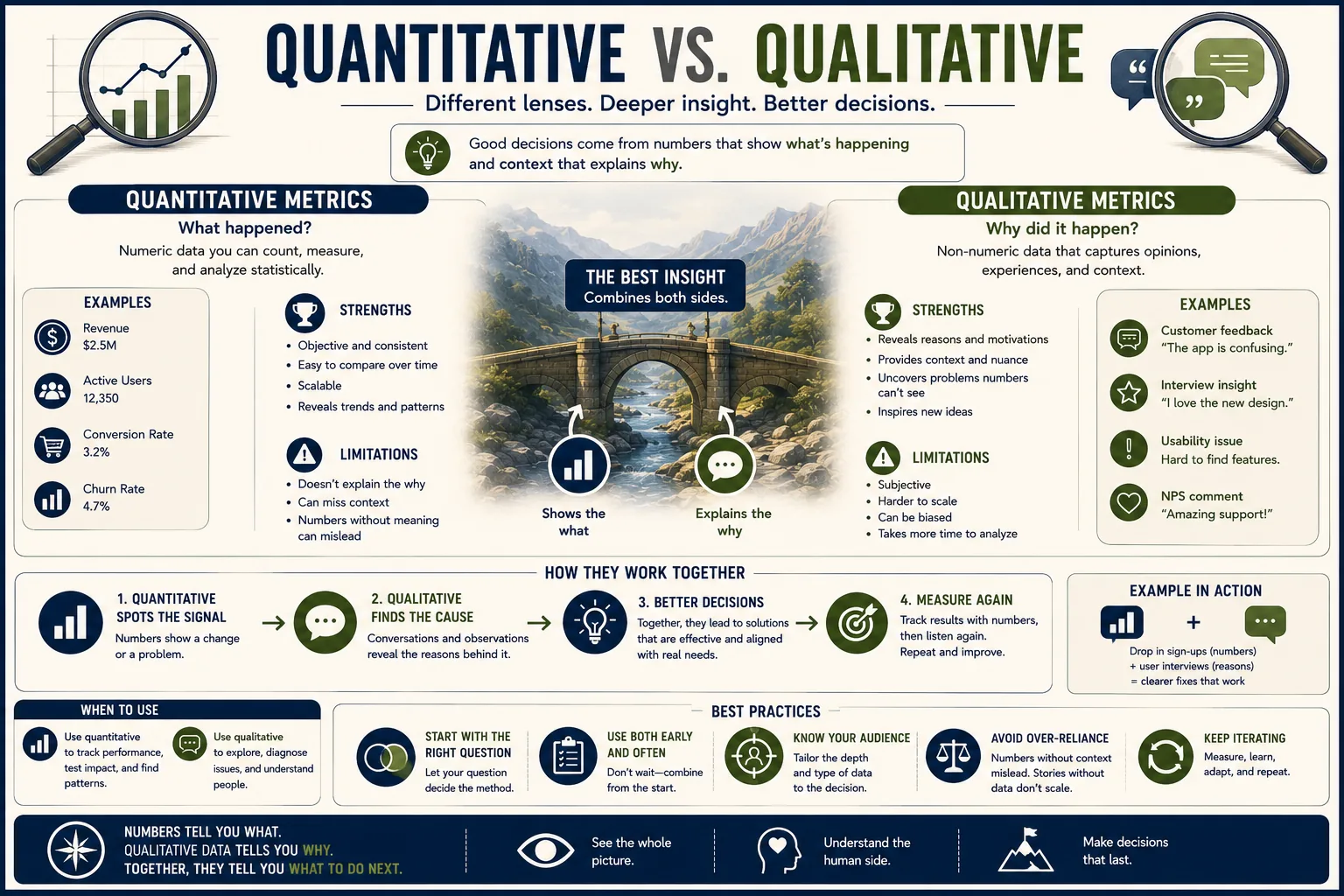
Quantitative vs qualitative metrics answer different questions that should usually be combined. Numerical measures show magnitude, trends, comparisons, and statistical patterns at scale, but can hide context and causes. Interviews, observations, narratives, and open responses reveal meaning, motivations, rare cases, and hypotheses, though they are harder to aggregate. Measurement becomes more useful when counting and understanding inform one another.
Your dashboard shows conversion rate increased 12%, user sessions up 23%, revenue growing 8% monthly. Everything quantified, tracked, trending. Data-driven. But you don't know why customers convert, what sessions actually accomplish, or whether revenue growth is sustainable. The numbers are clear; their meaning is opaque.
Meanwhile, user interviews reveal frustration with checkout flow, support tickets describe recurring pain points, and sales conversations expose unmet needs. Rich insight, hard to dashboard. Qualitative data provides understanding the numbers miss, but resists the neat summarization quantitative metrics offer.
Most organizations treat this as a choice: quantitative (rigorous, scalable, objective) or qualitative (subjective, time-intensive, anecdotal). But it's not either/or-it's both/and.
Understanding when each approach works, their respective strengths and limitations, and how they complement each other transforms measurement from counting to comprehension.
The Fundamental Distinction
Quantitative Metrics
Definition: Numerical measurements that quantify magnitude, frequency, or relationships.
Characteristics:
- Numbers
- Countable, measurable
- Aggregatable (can sum, average, trend)
- Large samples possible
- Statistical analysis applicable
- Standardized comparisons
Examples:
- Revenue, conversion rate, user count
- Survey ratings (1-5 scale)
- Time on page, click-through rate
- Error rates, response times
Qualitative Metrics
Definition: Non-numerical data that captures themes, patterns, context, and meaning.
Characteristics:
- Words, themes, narratives
- Descriptive, contextual
- Rich, detailed
- Small samples typical
- Interpretive analysis
- Unique insights, hard to compare
Examples:
- Interview transcripts, open-ended survey responses
- Customer support conversations
- Usability testing observations
- Case studies, field notes
The Comparison
| Aspect | Quantitative | Qualitative |
|---|---|---|
| Question | How much? How many? What's the rate? | Why? How? What's the experience? |
| Data | Numbers | Words, observations, artifacts |
| Sample size | Large (hundreds to millions) | Small (10-50 typical) |
| Analysis | Statistical | Interpretive (coding, themes) |
| Strength | Precision, scale, trends | Depth, context, understanding |
| Weakness | May miss "why" and context | Hard to scale, summarize |
| Goal | Measure | Understand |
When to Use Quantitative Metrics
Ideal Use Cases
| Purpose | Why Quantitative Works | Example |
|---|---|---|
| Measure magnitude | Numbers show "how much" | "Revenue is $2M/month" |
| Track trends | See changes over time | "Conversion rate up 15% vs. last year" |
| Compare groups | Standardized comparison | "Treatment group converted 3% better than control" |
| Test hypotheses | Statistical significance | "Feature A performs better than Feature B (p < 0.05)" |
| Aggregate at scale | Summarize millions of data points | "Average session duration: 3.2 minutes" |
| Identify patterns | Statistical correlations | "Users who complete tutorial have 40% higher retention" |
Strengths of Quantitative Metrics
1. Scale
- Can measure millions of users, transactions, events
- Automated collection
- Minimal marginal cost per data point
2. Objectivity
- Less subject to interpretation (in principle)
- Replicable
- Less researcher bias (though not immune)
3. Precision
- Exact values ("conversion increased 2.3%")
- Statistical confidence intervals
- Can detect small effects with large samples
4. Comparability
- Same metrics across time periods, segments, companies
- Benchmarking possible
- Clear performance tracking
5. Statistical Rigor
- Can test hypotheses formally
- Control for confounding variables
- Calculate probabilities of results being real vs. chance
Limitations of Quantitative Metrics
1. The "Why" Problem
- Numbers show what happened
- Don't explain why it happened
- Correlation without causation understanding
Example: "Churn rate increased 5%" data shows problem exists, not why people leave
2. Context Loss
- Aggregation erases individual stories
- Numbers flatten nuance
- Can miss rare but important cases
Example: Average customer satisfaction 4.2/5 hides bimodal distribution (some love it, some hate it)
As sociologist William Bruce Cameron wrote, "Not everything that counts can be counted, and not everything that can be counted counts." Averages and aggregates routinely bury the distinctions that actually drive behavior.
3. Measurability Bias
- Temptation to measure what's easy to quantify, not what matters[6]
- "What gets measured gets managed" manage the wrong things
Example: Call center optimizes "calls per hour" (measurable) but destroys customer satisfaction (harder to quantify)
"It is wrong to suppose that if you can't measure it, you can't manage it - a costly myth." - W. Edwards Deming, statistician and quality management pioneer
4. False Precision
- Numbers create illusion of accuracy
- Underlying measurement may be flawed
- "Precisely wrong" instead of "roughly right"
Example: "Employee engagement: 3.72/5" implies precision when construct is fuzzy
"The most important figures that one needs for management are unknown or unknowable, but successful management must nevertheless take account of them." - W. Edwards Deming, Out of the Crisis
5. Missing the Unmeasured
- If something isn't quantified, it becomes invisible
- Important qualitative factors ignored
Example: Startup focuses on quantifiable metrics (users, revenue), misses culture erosion until talent exodus
When to Use Qualitative Metrics
Ideal Use Cases
| Purpose | Why Qualitative Works | Example |
|---|---|---|
| Understand "why" | Captures motivations, reasoning | "Why did you cancel? What frustrated you?" |
| Explore new domains | Don't know what to measure yet | Early product research |
| Capture context | Situational factors, nuance | How feature is actually used in workflow |
| Generate hypotheses | Discover patterns to test quantitatively later | User interviews reveal pain point quantify prevalence |
| Understand experience | Subjective meaning, emotions | How does product make people feel? |
| Identify edge cases | Rare but important scenarios | Unusual user journeys |
Strengths of Qualitative Metrics
1. Depth
- Rich, detailed understanding
- Captures complexity numbers miss
- Individual stories, not just aggregates
2. Context
- Situational factors
- How and why, not just what
- Real-world messiness
3. Flexibility
- Can pursue unexpected findings
- Adapt questions based on responses
- Explore tangents that matter
4. Hypothesis Generation
- Discover what you didn't know to look for
- Qualitative often precedes quantitative
- Informs what to measure
5. Humanizes Data
- Reminds you of real people behind numbers
- Empathy and understanding
- Prevents abstraction from reality
Limitations of Qualitative Metrics
1. Scale
- Labor-intensive
- Can't interview millions
- Expensive per data point
2. Generalizability
- Small samples
- Can't say "X% of users..."
- Unclear how representative findings are
3. Subjectivity
- Interpretation required
- Researcher bias possible
- Different analysts may reach different conclusions
4. Comparability
- Hard to compare across contexts
- Not standardized
- Difficult to track trends numerically
5. Summarization Challenge
- How do you dashboard themes?
- Executive report wants numbers
- Hard to reduce rich data to bullet points
The False Dichotomy: Both Are Rigorous
The Quantitative Bias
Common assumption: "Quantitative = rigorous, qualitative = anecdotal"
Reality: Rigor depends on method quality, not data type.
"Qualitative research is a situated activity that locates the observer in the world. It consists of a set of interpretive, material practices that make the world visible." - Norman K.[14] Denzin & Yvonna S. Lincoln, The SAGE Handbook of Qualitative Research
Rigorous Qualitative Research
Characteristics:
| Element | How It Ensures Rigor |
|---|---|
| Systematic sampling | Purposive sampling (select diverse, information-rich cases) |
| Structured protocols | Interview guides, observation protocols |
| Multiple coders | Inter-rater reliability |
| Triangulation | Multiple data sources, methods |
| Member checking | Validate interpretations with participants |
| Audit trail | Document decisions, interpretations |
| Reflexivity | Acknowledge researcher perspective, biases |
Example of rigorous qualitative:
- 30 semi-structured user interviews
- Stratified sample (diverse user types)
- Two researchers independently code transcripts
- Calculate inter-rater reliability
- Identify themes appearing in >50% of interviews
- Validate themes with user follow-ups
This is systematic, replicable, and rigorous-just not quantitative.[3]
Bad Quantitative Research
Quantitative doesn't automatically mean rigorous:
- Biased samples
- Poor measurement (measuring wrong construct)
- P-hacking
- Confusing correlation with causation
- Cherry-picking results
Having numbers doesn't make analysis good. It just makes it numerical.
As Douglas Hubbard argued in How to Measure Anything, "The first step is to clarify what we mean by measurement...
A 'measurement' is a quantitatively expressed reduction in uncertainty based on one or more observations." Poor quantitative measurement reduces uncertainty less than it appears to - and sometimes increases it.
How They Complement Each Other
The Mixed-Methods Advantage
Quantitative tells you WHAT. Qualitative tells you WHY.
The mixed-methods approach is increasingly recognized as best practice in research design precisely because neither method alone answers both questions.[4]
| Phase | Method | Output | Next Step |
|---|---|---|---|
| Explore | Qualitative (interviews, observations) | Discover pain points, generate hypotheses | Test prevalence |
| Measure | Quantitative (surveys, analytics) | Measure how common pain points are | Understand why |
| Understand | Qualitative (deep dives on patterns) | Explain why pattern exists | Design intervention |
| Test | Quantitative (A/B test) | Measure impact of intervention | Understand mechanism |
| Explain | Qualitative (case studies) | Why did intervention work/fail? | Refine and retest |
Example: Understanding Churn
Quantitative alone:
- "30% of users churn within 90 days"
- "Churn highest in segment X"
- "Churn correlates with low engagement score"
Limitations: Know who and when, not why
Qualitative alone:
- "Some users say product is too complex"
- "Others mention missing key features"
- "Few describe pricing concerns"
Limitations: Know why for these specific users, not how common each reason is
Combined approach:
| Step | Method | Finding |
|---|---|---|
| 1. Quantify problem | Analytics | "30% churn within 90 days" |
| 2. Understand reasons | Exit interviews (20 users) | Three main themes: complexity, missing features, pricing |
| 3. Measure prevalence | Survey churned users (200) | 60% cite complexity, 25% missing features, 15% pricing |
| 4. Deep dive on #1 cause | Usability testing | Specific onboarding steps cause confusion |
| 5. Test fix | A/B test new onboarding | Churn reduced to 22% in treatment group |
| 6. Understand success | User interviews | Users now understand core workflow |
Result: Numbers provide scale and precision; words provide understanding and insight. Together, they enable effective action.
Quantifying Qualitative Data
When It Works
Appropriate quantification:
| Qualitative Source | Quantification | Why It Works |
|---|---|---|
| Open-ended survey responses | Code into categories, count frequency | Large sample allows patterns |
| Support tickets | Tag by issue type, track trends | Repeated themes become countable |
| User interviews | "7 of 10 mentioned X" | Shows prevalence within sample |
When It Backfires
Forced quantification problems:
1. Loss of Meaning
- Reducing rich narrative to number
- Context and nuance disappear
Example:
- Customer says: "Your product saved my business. The support team went above and beyond when we had a crisis..."
- Quantified as: "NPS = 10"
- Everything meaningful is lost
2. False Precision
- Pretending qualitative data is more precise than it is
- Small samples converted to percentages imply false confidence
Example:
- 3 out of 5 interviewees mentioned X
- Reporting as "60% of users experience X" (implies much larger, representative sample)
3. Decontextualization
- Quote means something in context
- Extracted as standalone metric, meaning shifts
Best Practice: Integrate, Don't Convert
Instead of converting qual quant:
- Present both
- Let qualitative illustrate quantitative
- Use quotes to bring numbers to life
Example:
"Churn rate is 30% within 90 days. Exit interviews reveal three main reasons:
- Complexity (60% of respondents): 'I spent an hour trying to figure out basic features. Too steep learning curve.'
- Missing features (25%): 'Product doesn't integrate with tools I use daily. I need X and Y.'
- Pricing (15%): 'Value is there, but budget doesn't allow right now.'"
Numbers show scale. Quotes show experience. Together: complete picture.
Practical Frameworks
The Exploration Validation Cycle
Framework:
Qualitative exploration (discover problems, generate hypotheses)
- Interviews, observations, open-ended surveys[7]
- Small sample (10-30)
- Output: Themes, hypotheses
Quantitative validation (test prevalence, measure magnitude)
- Closed-ended surveys, analytics
- Large sample (hundreds to millions)
- Output: Percentages, statistical tests
Qualitative explanation (understand why patterns exist)
- Deep dives on quantitative findings[12]
- Targeted interviews
- Output: Mechanisms, causal explanations
The 80/20 Approach
For most decisions:
Quantitative: 80% of effort
- Track key metrics
- Dashboards, reports
- Statistical tests
Qualitative: 20% of effort
- Regular user conversations
- Support ticket review
- Occasional deep dives
Why: Quantitative scales better for ongoing monitoring. Qualitative provides periodic deep understanding.
The Voice of Customer Framework
Three layers:
| Layer | Method | Frequency | Output |
|---|---|---|---|
| Quantitative signals | NPS, CSAT surveys, analytics | Continuous | Dashboards, trends |
| Qualitative themes | Support tickets, feedback forms | Weekly review | Common issues list |
| Deep understanding | User interviews, site visits | Quarterly | Case studies, insights |
Examples by Domain
Product Development
| Question | Quantitative Approach | Qualitative Approach |
|---|---|---|
| Which features matter? | Feature usage analytics | User interviews on workflow |
| How common is problem X? | Survey: % reporting problem | Deep dive: How does problem manifest? |
| Did redesign work? | A/B test metrics | Usability testing observations |
Best: Quantify usage, qualify experience.
Customer Experience
| Question | Quantitative Approach | Qualitative Approach |
|---|---|---|
| Are customers satisfied? | NPS, CSAT scores | Interviews: What drives satisfaction? |
| Where do customers struggle? | Analytics: Where do they drop off? | Session recordings, user testing |
| What improvements matter? | Survey: Rate importance (1-5) | Open-ended: What frustrates you? |
Best: Scores show magnitude, stories show meaning.
Employee Engagement
| Question | Quantitative Approach | Qualitative Approach |
|---|---|---|
| How engaged are employees? | Engagement survey scores | One-on-one conversations |
| What drives turnover? | Retention rates by department | Exit interviews |
| Is culture healthy? | Pulse survey metrics | Focus groups, observations |
Best: Surveys scale, conversations reveal nuance.
Common Mistakes
Mistake 1: Only Quantitative
Problem: Numbers without understanding
Example:
- Dashboard shows all metrics green
- Revenue up, engagement up, NPS up
- Yet customer complaints increasing
- Churn secretly rising in key segment
- Quantitative metrics missed early warning signals qualitative data would catch
Mistake 2: Only Qualitative
Problem: Rich insights, no sense of scale
Example:
- Interviewed 10 users, found problems A, B, C
- Don't know how common each problem is
- Don't know if fixing A helps 2% or 80% of users
- Can't prioritize without quantification
Mistake 3: Treating Qualitative as Less Rigorous
Problem: Dismissing qualitative as "just anecdotes"
Reality: Rigorous qualitative research is systematic and valuable[13]
Fix: Apply quality standards to both quantitative and qualitative[8]
Mistake 4: Quantifying Everything
Problem: Forcing numbers onto things that resist quantification
Result: False precision, loss of meaning
Example: "Rate your existential fulfillment 1-10"
Better: Some constructs deserve qualitative description
Mistake 5: Not Integrating Findings
Problem: Quantitative team and qualitative team work separately
Result: Disconnected insights, missed synthesis
Fix: Integrated analysis, shared interpretation
Choosing Your Approach
Decision Framework
Ask yourself:
| If Your Goal Is... | Use... |
|---|---|
| Measure magnitude, track trends | Quantitative |
| Understand why, explore new domain | Qualitative |
| Test hypothesis statistically | Quantitative |
| Generate hypotheses | Qualitative |
| Aggregate at scale | Quantitative |
| Capture context and nuance | Qualitative |
| Compare across groups | Quantitative |
| Understand experience | Qualitative |
Usually: Both.
For a structured approach to choosing between methods under real constraints, see Decision Frameworks for High Performers.
Resource Allocation
For most organizations:
| Method | % of Measurement Budget | Why |
|---|---|---|
| Quantitative | 70-80% | Scales better, ongoing monitoring |
| Qualitative | 20-30% | Depth, understanding, hypothesis generation |
Exceptions:
- Early-stage (exploring): 50/50 or more qualitative
- Mature product (optimizing): Higher quantitative
- Research-driven: May be 50/50
Conclusion: Complementary, Not Competing
Quantitative and qualitative aren't rivals. They're partners.
Quantitative without qualitative:
- Knows what and how much
- Misses why and how
- Optimizes numbers that may not matter
- Loses human understanding
Qualitative without quantitative:
- Knows why for specific cases
- Doesn't know how common
- Can't prioritize by impact
- Hard to track trends
Together:
- Numbers show scale and precision
- Words show meaning and understanding
- Combined: actionable insight
The best measurement systems use both.
Count what can be counted. Describe what must be described. Integrate relentlessly.
The choice between data types is ultimately a question of fit: what does your decision-making actually require - scale and precision, or depth and understanding? Usually, it requires both.[15]
What Research Shows About Quantitative and Qualitative Measurement Integration
The empirical literature on mixed-methods research has produced robust findings about when quantitative and qualitative approaches succeed and fail independently, and what outcomes improve when they are systematically combined.[5]
John Creswell at the University of Nebraska-Lincoln and Vicki Plano Clark at the University of Cincinnati conducted a comprehensive review of mixed-methods studies across health sciences, education, and social research, published in their 2018 third edition of Designing and Conducting Mixed Methods Research.[1]
Analyzing over 200 published mixed-methods studies, Creswell and Plano Clark found that studies using sequential explanatory design - quantitative data collection followed by qualitative follow-up to explain quantitative findings - produced substantially more actionable conclusions than purely quantitative studies of comparable topics.
They documented that approximately 40% of quantitative-only studies in their sample reached conclusions that were later contradicted or substantially qualified by qualitative research on the same phenomena.
Michael Patton at the Evaluation Center at Western Michigan University spent three decades studying evaluation methodology across government programs, nonprofit initiatives, and corporate strategy assessments, synthesizing findings in Qualitative Research and Evaluation Methods (4th edition, 2015).[2]
His most significant finding regarding the quantitative-qualitative distinction: the organizational bias toward quantitative data in program evaluation consistently led to what he called "goal displacement" - the tendency for programs to optimize measurable outputs rather than unmeasurable outcomes.
Patton documented 47 case studies where programs showed strong quantitative performance metrics while qualitative assessment revealed failure to achieve stated goals.
His most striking example was a literacy program in a US urban school district in the 1990s that achieved statistically significant improvements in standardized reading test scores over three years while simultaneously producing qualitative evidence - via classroom observation, teacher interviews, and student focus groups - that the instructional approach was narrowing rather than deepening students' engagement with reading as a practice.
The quantitative metric improved; the underlying capability did not. Without the qualitative component, the program would have been classified a success and expanded.[9]
Alexandra Kalev, Frank Dobbin, and Erin Kelly at the Hebrew University of Jerusalem, Harvard, and the University of Minnesota published a landmark 2006 study in the American Sociological Review examining the effectiveness of diversity initiatives across 708 private sector companies over 31 years, combining quantitative workforce composition data with qualitative organizational case studies.
The quantitative analysis found that training programs and grievance procedures - the most commonly adopted initiatives - produced near-zero changes in managerial diversity, while mentoring programs and organizational task forces showed significant positive effects.
The qualitative component explained why: programs that produced quantifiable documentation (training completion certificates, grievance logs) without changing decision-making structures were gamed by organizations seeking to satisfy legal and reputational requirements without changing practices.
The measurement of program completion was decoupled from the goal of changed outcomes. This finding, only possible through the combination of longitudinal quantitative data and organizational case studies, directly contradicted the assumptions underlying most corporate diversity investment at the time.
The technology industry has generated large-scale natural experiments on quantitative versus qualitative measurement that have been documented in the academic literature.
Christian Terwiesch and Yi Xu at the Wharton School of Business published a 2008 study in Management Science examining innovation output across 40 companies that had different balances of quantitative metric tracking and qualitative customer research in their product development processes.
Companies that relied primarily on quantitative usage metrics and A/B testing produced innovations that showed incremental improvements on existing metrics but significantly lower rates of category-creating innovation.
Companies with systematic qualitative research programs - including ethnographic observation, longitudinal customer interviews, and contextual inquiry studies - showed 2.7 times higher rates of new product category creation over a 10-year period, though their quantitative metrics in any given period were often weaker than their primarily-quantitative counterparts.
The finding suggests a systematic trade-off: quantitative optimization improves performance within existing frameworks; qualitative research is the primary mechanism by which new frameworks are identified.[10]
Real-World Case Studies in Quantitative and Qualitative Measurement
Intel's ethnographic research program, established in the 1990s under the direction of anthropologist Genevieve Bell, provides one of the most extensively documented corporate cases of qualitative research generating insights that quantitative approaches had systematically missed.
Intel's corporate researchers spent extended time living with families in China, India, and other markets to understand how computing actually fit into daily life - a qualitative approach that produced findings fundamentally different from what quantitative usage data and surveys were showing.
The most consequential finding: in many Asian and African markets, computers were not understood as personal devices but as family and community resources, with usage patterns, security concerns, and product requirements that differed fundamentally from the Western individual-user model Intel's products were optimized for.
This qualitative insight, documented in a 2009 paper by Bell in IEEE Computer and summarized in subsequent business case analyses, informed Intel's product strategy in emerging markets in ways that quantitative market sizing and feature preference surveys had not identified.
By 2010, Intel had established a 100-person research organization combining ethnographic, sociological, and anthropological approaches with quantitative product research, one of the largest corporate social science research groups in the technology industry.
The UK National Health Service's experience with the Friends and Family Test (FFT), introduced in 2012 as a mandatory single-question patient satisfaction metric, illustrates the limitations of quantitative-only measurement at institutional scale.
The FFT asked patients "How likely are you to recommend this service to friends and family?" and produced a single numerical score for each hospital ward and unit. By 2015, NHS England had collected over 30 million responses, representing the largest patient experience dataset in the world.
Yet a 2016 review by the King's Fund, a UK health policy think tank, found that the FFT score was a poor predictor of clinical quality indicators and that hospitals with high FFT scores had widely varying rates of adverse events, infections, and avoidable mortality.
The metric was measuring something - patient satisfaction with interpersonal care - without measuring the clinical quality dimensions that most directly affected health outcomes.
A parallel qualitative program using structured patient narrative interviews, introduced in a subset of NHS trusts by researcher Jane Couchman and colleagues at the University of Exeter, identified actionable quality problems that the FFT metric had not captured, including systemic communication failures and unsafe ward handover practices.
The King's Fund recommended supplementing the FFT with qualitative patient narrative data, a policy the NHS partially adopted in 2017.
Airbnb's research and design team provides a recent large-scale case study in mixed-methods integration that has been documented in multiple published accounts.[11]
Between 2014 and 2017, Airbnb's data team ran hundreds of quantitative A/B tests on platform features, generating highly reliable causal evidence about which feature changes increased booking rates, session duration, and host acceptance rates.
But the team documented a persistent problem: quantitative tests reliably identified which changes improved metrics, but could not explain why some large-scale changes failed to improve metrics despite strong theoretical justification.
In 2016, Airbnb's researcher Leif Singer and colleagues instituted a systematic practice of pairing each major feature test with small-scale qualitative research - typically 8-15 structured user interviews with a mix of hosts and guests - to understand the mechanisms behind quantitative patterns.
In one documented instance, a redesigned search results page showed improved click-through rates in quantitative testing but reduced booking completion rates in a way the quantitative data could not explain.
The qualitative interviews revealed that users were clicking more because they were confused by the new layout, exploring multiple listings to reorient themselves rather than because they were genuinely interested in more options.
The quantitative metric (clicks) had improved while the experience it was supposed to measure (engagement with relevant listings) had degraded - a classic case of metric decoupling from goal, only visible through qualitative investigation.
The Boeing 737 MAX certification process, which preceded two fatal crashes killing 346 people in 2018 and 2019, illustrates how overreliance on quantitative safety metrics without qualitative organizational research can produce systematic blindness to systemic risk.
Federal Aviation Administration certification requirements specified quantitative safety thresholds for individual system failure probabilities - the probability of an unsafe condition had to fall below 10^-9 per flight hour for catastrophic failures.
Boeing's MCAS system was certified against these quantitative thresholds through failure mode analysis models.
What the quantitative certification process did not capture was the qualitative organizational dynamic that researchers studying high-reliability organizations had documented for decades: the progressive normalization of known problems, the cultural pressure to maintain schedule commitments, and the organizational incentive to minimize training requirements to maintain the 737 MAX's certification as an upgrade rather than a new type.
A 2019 report by the Joint Authorities Technical Review, which included qualitative organizational analysis alongside quantitative safety data, found that Boeing's safety culture had deteriorated in ways that quantitative certification metrics could not detect.
The organization had the right numbers; it had the wrong practices. The report's recommendations included not just quantitative certification requirement changes but qualitative organizational requirements - cultural assessments, independent engineering review processes, and whistleblower protection mechanisms - that addressed the qualitative organizational failures the quantitative model had missed.
Sources & Further Reading
Creswell, J. W., & Plano Clark, V. L. (2018). Designing and Conducting Mixed Methods Research (3rd ed.). SAGE Publications.
Patton, M. Q. (2015). Qualitative Research & Evaluation Methods (4th ed.). SAGE Publications.
Braun, V., & Clarke, V. (2006). "Using Thematic Analysis in Psychology." Qualitative Research in Psychology, 3(2), 77-101.
Maxwell, J. A. (2012). Qualitative Research Design: An Interactive Approach (3rd ed.). SAGE Publications.
Johnson, R. B., & Onwuegbuzie, A. J. (2004). "Mixed Methods Research: A Research Paradigm Whose Time Has Come." Educational Researcher, 33(7), 14-26.
Kaplan, R. S., & Norton, D. P. (1996). The Balanced Scorecard: Translating Strategy into Action. Harvard Business School Press.
Glaser, B. G., & Strauss, A. L. (1967). "The Discovery of Grounded Theory: Strategies for Qualitative Research." Aldine.
Miles, M. B., Huberman, A. M., & Saldaña, J. (2014). Qualitative Data Analysis: A Methods Sourcebook (3rd ed.). SAGE Publications.
Guba, E. G., & Lincoln, Y. S. (1989). Fourth Generation Evaluation. SAGE Publications.
Eisenhardt, K. M. (1989). "Building Theories from Case Study Research." Academy of Management Review, 14(4), 532-550.
Yin, R. K. (2017). Case Study Research and Applications: Design and Methods (6th ed.). SAGE Publications.
Charmaz, K. (2006). Constructing Grounded Theory: A Practical Guide Through Qualitative Analysis. SAGE Publications.
Tracy, S. J. (2010). "Qualitative Quality: Eight 'Big-Tent' Criteria for Excellent Qualitative Research." Qualitative Inquiry, 16(10), 837-851.
Denzin, N. K., & Lincoln, Y. S. (2011). The SAGE Handbook of Qualitative Research (4th ed.). SAGE Publications.
Teddlie, C., & Tashakkori, A. (2009). Foundations of Mixed Methods Research: Integrating Quantitative and Qualitative Approaches in the Social and Behavioral Sciences. SAGE Publications.
About This Series: This article is part of a larger exploration of measurement, metrics, and evaluation. For related concepts, see [Designing Useful Measurement Systems], [What Should Be Measured and Why], [KPIs Explained Without Buzzwords], and [Interpreting Data Without Fooling Yourself].