
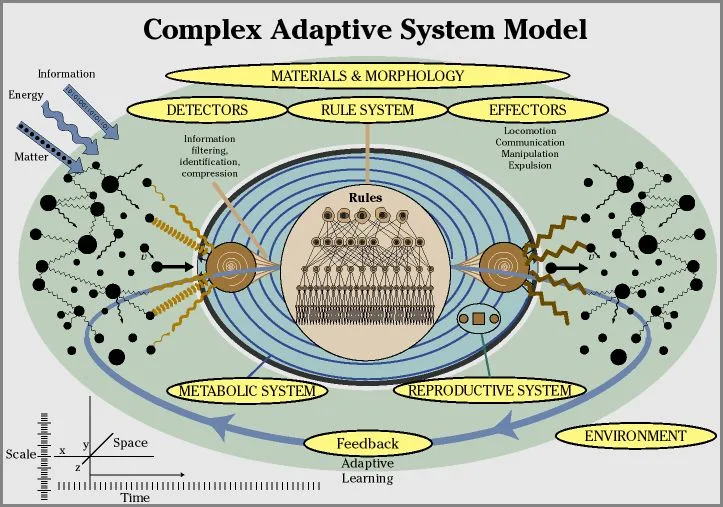
In simple systems, ethics is straightforward: you act, consequences follow, responsibility is clear. In complex systems-where actions ripple through feedback loops, interact with other forces, and produce emergent outcomes no one intended-ethical reasoning becomes radically harder.
Good intentions routinely produce harm. Responsibility diffuses. Prediction fails.
This is the ethics of algorithms, markets, organizations, cities, and ecosystems. Understanding how to think ethically in complex systems is increasingly urgent.
Table of Contents
- What Makes Systems Complex
- Why Traditional Ethics Struggles
- Emergent Harm: When No One Intends the Outcome
- Second-Order and Nth-Order Effects
- The Problem of Distributed Responsibility
- Ethical Principles for Complex Systems
- System Design as Ethical Practice
- Feedback Loops and Moral Learning
- Case Studies of Systemic Ethical Failures
- Practical Decision-Making in Complexity
- References
What Makes Systems Complex
Not all systems are complex in the technical sense. Understanding the difference matters for ethical reasoning.
As systems thinker Donella Meadows observed, "You think that because you understand 'one' that you must therefore understand 'two' because one and one make two.
But you forget that you must also understand 'and'." The interactions between parts - the "and" - are where complex systems develop their distinctive, unpredictable character.
| System Type | Characteristics | Ethical Implications |
|---|---|---|
| Simple | Few components, linear causality, predictable | Standard ethical reasoning works: act consequence responsibility |
| Complicated | Many parts, but knowable relationships, predictable with expertise | Ethical analysis requires expertise but remains tractable |
| Complex | Many interacting agents, feedback loops, emergent behavior, unpredictable | Ethical outcomes emerge from interactions; prediction often fails; responsibility diffuses |
| Chaotic | Sensitive to initial conditions, no stable patterns | Ethical responsibility for setup/bounds, not specific outcomes |
Defining Features of Complex Systems
1. EmergenceMacro-level patterns arise from micro-level interactions that no single agent intends or controls.[1] The "behavior" of the system is not reducible to the intentions of its parts.
Example: Traffic jams emerge from individual driving decisions. No one intends the jam; it arises from interactions.
2. Feedback LoopsActions create effects that feed back to change conditions for future actions, creating reinforcing or balancing dynamics.
Example: Social media algorithms amplify engagement, which trains algorithms to amplify more, which changes user behavior, which feeds back into training data.[10]
3. Nonlinearity
Small changes can have large effects; large changes can have small effects. Proportionality breaks down.
Example: A single subprime mortgage default is trivial. Millions of correlated defaults collapse the financial system.
4. Adaptation
Agents in the system learn and change behavior in response to the system, producing outcomes the designer never anticipated.[8]
Example: Students "teach to the test" when assessments become high-stakes, undermining the goal of measuring learning.
5. Path Dependence
History matters. Systems can get locked into suboptimal states because early choices constrain future options.
Example: QWERTY keyboard layout persists despite more efficient alternatives because switching costs are prohibitive.
Why Traditional Ethics Struggles
Most ethical frameworks were developed for simple or complicated contexts-direct actions with foreseeable consequences and clear agents.
Ethical Framework Assumptions vs. Complex Reality
| Traditional Assumption | Reality in Complex Systems |
|---|---|
| Clear causality: Action A causes outcome B | Outcomes emerge from interactions; causality is distributed and nonlinear |
| Predictable consequences: Foresee what will happen | Emergent effects are often unpredictable |
| Identifiable agents: Know who acted | Many agents contribute; no single cause |
| Proportional impact: Small actions = small effects | Nonlinearity means tiny changes can cascade |
| Static environment: Context stays constant | Systems adapt and evolve in response |
| Reversibility: Can undo harm | Path dependence means some harms lock in |
Why Consequentialism Fails
Consequentialism judges actions by their outcomes. But in complex systems:
- Outcomes emerge over time and are often invisible at decision time
- Unintended consequences can swamp intended ones
- Attribution is ambiguous-which action caused which outcome?
Example: A well-meaning microfinance program lifts some families out of poverty but creates debt traps for others and distorts local labor markets. Is it ethical? The answer depends on which outcomes you weight and over what time horizon.
Why Deontology Fails
Deontology judges actions by adherence to rules or duties. But in complex systems:
- Rules designed for simple contexts produce perverse outcomes
- Duties conflict (duty to innovate vs. duty to avoid harm)
- "Follow the rules" becomes an excuse when the system produces harm
Example: A pharmaceutical company follows all FDA regulations but designs pricing and distribution systems that make life-saving drugs inaccessible to the poor. Rule-following doesn't equal ethical.
Why Virtue Ethics Fails
Virtue ethics judges character-are you acting with wisdom, courage, temperance, justice? But in complex systems:[9]
- Virtuous individuals can collectively produce terrible outcomes
- Systemic harm emerges from structural features, not character flaws
- Personal virtue doesn't prevent algorithm-driven discrimination or market-driven inequality[7]
Example: Honest, hardworking bankers following prudent local lending standards collectively fueled a subprime bubble that devastated the economy.
Implication: We need ethical frameworks adapted to complexity.[13]
"Every system is perfectly designed to get the results it gets." - W. Edwards Deming, management theorist and quality systems pioneer
Emergent Harm: When No One Intends the Outcome
The most disturbing feature of complex systems: harm can emerge from the interactions of well-intentioned agents, none of whom intends or even sees the harm.
The Mechanism
- Individual agents act rationally (from their perspective)
- Actions interact with others' actions through the system
- Emergent patterns form at the system level
- Harmful outcomes occur that no one designed or desired
Classic Examples
| System | Individual Actions | Emergent Harm |
|---|---|---|
| Tragedy of the Commons | Farmers rationally graze more animals | Pasture collapses; all lose |
| Bank runs | Depositors rationally withdraw savings | Bank fails; depositors lose anyway |
| Arms races | Nations rationally build defenses | Everyone less secure, resources wasted |
| Social media filter bubbles | Users click what interests them; algorithms optimize engagement | Polarization, misinformation, radicalization |
| Urban sprawl | Families choose affordable housing farther out | Traffic, pollution, infrastructure strain, inequality |
The Ethical Problem
Who is responsible?
- Not individual users-they're acting reasonably given their constraints
- Not system designers-they often didn't foresee the emergent harm
- Not operators-they're following rules or incentives
Traditional responsibility frameworks break down. You can't simply blame "the system"-systems don't have agency. But you also can't pin it on individuals without ignoring systemic causality.
"We cannot solve our problems with the same thinking we used when we created them." (widely attributed to Albert Einstein, though no verified source for this exact wording appears in his writings) - Albert Einstein, theoretical physicist
Second-Order and Nth-Order Effects
In complex systems, first-order effects (immediate, direct outcomes) are often swamped by second-order effects (consequences of consequences) and nth-order effects (cascading downstream impacts).
Order Effects Explained
| Order | Definition | Visibility | Ethical Weight |
|---|---|---|---|
| First-order | Direct, immediate consequence of action | High-obvious at decision time | Often emphasized but can mislead |
| Second-order | Consequences of the first-order consequence | Medium-requires thinking ahead | Often dominates long-term impact |
| Third-order+ | Further cascading effects | Low-hard to foresee | Can dwarf earlier effects; often ignored |
Example: Introducing Antibiotics
| Order | Effect |
|---|---|
| First-order (positive) | Saves millions of lives from bacterial infections; revolutionizes medicine |
| Second-order (mixed) | Overuse leads to antibiotic resistance; some bacteria become untreatable |
| Third-order (negative) | Resistant bacteria spread globally; "superbugs" kill hundreds of thousands annually |
| Fourth-order (systemic) | Evolutionary arms race; future pandemics may lack effective treatments; medical procedures become riskier |
Ethical question: Is it ethical to widely deploy antibiotics knowing resistance is inevitable? The first-order benefit is enormous. The nth-order harm could be catastrophic. How do you weigh them?
Example: Social Media Platforms
| Order | Effect |
|---|---|
| First-order (positive) | Connects people; democratizes information; enables movements like Arab Spring |
| Second-order (mixed) | Algorithms optimize engagement; viral content spreads faster than truth; filter bubbles form |
| Third-order (negative) | Polarization deepens; misinformation undermines institutions; democracies destabilize; mental health declines |
| Fourth-order (systemic) | Trust in media, science, government collapses; social cohesion erodes; authoritarian manipulation scales |
Ethical question: Are platform designers responsible for third- and fourth-order harms they didn't intend but were foreseeable? What duty do they have to model downstream effects?
The Foreseeability Problem
When are you responsible for unintended consequences?
Traditional ethics often says: "You're responsible for foreseeable harms."
But in complex systems:
- Some harms are foreseeable in principle (someone could model them) but not foreseen (no one did)
- Some harms are predictable in type (something will go wrong) but unpredictable in specifics (exactly what or when)
- Some harms are unforeseeable because they depend on interactions with future systems that don't exist yet
Emerging standard: You are responsible for harms that are foreseeable given reasonable effort to model the system. This creates a duty to think in systems terms.
"The normal accident is one that has a strong likelihood of occurring in a system given the characteristics of that system." - Charles Perrow, sociologist, Normal Accidents (1984)
The Problem of Distributed Responsibility
In complex systems, causality is distributed across many agents. This creates profound challenges for moral responsibility.
The Responsibility Dilution Problem
| Scenario | Traditional Ethics | Complex Systems Reality |
|---|---|---|
| One actor, one victim | Clear responsibility | N/A |
| One actor, many victims | Clear responsibility; actor bears full moral weight | Possible in complex systems (e.g., designer of harmful algorithm) |
| Many actors, one victim | Shared responsibility; each bears partial weight | Typical in complex systems; emergent harm |
| Many actors, many victims | Diffuse responsibility; unclear attribution | Dominant in complex systems; systemic harm |
Mechanisms of Responsibility Diffusion
1. Many Hands Problem
When many people contribute to an outcome, each can claim "I only did a small part; I'm not responsible for the whole."[4]
Example: Financial crisis-mortgage brokers, lenders, rating agencies, regulators, investors all contributed. Each claims they're not responsible for the system-wide collapse.
2. Ignorance Defense
"I didn't know this would happen." In complex systems, genuine ignorance is common. But is ignorance an excuse?
Emerging standard: Willful ignorance or negligent failure to investigate foreseeable harms is not exculpatory.
3. Following Orders/Rules
"I was just following instructions/the law." Compliance becomes an excuse even when the system produces harm.
Ethical response: Following rules is necessary but not sufficient. You bear some responsibility for the systemic outcomes your actions enable.
4. Attribution Ambiguity
Causality is so distributed that pinning harm on specific decisions is nearly impossible.
Example: Climate change-millions of actors over decades. Who is responsible for a specific hurricane?
Toward Systemic Responsibility
New framework needed:
- Designers are responsible for foreseeable emergent harms and for building in monitoring/feedback[6]
- Operators are responsible for detecting and responding to unintended harms
- Governors (regulators, boards) are responsible for oversight and forcing externalities to be internalized
- Participants bear responsibility proportional to their power and knowledge
Key principle: Responsibility scales with power to shape the system and knowledge of systemic effects.
"The combination of complexity and coupling is the source of most catastrophes. Complexity alone is manageable; coupling alone is manageable; but the two together create conditions where failures cascade in ways we cannot prevent or even predict." - Charles Perrow, sociologist and organizational theorist
Ethical Principles for Complex Systems
Given the failure of traditional frameworks, what principles can guide ethical action in complexity?
Principle 1: Precautionary Principle
Statement: When an action has uncertain but potentially catastrophic systemic effects, err on the side of caution.
Rationale: In complex systems, failures can cascade and lock in. Irreversibility demands caution.
Application:
- Don't deploy technologies with existential risk (e.g., AGI, synthetic biology) without extreme safeguards
- In ecosystems, avoid interventions that could trigger tipping points
Critique: Can stifle innovation if applied too broadly. Requires judgment about what counts as "catastrophic."
Principle 2: Transparency and Legibility
Statement: Make system behavior visible to those affected. Complex systems should be as legible as possible.
Rationale: Opacity prevents accountability and learning. Affected parties can't consent to what they can't see.
Application:
- Algorithm explainability requirements
- Public reporting of systemic risks
- Open data on system performance
Critique: Some complexity resists simplification. Full transparency can be exploited (Goodhart's Law).
Principle 3: Reversibility and Experimentation
Statement: Prefer interventions that can be undone. Test changes incrementally before scaling.
Rationale: In unpredictable systems, you learn by doing. Reversibility limits downside.
Application:
- Pilot programs before national rollout
- "Circuit breakers" that halt systems when anomalies arise
- Sunset clauses for policies
Critique: Some changes (e.g., infrastructure, cultural shifts) are inherently irreversible.
Principle 4: Monitoring and Feedback Obligations
Statement: Those who design or operate systems have a duty to monitor for unintended harms and respond.
Rationale: You can't foresee all harms ex ante. Ethical responsibility includes learning and correcting.
Application:
- Real-time monitoring dashboards
- Whistleblower protections
- Mandatory incident disclosure
Critique: Monitoring is costly. Who pays? How intrusive can it be?
Principle 5: Internalizing Externalities
Statement: Actors should bear the costs of harms their actions impose on others through the system.
Rationale: Externalities (costs borne by others) drive systemic harm.[3] Internalization aligns incentives with ethics.
Application:
- Carbon taxes for emissions
- Liability for algorithmic discrimination
- Pollution penalties
Critique: Quantifying and assigning externalities is technically and politically difficult.
Principle 6: Diversity and Redundancy
Statement: Systems should have diverse components and redundant pathways to prevent failure cascades.
Rationale: Monocultures are brittle. Diversity buffers against systemic shocks.
Application:
- Multiple suppliers in supply chains
- Competing platforms (avoid monopoly)
- Cognitive diversity in decision-making teams
Critique: Diversity and redundancy are costly; trade off against efficiency.
System Design as Ethical Practice
If ethics in complex systems is hard, prevention is better than correction. Designing systems with ethical outcomes in mind is a form of moral action.
Design Principles for Ethical Systems
| Principle | Mechanism | Example |
|---|---|---|
| Alignment of Incentives | Structure rewards so individual rationality produces collective good | Markets with proper regulation; well-designed taxes/subsidies |
| Default to Ethical Outcomes | Make the easiest path the ethical one | Opt-out organ donation; privacy-by-default settings |
| Circuit Breakers | Automatic halts when system behaves anomalously | Stock market trading halts; medication dose limits |
| Feedback Loops | Real-time information on systemic effects | Emissions dashboards; diversity metrics; user harm reports |
| Modularity | Isolate failures so they don't cascade | Financial firewalls; modular code architecture |
| Escape Valves | Allow agents to exit or override when system fails | Emergency stops; human-in-the-loop for high-stakes decisions |
| Red Teams | Dedicated adversarial testing for failure modes | Security penetration testing; bias audits |
Case: Ethical Algorithm Design
Problem: Recommendation algorithms optimize engagement, which can amplify misinformation and extremism.
Ethical design interventions:
- Objective redesign: Optimize for long-term satisfaction or diverse exposure, not just clicks
- Friction for harmful content: Slow the spread of likely misinformation (e.g., prompt to read before sharing)
- Transparency: Show users why content was recommended
- User control: Let users adjust algorithmic parameters
- Monitoring: Track radicalization pathways and intervene
- Auditing: External review for bias and harm
Trade-off: Ethical design often reduces engagement (and revenue). This is why regulation may be necessary-market incentives alone won't produce ethical systems.
Feedback Loops and Moral Learning
In complex systems, you can't predict all outcomes ex ante. Ethical practice requires learning from feedback.
The Moral Learning Cycle
- Act (design system, launch policy, deploy technology)
- Monitor (measure outcomes, including unintended ones)
- Analyze (identify second-order effects, emergent harms, systemic failures)
- Adjust (redesign, intervene, correct)
- Iterate (repeat)
Feedback Loop Types and Ethical Implications
| Loop Type | Mechanism | Ethical Implication |
|---|---|---|
| Reinforcing | Success breeds more success (or failure breeds more failure) | Can amplify harms; creates winner-take-all dynamics |
| Balancing | System self-corrects toward equilibrium | Stabilizes; prevents runaway harm |
| Delayed | Effects take time to appear | Ethical harms invisible until it's too late to reverse |
Example: Social Media Echo Chambers (Reinforcing Loop)
- User engages with partisan content
- Algorithm learns user prefers this content
- Algorithm shows more partisan content
- User becomes more partisan
- User engages even more with partisan content
- Loop accelerates radicalization
Ethical intervention: Break the loop-introduce balancing mechanisms (diverse content injection, engagement limits, friction).
The Challenge of Delayed Feedback
Many systemic harms have long time lags between action and consequence:
- Climate change: Emissions today cause harm decades later
- Antibiotic resistance: Overuse today creates untreatable infections years later
- Debt: Borrowing today constrains choices for decades
- Education policy: Effects on students appear years after implementation
Ethical difficulty: Humans discount future harms. Systems that create delayed harm are ethically problematic even if no one intended harm.
Implication: We need anticipatory governance-institutions that force consideration of long-term systemic effects.
Case Studies of Systemic Ethical Failures
Case Study 1: The 2008 Financial Crisis
System: Global financial markets with complex derivatives, securitization, and leverage.
Individual Actions (seemingly rational):
- Homebuyers took out mortgages they could afford under initial terms
- Mortgage brokers earned commissions selling loans
- Banks securitized mortgages to spread risk
- Rating agencies gave high ratings (paid by issuers)
- Investors bought AAA-rated securities
- Regulators relied on market discipline
Emergent Outcome: Correlated defaults triggered cascade; financial system collapsed; millions lost homes, jobs, savings.
Ethical Lessons:
- Distributed responsibility: No single villain, but system-wide failure
- Misaligned incentives: Short-term gains privatized; long-term losses socialized
- Opacity: Complexity obscured risk; even experts didn't understand system[14]
- Externalities: Harm borne by those (homeowners, taxpayers) not party to transactions
- Lack of circuit breakers: No mechanisms to halt cascade once started
Who was responsible?
- Designers of derivatives? (Enabled complexity)
- Regulators? (Failed to govern)
- Rating agencies? (Misjudged risk)
- Bankers? (Pursued profit without considering systemic risk)
- Homebuyers? (Took on debt)
Answer: All share partial responsibility scaled to their power and knowledge.
Case Study 2: Facebook and the Rohingya Genocide
System: Facebook platform used by millions in Myanmar, where it's the primary internet for many.
Individual Actions:
- Burmese military and extremists posted anti-Rohingya propaganda
- Users shared inflammatory content
- Facebook's algorithm amplified viral, engaging content
- Moderators (understaffed, non-Burmese-speaking) missed hate speech
Emergent Outcome: Hate speech radicalized population; contributed to genocide of Rohingya Muslims.[15]
Ethical Lessons:
- Second-order harm: Platform designed for connection enabled mass violence
- Foreseeable but not foreseen: Experts warned of risks; Facebook didn't act
- Algorithmic amplification: Engagement optimization spreads hate faster than counterspeech
- Responsibility of designers: Facebook had power to intervene; chose not to prioritize it
- Global vs. local: System designed for U.S. context failed catastrophically in Myanmar
Who was responsible?
- Military and extremists? (Direct perpetrators)
- Facebook? (Provided amplification mechanism; failed to moderate)
- Users? (Shared hate speech)
Consensus: Facebook bears significant moral responsibility for enabling and amplifying hate, even if it didn't intend genocide. Power to shape the system creates responsibility for its outcomes.
Case Study 3: The Opioid Epidemic
System: Pharmaceutical companies, doctors, patients, regulators, insurance, cultural attitudes toward pain.
Individual Actions:
- Purdue Pharma marketed OxyContin as low-risk for addiction (false claims)
- Doctors prescribed opioids to manage pain (often appropriate)
- Patients took prescribed medication (trusting doctors)
- Insurance reimbursed pills but not alternative treatments
- Regulators approved drugs based on company-funded research
Emergent Outcome: Millions addicted; hundreds of thousands dead from overdoses.
Ethical Lessons:
- Incentive corruption: Pharma profits from volume; doctors rewarded for prescribing; no one incentivized to prevent addiction
- Information asymmetry: Companies knew addiction risk; patients and doctors didn't
- Regulatory capture: Purdue influenced FDA and medical establishment
- Systemic lock-in: Once addiction took hold, people couldn't escape; treatment infrastructure inadequate
- Externalized harm: Pharma profited; patients and society bore costs
Who was responsible?
- Purdue Pharma? (Knowingly misled)
- Doctors? (Overprescribed)
- Regulators? (Failed oversight)
- Patients? (Some accountability, but power imbalance and addiction undermine agency)
Outcome: Courts held Purdue accountable (billions in fines, bankruptcy); individual executives prosecuted. Recognition that systemic harm requires systemic accountability.
Practical Decision-Making in Complexity
Given the ethical challenges of complex systems, how should individuals and organizations make decisions?
Decision Framework for Complex Systems
| Step | Action | Purpose |
|---|---|---|
| 1. Map the system | Identify key agents, feedback loops, external dependencies | Understand structure |
| 2. Model second-order effects | Ask "What happens next? And then what?" | Surface unintended consequences |
| 3. Pre-mortem analysis | Assume failure; work backward to causes | Identify failure modes |
| 4. Identify externalities | Who bears costs who isn't party to decision? | Ensure fairness |
| 5. Assess reversibility | Can this be undone if it goes wrong? | Limit downside |
| 6. Build in monitoring | How will we detect unintended harm? | Enable learning |
| 7. Stress test | What happens under extreme conditions? | Prevent catastrophic failure |
| 8. Consult affected parties | Who will live with the consequences? | Respect autonomy and justice |
| 9. Iterate and adjust | Plan to learn and correct | Commit to feedback |
Red Flags: When to Be Extra Cautious
| Warning Sign | Why It Matters |
|---|---|
| Irreversibility | Can't undo harm if wrong |
| Opacity | Can't see what's happening; accountability impossible |
| Winner-take-all dynamics | Reinforcing loops create extreme inequality |
| Long time lags | Harm appears too late to correct |
| Catastrophic downside | Low-probability, high-impact failures |
| Vulnerable populations affected | Power imbalance means they can't defend themselves |
| Novelty | No historical precedent; outcomes truly unpredictable |
Questions to Ask
Before Acting:
- What are the second- and third-order effects of this decision?
- Who benefits? Who bears the costs?
- What could go wrong? How would we know?
- Can we reverse this if it fails?
- Are we monitoring for unintended harms?
- What feedback loops does this create?
While Operating:
- Are outcomes matching expectations?
- What unintended consequences are emerging?
- Are there early warning signs of systemic failure?
- Who is being harmed that we didn't anticipate?
After Failure:
- What systemic features enabled this harm?
- Who had the power to prevent it?
- How do we redesign to prevent recurrence?
- What did we fail to monitor?
Conclusion
"The black swan is the outlier, the unexpected, the unpredictable - and yet it is these rare events that explain almost everything in the world." - Nassim Nicholas Taleb, The Black Swan (2007)
Ethics in complex systems is ethics in a world where:
- Good intentions routinely produce harm
- Outcomes emerge from interactions no one controls
- Responsibility is distributed and ambiguous
- Prediction is unreliable, and learning must be continuous
Traditional ethical frameworks-consequentialism, deontology, virtue ethics-were built for simpler worlds. They struggle in complexity.
What's needed:
- Anticipatory governance that models systemic effects
- System design as ethical practice
- Monitoring and feedback obligations
- Accountability scaled to power and knowledge
- Humility about limits of prediction, commitment to learning
The hardest truth: You can be individually ethical-honest, kind, rule-following-and still contribute to systemic harm. Ethics in complex systems demands thinking beyond individual virtue to structural responsibility.
The systems we build shape the outcomes we get. Designers, operators, and governors of complex systems bear moral responsibility for the worlds they create-intended and emergent.
Research Evidence: Empirical Studies on Complexity and Ethical Outcomes
The field of complex systems ethics has moved beyond philosophical analysis to generate testable predictions and empirical studies of how system structure shapes moral outcomes. Several research programs have produced findings directly relevant to ethical reasoning and governance in complex environments.
Elinor Ostrom, who won the 2009 Nobel Memorial Prize in Economic Sciences, conducted decades of field research documenting how communities actually govern shared resources-fisheries, groundwater basins, forests, irrigation systems-without either privatization or top-down state control.[5]
Her landmark book Governing the Commons (1990) synthesized case studies from Switzerland, Japan, Spain, California, and Nepal.
The central finding challenged the dominant assumption that collective resource management inevitably produces Hardin's "tragedy of the commons": Ostrom documented communities that sustained shared resources for centuries through self-designed governance institutions.
Crucially, she identified the design principles-clearly defined boundaries, proportional rules, collective-choice arrangements, effective monitoring, graduated sanctions, conflict-resolution mechanisms-that distinguished successful from failed commons governance.
The Nobel Committee cited this as evidence that "economic analysis can shed light on most forms of social organisation," including complex multi-stakeholder ethical problems that resist simple optimization.
Ostrom's most direct ethical implication: distributed responsibility need not mean diffuse accountability. She found that communities achieving sustainable governance consistently built monitoring and sanctioning into their institutions rather than relying on individual virtue.
This aligns with Principle 4 of the ethical framework described above: monitoring obligations are not merely procedural but constitute the ethical core of responsibility in complex systems. Without monitoring, moral responsibility becomes rhetorical.
Nassim Nicholas Taleb's empirical work on tail risks, developed across Fooled by Randomness (2001), The Black Swan (2007), and Antifragile (2012), established an important empirical regularity with ethical implications: complex systems are subject to rare, high-impact events that standard statistical models systematically underestimate, and the people who bear the costs of these events are typically not the people who made the decisions that created the vulnerabilities.
Taleb analyzed historical financial crises, technological disasters, and geopolitical shocks to document that complex systems fail in ways that are improbable under normal assumptions but become near-certain over long time horizons when fragilities accumulate.[11]
The ethical dimension Taleb made explicit: systems designers who privatize gains (profits in normal times) while socializing losses (bailouts and harm in crisis) are making an implicit ethical choice that his framework identifies as "antifragile harm transfer." His 2014 paper with Constantine Sandis in Review of Behavioral Economics, "The Skin in the Game Heuristic for Protection Against Tail Events," argued that decision-makers who do not personally bear the downside of their choices have insufficient ethical skin in the game to produce reliable risk management.
This connects directly to the distributed responsibility problem: when complexity allows moral hazard to be built into system structure, emergent harm becomes predictable rather than accidental.
Dirk Helbing, professor of computational social science at ETH Zurich, has produced quantitative research on how digital systems-particularly algorithmic recommendation systems and social media platforms-generate emergent social harms through feedback mechanisms.
His 2016 paper "Societal, Economic, Ethical and Legal Challenges of the Digital Revolution" in Foundations of Physics used simulation models to show that relatively small algorithmic biases toward engagement can produce large-scale polarization effects through network amplification.[12]
Helbing's quantitative models predicted polarization magnitudes that subsequent empirical measurements have largely validated: a 2018 study by Bail and colleagues in Proceedings of the National Academy of Sciences found that Twitter users exposed to opposing viewpoints became more politically extreme-evidence that even well-intentioned algorithmic interventions can produce counter-intuitive second-order effects in complex social systems.
Helbing co-authored a 2017 article in Scientific American titled "Will Democracy Survive Big Data and Artificial Intelligence?" documenting evidence from multiple countries that social media amplification of outrage-inducing content correlated with measurable increases in political polarization, declining trust in democratic institutions, and increased support for authoritarian alternatives.
The paper identified the mechanism: complex feedback loops between user behavior, algorithmic optimization, content creator incentives, and advertiser demand create a self-reinforcing system that produces polarization as an emergent property even when no individual actor intends it.
The study estimated that platforms reaching over 2 billion users had system-level effects on democratic stability that no single actor controlled but that the designers of the optimization functions could, in principle, have modeled in advance.
Charles Perrow's organizational accident research, particularly his analysis of the 1979 Three Mile Island nuclear accident and the comparative study of accidents across aviation, marine shipping, dams, nuclear power, chemical plants, and nuclear weapons in Normal Accidents (1984), established empirically that tight coupling combined with complex interactions produces accidents at predictable rates-not because of human error or individual negligence, but because of system structure.
Perrow's case studies of major industrial accidents (nuclear, chemical, aviation, and maritime) found that the most catastrophic accidents consistently occurred in systems combining high complexity (many interacting components with non-linear relationships) and tight coupling (rapid propagation of failures without slack or buffer).[2]
His conclusion: "Some systems are so complex and tightly coupled that accidents are normal, not aberrational."
The ethical implication Perrow drew was specific: system designers who build tightly coupled complex systems bear heightened moral responsibility for accidents that are, by his analysis, statistically inevitable. This extends conventional notions of negligence.
If a designer can be shown to have built a normal-accident system-one where accidents are predictable from structure-the conventional defense of "no one anticipated this failure" becomes weaker.
Perrow's framework has been applied to analyze disasters at Bhopal (1984), Chernobyl (1986), Deepwater Horizon (2010), and financial system collapses, in each case identifying the structural features that made disasters normal rather than exceptional.
Case Studies: When Systemic Complexity Produced Measurable Ethical Harm
The abstract principles of complex systems ethics become concrete through documented cases where complexity, distributed responsibility, and emergent harm produced quantifiable damage. These cases are useful not as cautionary tales but as evidence for what system structures reliably produce which ethical outcomes.
The Subprime Mortgage Crisis: Distributed Responsibility and Emergent Harm at Scale
The 2007-2009 financial crisis, often attributed to simple greed or regulatory failure, was analyzed more precisely by economists Gary Gorton and Andrew Metrick in their 2012 Journal of Financial Economics paper "Securitized Banking and the Run on Repo." Their central finding: the crisis was a run on the "shadow banking system"-a complex network of short-term financing arrangements that were individually prudent but collectively fragile.
Each institution acted within accepted norms of financial practice; the catastrophic systemic outcome emerged from the interaction of millions of locally rational decisions through interconnected feedback loops.
The quantified damage establishes the ethical stakes: the Federal Reserve Bank of Dallas estimated total cumulative output loss from the financial crisis at between $6 trillion and $14 trillion-roughly one full year of US GDP. Approximately 8.8 million Americans lost jobs between 2008 and 2010.
Over 3.8 million families lost their homes to foreclosure between 2007 and 2010, according to RealtyTrac data.
Economists Emmanuel Saez and Gabriel Zucman documented that the crisis caused the largest wealth destruction for the bottom 90% of American households in the post-World War II period, while the top 1% recovered all wealth losses within three years.
The distributed responsibility structure makes the ethical analysis complex in precisely the ways described in this article.
Mortgage brokers who originated loans they knew were unsuitable for borrowers bore partial responsibility-but the compensation structures designed by their employing banks incentivized origination volume without quality controls.
Investment banks that securitized mortgages into CDOs bears partial responsibility-but ratings agencies provided AAA ratings that created apparent regulatory legitimacy for the securities.
Ratings agencies bear partial responsibility-but were paid by the issuers whose products they rated, a structural conflict of interest that regulators had observed and not corrected.
Regulators bear partial responsibility-but operated under regulatory frameworks designed in the 1930s that did not contemplate shadow banking's scale or complexity.
Alan Greenspan, chairman of the Federal Reserve from 1987 to 2006, testified before the House Oversight Committee in October 2008 that he had "found a flaw" in his economic model-specifically, the assumption that self-interest in financial institutions would protect shareholder equity.
"I made a mistake in presuming that the self-interest of organizations, specifically banks and others, were such as that they were best capable of protecting their own shareholders and their equity in the firms," Greenspan testified.
This public acknowledgment by the most consequential financial regulator of the era constitutes a direct empirical test of the ethical principle that distributed systems cannot rely on individual rationality to produce collective safety.
The Rana Plaza Collapse: Complex Supply Chains and Distributed Responsibility
On April 24, 2013, the Rana Plaza building in Dhaka, Bangladesh collapsed, killing 1,134 garment workers and injuring over 2,500 more. The building housed five garment factories producing clothing for major Western brands.
The ethical complexity of the case comes from its supply chain structure: no single entity-not the building owner, the factory managers, the brands, or the Bangladeshi regulatory system-held complete responsibility for the conditions that produced the collapse.
Post-collapse investigations, including the independent Rana Plaza Arrangement coordinated by the International Labour Organization, documented the following responsibility distribution: building owner Sohel Rana had obtained construction permits for a five-story building, then added three unauthorized floors for factory space; factory managers were aware of structural cracks discovered the morning of the collapse but ordered workers to return after brief inspection; brands had contracted with factories through intermediary sourcing agents who bore formal contractual responsibility for supplier compliance; the Bangladeshi regulatory system had insufficient inspectors and documented corruption in the building permit process.
The ILO estimated total compensation paid to victims and their families through the Rana Plaza Arrangement at $30 million-a figure agreed to be substantially less than adequate for the harm caused.
The Dhaka-based think tank Centre for Policy Dialogue estimated the lifetime economic loss to victims' families at approximately $155 million at conservative valuation.
The gap between compensation paid and harm caused illustrates the accountability failure that distributed responsibility enables: when no entity bears full responsibility, the aggregate compensation tends to reflect negotiating power rather than actual damage.
The case produced the Bangladesh Accord on Fire and Building Safety, a legally binding agreement between global clothing brands and trade unions covering over 1,600 factories.
As of 2022, Accord inspectors had conducted over 38,000 safety inspections and required remediation of over 95% of identified hazards, according to the Accord's published reports.
The Bangladesh Garment Manufacturers and Exporters Association reported zero structural building collapses in Accord-covered factories since the agreement's implementation-evidence that structural governance intervention in complex supply chains can measurably reduce emergent harm when it establishes clear responsibility and monitoring.
The Rana Plaza case illustrates the practical application of several principles from this article. The complex supply chain structure distributed both production and risk across multiple jurisdictions and actors.
The emergent harm-a building collapse-arose from the interaction of many locally rational decisions (brands seeking low-cost sourcing, factories seeking building space, owners seeking rental income, regulators overwhelmed by rapid industrial growth).
The post-collapse governance response-the Accord's legally binding monitoring requirements-demonstrates the "monitoring and feedback obligations" principle: ex post design of accountability structures produced measurable harm reduction even in a system where ex ante prediction of the specific failure would have been extremely difficult.
The Flint Water Crisis: Government System Complexity and Vulnerable Populations
The Flint, Michigan water crisis (2014-2019) provides a case study in how complex governmental systems, when under fiscal stress, can produce catastrophic harm to vulnerable populations through distributed decision-making that no single actor intended.
In April 2014, the state-appointed emergency manager for Flint decided to switch the city's water source from Lake Huron (purchased from Detroit) to the Flint River, primarily to reduce costs during the city's financial emergency.
The decision was the product of a complex governance structure: Michigan's emergency manager law gave state-appointed officials decision authority that bypassed locally elected government; the Michigan Department of Environmental Quality (MDEQ) was responsible for water quality oversight; the Environmental Protection Agency had federal oversight authority; and the Flint city government had operational responsibility for the water system.
The lead contamination that followed-caused by failure to add corrosion inhibitors to the more corrosive Flint River water-was documented by Virginia Tech environmental engineering professor Marc Edwards, whose team tested 277 Flint homes in 2015 and found 40% with lead levels above the EPA action level of 15 parts per billion.
Blood lead levels in Flint children under age five increased from 2.4% above 5 micrograms per deciliter before the water switch to 4.9% after-a doubling of children with elevated blood lead that the Hurley Medical Center researchers Mona Hanna-Attisha and Jenny LaChance documented in a 2016 American Journal of Public Health study.
The researchers faced initial denial from Michigan state officials before their findings were confirmed by independent analysis.
Lead exposure in early childhood has well-documented irreversible effects on cognitive development.
Researchers Marc Edwards and Siddhartha Roy estimated in a 2019 paper that the 8,000 children under six who were exposed to elevated lead water in Flint faced a lifetime earning reduction of approximately $395 million, plus substantial associated public costs in special education and social services.
The Michigan Civil Rights Commission, in a 2017 report, concluded that race and poverty were factors in the inadequate government response: "The facts of the Flint water crisis lead us to conclude that systemic racism through explicit and implicit bias, along with the Snyder administration's failure of leadership, culture and accountability, needs to be addressed before Michigan can effectively address the crisis Flint is still experiencing."
The Flint case illustrates several complex systems ethical principles with unusual clarity. The responsibility diffusion across the emergency manager, MDEQ, EPA, and city officials created conditions where each entity could attribute responsibility to others when the harm became apparent.
The populations most harmed-low-income Black residents of Flint-had the least political power to demand accountability.
The irreversibility of lead exposure in developing children made the harm particularly severe: unlike many complex system failures that produce economic damage which can partially be compensated, neurological harm to children cannot be undone.
And the long time lag between the water switch decision and visible health effects created the delayed feedback dynamics that make complex system ethical failures difficult to interrupt.
Sources & Further Reading
Meadows, D. H. (2008). Thinking in Systems: A Primer. Chelsea Green Publishing.
Essential introduction to systems thinking and leverage points.Perrow, C. (1984). Normal Accidents: Living with High-Risk Technologies. Princeton University Press.
Explains how complex systems produce "normal" failures.Hardin, G. (1968). "The Tragedy of the Commons." Science, 162(3859), 1243-1248.
Classic articulation of emergent harm from individual rationality.Thompson, D. F. (1980). "Moral Responsibility of Public Officials: The Problem of Many Hands." American Political Science Review, 74(4), 905-916.
Foundational work on distributed responsibility.Ostrom, E. (1990). Governing the Commons: The Evolution of Institutions for Collective Action. Cambridge University Press.
How communities solve collective action problems without centralized control.Johnson, D. G., & Powers, T. M. (2005). "Computer Systems and Responsibility: A Normative Look at Technological Complexity." Ethics and Information Technology, 7(2), 99-107.
Ethics of responsibility in technological systems.O'Neil, C. (2016). Weapons of Math Destruction: How Big Data Increases Inequality and Threatens Democracy. Crown.
Case studies of algorithmic harm in complex systems.Tenner, E. (1996). Why Things Bite Back: Technology and the Revenge of Unintended Consequences. Knopf.
Historical examples of technological backfires.Vallor, S. (2016). Technology and the Virtues: A Philosophical Guide to a Future Worth Wanting. Oxford University Press.
Virtue ethics adapted for technological complexity.Zuboff, S. (2019). The Age of Surveillance Capitalism: The Fight for a Human Future at the New Frontier of Power. PublicAffairs.
Systemic ethical analysis of data-driven business models.Taleb, N. N. (2007). The Black Swan: The Impact of the Highly Improbable. Random House.
On unpredictability and tail risks in complex systems.Sunstein, C. R. (2019). How Change Happens. MIT Press.
Social cascades and tipping points in complex social systems.Floridi, L. (2013). The Ethics of Information. Oxford University Press.
Philosophical framework for information ethics in complex systems.Pasquale, F. (2015). The Black Box Society: The Secret Algorithms That Control Money and Information. Harvard University Press.
On opacity and accountability in algorithmic systems.United Nations Human Rights Council (2018). Report of the Independent International Fact-Finding Mission on Myanmar.
Documents Facebook's role in Rohingya genocide.
About This Series: This article is part of a larger exploration of ethics, complexity, and decision-making. For related concepts, see [Unintended Consequences], [Good Intentions, Bad Outcomes], [Systems Thinking Vocabulary], [Second-Order Thinking], and [Ethical Decision-Making Explained].