
In 2019, journalist Kashmir Hill conducted an experiment: she blocked all traffic to the five major tech companies (Amazon, Facebook, Google, Microsoft, and Apple) from her home network.[6] The results were jarring. Not just her own services stopped working.
She discovered that these companies' infrastructure was embedded in thousands of websites and apps she used regularly. Blocking Amazon Web Services took down large swaths of the internet. Blocking Facebook broke login systems on sites that had nothing to do with Facebook.
The experience illustrated something most people have not fully processed: the internet as we experience it is not just delivered through these companies. It is built on them.
Privacy protection is not out of reach. Instead, protecting your privacy online means grasping the actual threat model: who is collecting your data, what they do with it and which protective measures have real effect versus security theater.
There is good news. A focused set of practical steps that need neither technical expertise nor paranoia can greatly cut your exposure.
This guide covers what actually works.
Understanding Who Collects Your Data and Why
Getting privacy protection begins by knowing your adversaries. Everyone does not face the same threat model and the protection measures that work for a journalist in an authoritarian country are very different from what an ordinary consumer needs to do to cut commercial tracking.
The most common data collectors and their motivations:
Commercial data brokers and advertisers: To create profiles that target ads, these entities gather behavioral data such as websites visited, purchases made, search queries and location history. This is by far the most widespread kind of data collection that affects ordinary users.
Most of it is legal and disclosed in privacy policies that almost no one reads and the money involved is huge. The global digital advertising industry passed $600 billion in 2023.
Platform companies (Meta, Google, Microsoft, Apple): These companies collect extensive data about your behavior across their own services and, through tracking pixels and SDKs, across much of the rest of the internet.
Business models differ among them. Google and Meta mainly make money from advertising and Apple makes privacy its differentiator but all collect large amounts of behavioral data.
Cybercriminals: Financial gain drives these criminals as they go after passwords, financial data and account access. Phishing, credential stuffing using leaked passwords from one breach to get into other accounts and malware are among the methods they use.
Data breach exposure: Through breaches at companies that hold it, many people's personal data gets exposed rather than through active targeting. Health insurers, retailers, financial institutions and government agencies are among the organizations whose breaches can expose data even when your personal security practices are excellent.
Ask these questions and you grasp your threat model. Who is most likely to want my data, what would they do with it and what is my actual risk. The protective steps that count most turn on the answers.
The Most Effective Privacy Protections: What the Evidence Shows
Not all privacy measures are created equal. Among those discussed widely, some have little practical effect. Others have a large and measurable effect. Knowing the difference helps you to prioritize.
Research published by Güunes Acar, Claudia Diaz, and colleagues at imec-COSIC, KU Leuven and later extended by the Electronic Frontier Foundation in their Cover Your Tracks project (2020-2023) measured the actual effectiveness of common browser-based privacy measures against fingerprinting.[5] Their findings showed that:
- Though they cut tracking a great deal, standard browser privacy settings like third-party cookie blocking and private/incognito mode did not stop fingerprinting. That is the practice of identifying users by their browser configuration, fonts and hardware characteristics even without cookies[1].
- Privacy-focused browsers (Firefox with strict settings, Brave) reduced fingerprinting substantially but not completely
- Both browser choice and configuration were needed for the strongest fingerprinting protection and in their test suite Brave's anti-fingerprinting mode gave near-complete protection.
A parallel research effort by Steven Englehardt and Arvind Narayanan at Princeton University's Center for Information Technology Policy, published as the OpenWPM web privacy measurement study (2016, with ongoing updates), crawled over 1 million websites to measure tracking behavior.[2]
Their findings, updated through 2023, established that:
- Third-party tracking (trackers embedded on sites you visit that belong to other companies) was present on 92% of the top 1 million websites
- Google operated trackers on approximately 75% of websites studied
- Fingerprinting scripts were present on roughly 30% of the top 10,000 websites, and fingerprinting was used even on pages the user would not expect to be commercial
"The scale of third-party tracking means that browsing with default browser settings - even in private mode - leaves a comprehensive behavioral trail with dozens of third parties per session."
Narayanan & Englehardt, Princeton CITP, 2023
Browser and Search Engine: Your First Line of Defense
Of almost any single choice, your browser and search engine selections have the biggest effect on privacy.
Browser recommendations:
| Browser | Privacy Default | Fingerprinting Protection | Ease of Use | Best For |
|---|---|---|---|---|
| Brave | Excellent | Strong (built-in) | Easy | Most users wanting high privacy |
| Firefox | Good (with setup) | Moderate | Easy | Users wanting open-source + extensions |
| Chrome | Poor | Weak | Easy | Not recommended for privacy |
| Safari | Moderate | Moderate (ITP) | Easy | Apple ecosystem users |
| Tor Browser | Maximum | Maximum | Harder | High-risk users, journalists |
For most users, Brave offers the best balance of strong default privacy, ease of use and compatibility. Ads and trackers are blocked by default and aggressive anti-fingerprinting is built in, with no configuration required.
Search engine recommendations:
- DuckDuckGo: There is no search tracking, no search history and no profile building. Queries that are obscure get slightly less accurate results from DuckDuckGo but most searches get results that are entirely adequate.
- Brave Search: Independent index (not Google or Bing data), strong privacy defaults, growing accuracy.
- Startpage: This tool gives back Google results without sending your identity to Google. It is a useful middle choice if you need Google's accuracy.
Passwords, Authentication, and Account Security
Measurable harm is greatest where password security is concerned. Account takeovers that can then lead to financial fraud, reputational damage and loss of access to critical services follow from credential theft.
The fundamental rules:
Unique passwords for every account. The most important single habit. When a site is breached (and sites are breached constantly), attackers use the leaked credentials to attempt access on other services (credential stuffing). A unique password per site means a breach of one service cannot compromise your others.
A password manager makes this possible. No human can remember 150 unique strong passwords. Password managers generate, store, and autofill them. Recommended options:
- Bitwarden: Open source, audited, free for individuals, cross-platform. Best default recommendation.
- 1Password: Excellent UX, strong security model, paid ($3/month)
- Dashlane: Good interface, includes dark web monitoring, paid
Two-factor authentication (2FA) on every account that offers it. 2FA requires a second verification step beyond your password - typically a time-based code from an authenticator app. Even if your password is stolen, an attacker cannot access your account without the second factor.
Wherever possible, use an authenticator app such as Google Authenticator, Authy or built into Bitwarden instead of 2FA based on SMS. Criminals can make your carrier redirect your phone number through social engineering and SMS codes are vulnerable to that kind of SIM-swapping attack.
Email Privacy: Reducing Your Exposure
Sensitive personal and professional information goes into email and most online accounts use it as their identity anchor. Standard email protocols send metadata that shows how people communicate and email is a major privacy exposure surface.
Email provider choices:
| Provider | Encryption | Data Use | Privacy Jurisdiction |
|---|---|---|---|
| Gmail | Transport only | Ad targeting | US |
| Outlook/Hotmail | Transport only | Ad targeting | US |
| ProtonMail | End-to-end (between PM users) | None | Switzerland |
| Tutanota | End-to-end (between Tuta users) | None | Germany |
| Fastmail | Transport only, privacy-focused | None | Australia |
Users who need higher privacy get the strongest protection from ProtonMail. Messages between ProtonMail users are end-to-end encrypted and the company cannot read your mail. The catch is that end-to-end encryption works only when both sides use ProtonMail.
Email aliases: With services such as SimpleLogin and addy.io you can make unlimited email aliases that forward to your actual inbox. Give each site you sign up with its own unique alias. When an alias starts getting spam, it shows you which service sold your address and you can turn off that alias without having to change your real email.
Mobile Privacy: What Your Phone Reveals
Of all devices that most people own, your smartphone is the one that intrudes most on privacy. It knows your location constantly, your communication patterns, what apps you use and your sleep schedule and usually your physical health data as well.
Key mobile privacy steps:
Audit app permissions. Go through your apps and revoke unnecessary permissions: location access for apps that do not need it, microphone and camera access for apps you do not want having it, contacts access for apps that should not need it.
Both iOS and Android now show you how often apps are accessing sensitive permissions - review this periodically.
Disable advertising IDs. On both iOS (Settings > Privacy > Tracking) and Android (Settings > Privacy > Ads), you can opt out of cross-app behavioral tracking and reset your advertising identifier and that meaningfully cuts down targeted advertising.
Use a VPN on untrusted networks. Your traffic gets encrypted and protection against local eavesdropping is built in when you use a VPN on public Wi-Fi. Mullvad (no logs and cash payment available), ProtonVPN (audited and based in Switzerland) or IVPN are recommended choices.
Review what data your phone sends to the manufacturer. Telemetry is collected by both Apple and Google. In settings, the iOS Improve iPhone & Watch settings and Android usage data sharing can be turned off.
Research on the Privacy-Behavior Gap and What Closes It
One of the most consistent findings in privacy research is the privacy paradox: users report caring about privacy but do not take protective action. Understanding why this gap exists helps explain what interventions actually change behavior.
Research by Laura Brandimarte, Alessandro Acquisti, and George Loewenstein at Carnegie Mellon University's Heinz College, published in Psychological Science (2013) and extended in subsequent work, identified a key driver: users consistently underestimate the scope of data collection because they cannot see it happening.[3]
Unlike physical surveillance where a camera in a room is visible, digital data collection is invisible and that reduces the psychological discomfort that would otherwise drive people to take protective action.
A major 2023 study by Yixin Zou, Shawn Danino, and colleagues at the University of Michigan School of Information, published in IEEE Security & Privacy, surveyed 1,006 Americans on their privacy knowledge and behavior.[4] Only 20% of respondents could correctly identify what information their smartphones tracked.
Still, users who went through a 10-minute informational intervention on actual data collection practices saw a 63% increase in taking at least one concrete protective step within 30 days. That confirms that information does change behavior when it is made concrete and specific.
"Privacy protection is not primarily an attitude problem. It is a knowledge problem. Users who understand specifically what data is collected and specifically what it enables take substantially more protective action."
Zou et al., University of Michigan, 2023
A Practical Privacy Improvement Checklist
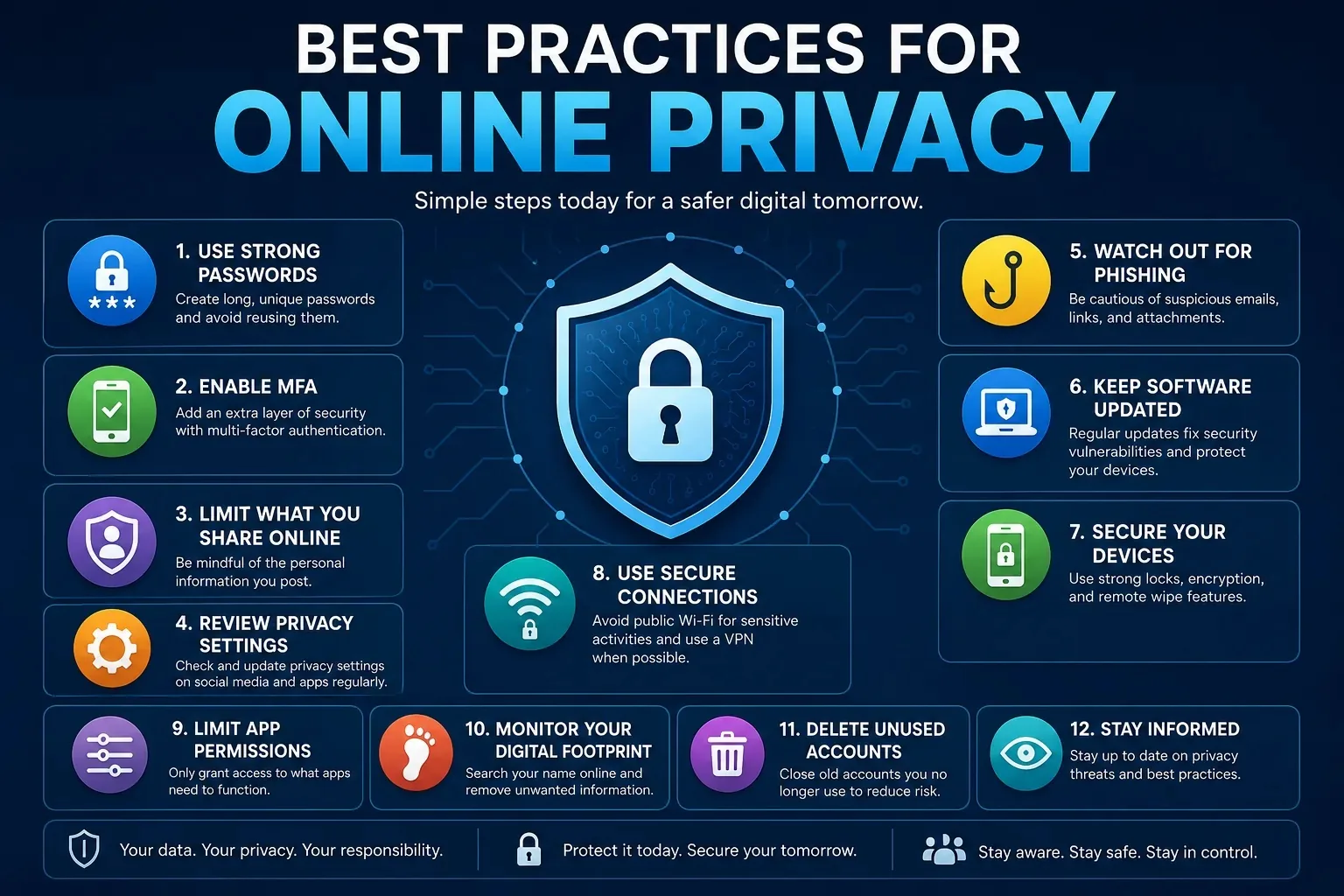
Putting every privacy protection in place at once is too much to handle. This sequenced checklist prioritizes the steps by impact and effort.
High impact, low effort (do these first):
- Install a password manager and start creating unique passwords for new accounts
- Enable 2FA on your email account and financial accounts
- Switch your default search engine to DuckDuckGo or Brave Search
- Install Brave browser or configure Firefox with uBlock Origin
High impact, moderate effort:
- Switch browser on mobile to Brave
- Audit and revoke unnecessary mobile app permissions
- Disable advertising ID on your phone
- Create email aliases for new signups going forward
Moderate impact, ongoing habit:
- Use a VPN when on public Wi-Fi
- Check HaveIBeenPwned.com for your email addresses; change passwords for any breached accounts
- Review your Google account activity and data settings annually
- Delete apps you no longer use (they continue collecting data)
For higher-risk situations:
- Consider ProtonMail for sensitive communications
- Use Signal for messaging instead of standard SMS
- Review what Google, Meta, and Apple data dashboards say they have collected about you
Why Privacy Is Structurally Difficult: The Economics of Surveillance
This guide gives practical advice that works. Swimming against a current is what following it feels like and there is a cause for that feeling and it counts. It does not count to bring on hopelessness and knowing why privacy protection is structurally hard is what lets you be realistic about what individual action can and cannot do.
The attention economy: your data is the product
The dominant business model of the consumer internet is built on a fundamental exchange: you receive a free service, and in return the company collects data about your behavior, which it uses to sell targeted advertising. This is not a flaw in the system - it is the system.
The services that billions of people use daily (search, email, social media, maps, video) were built on the assumption that behavioral surveillance is the revenue model.
Structural misalignment results from this. The company's financial incentive is to collect as much data as possible, retain it for as long as possible and use it in as many ways as possible. Your privacy interest is the exact opposite and the two goals cannot both be maximized at the same time.
When the service is free, the business model is the answer to the question of whose interests win.
Network effects that entrench surveillance
Targeted advertising only works at scale. An advertiser who wants to reach left-handed guitarists in their 30s needs a platform with enough users to make that segment commercially viable.
This creates a self-reinforcing dynamic: the platforms with the most users attract the most advertising revenue, which funds better services, which attract more users. Winner-take-all dynamics consolidate surveillance into a small number of extremely large platforms.
The network effect operates on advertisers too. Agencies move their spending to platforms where the data is richest and the targeting is most precise - which further rewards the companies that have collected the most. New entrants cannot easily compete because they lack the data flywheel that makes targeting accurate.
Alternatives that respect privacy have a structurally higher bar to meet. They have to compete on quality against incumbents that get subsidies from surveillance revenue.
The principal-agent problem in privacy
In economics, a principal-agent problem arises when one party (the agent) is supposed to act in the interests of another (the principal), but their own incentives point in a different direction. Privacy is a textbook case.
As the principal, you are in charge. The company acts as the agent that is nominally bound by privacy policies saying what will happen to your data. Yet the profit motive of the company, which drives its decisions in reality, does not line up with what your privacy interest needs.
Privacy policies are not contracts negotiated between equals. They are terms the company writes, can change unilaterally, and which you agree to by continuing to use a service you depend on. The agent has written the rules governing the agent's behavior.
That is why privacy advocacy that relies on companies "doing the right thing" has historically failed without external pressure from regulation or competition.
Information asymmetry and the privacy paradox
Every click, every dwell time, every purchase, every location ping and every search query are collected by companies that know precisely what they gather. Engineering teams devoted to making this collection complete and accurate exist in each company.
Users, by contrast, have no visibility into what is collected, how it is stored, how long it is retained, who it is shared with, or how it is used in decisions affecting them.
This information asymmetry is the root cause of the phenomenon researchers call the privacy paradox - the consistent finding that users report caring about privacy but do not take protective action. The paradox dissolves once you understand the asymmetry: it is not that users are irrational or hypocritical.
The reason is that invisible data collection does not bring out the same psychological reaction as visible surveillance. What you cannot see you have no way to guard against.
The "just read the privacy policy" response to this problem is not a solution - it is an illustration of the problem. Researchers at Carnegie Mellon University calculated that reading every privacy policy an average American encounters in a year would require 76 full work days.
These policies are long, deliberately complex and written in legal language. They are also subject to change. Over the decades as the internet has grown, privacy policy length has risen markedly though not because users wanted more detail. The reason is that longer, more complex policies give better legal cover and ensure near-zero comprehension.
"Surveillance capitalism unilaterally claims human experience as free raw material for translation into behavioral data.
Although some of these data are applied to product or service improvement, the rest are declared as a proprietary behavioral surplus, fed into advanced manufacturing processes known as 'machine intelligence,' and fabricated into prediction products that anticipate what you will do now, soon, and later."
Shoshana Zuboff, The Age of Surveillance Capitalism, 2019
Why regulation has been limited
Data privacy regulation exists - GDPR in Europe, CCPA in California, sector-specific rules in the US for healthcare and financial data - and it has produced real improvements. But regulation has significant structural limitations.
Data is hard to define as property, which complicates legal frameworks built around ownership. Surveillance crosses jurisdictions continuously: your data may be collected by a company in one country, processed in another, and sold to advertisers in a third.
Harmonizing regulations across jurisdictions is slow, technically complex, and politically contested. Meanwhile, the companies most affected by privacy regulation have the resources to hire substantial legal and lobbying operations to slow, weaken, and shape any legislation that threatens their data collection business.
The regulatory gap is not mainly a matter of political will failing. Instead, the complexity of the problem does not match up well against the speed and scale at which legislative and enforcement bodies work.
Why individual action still matters
None of this structural analysis should produce fatalism. The argument that "individual action is pointless because the problem is structural" is itself a kind of learned helplessness that happens to be very convenient for the entities that benefit from surveillance.
Privacy does not exist on a binary scale. It appears on a spectrum. By blocking every tracker, using every alias and revoking every unnecessary permission as well as deleting every account you do not need anymore, your exposure falls in meaningful and cumulative ways.
The goal is not perfect privacy (which is unachievable while participating in modern digital life) but meaningfully better privacy than the default configuration provides.
Actions by individuals add up to bigger effects. Product decisions get influenced by the market signal when enough users take up privacy-protective browsers. Companies put in encryption when users call for it and what people do in total forms the economics.
The attention economy is not a law of nature - it is a business model, and business models respond to the market conditions users collectively create.
Structural limits are real and individual action by itself cannot solve the privacy problem. Yet individual action cuts your personal exposure right now and at scale it shifts the conditions that let the surveillance economy work.
Sources & Further Reading
- Acar, G., Eubank, C., Englehardt, S., Juarez, M., Narayanan, A., & Diaz, C. (2014, updated 2023). The Web Never Forgets: Persistent Tracking Mechanisms in the Wild. ACM CCS.
- Englehardt, S., & Narayanan, A. (2016, ongoing). Online Tracking: A 1-million-site Measurement and Analysis. ACM CCS 2016. Princeton CITP. View source
- Brandimarte, L., Acquisti, A., & Loewenstein, G. (2013). Misplaced Confidences: Privacy and the Control Paradox. Social Psychological and Personality Science. Carnegie Mellon University. View source
- Zou, Y., Danino, S., & Schaub, F. (2023). Privacy Knowledge and Protective Behavior in US Adults. IEEE Security & Privacy. University of Michigan. View source
- Electronic Frontier Foundation. (2023). Cover Your Tracks: Browser Fingerprinting Study. EFF. View source
- Hill, K. (2019). I Cut the 'Big Five' Tech Giants From My Life. It Was Hell. Gizmodo/Vice. View source